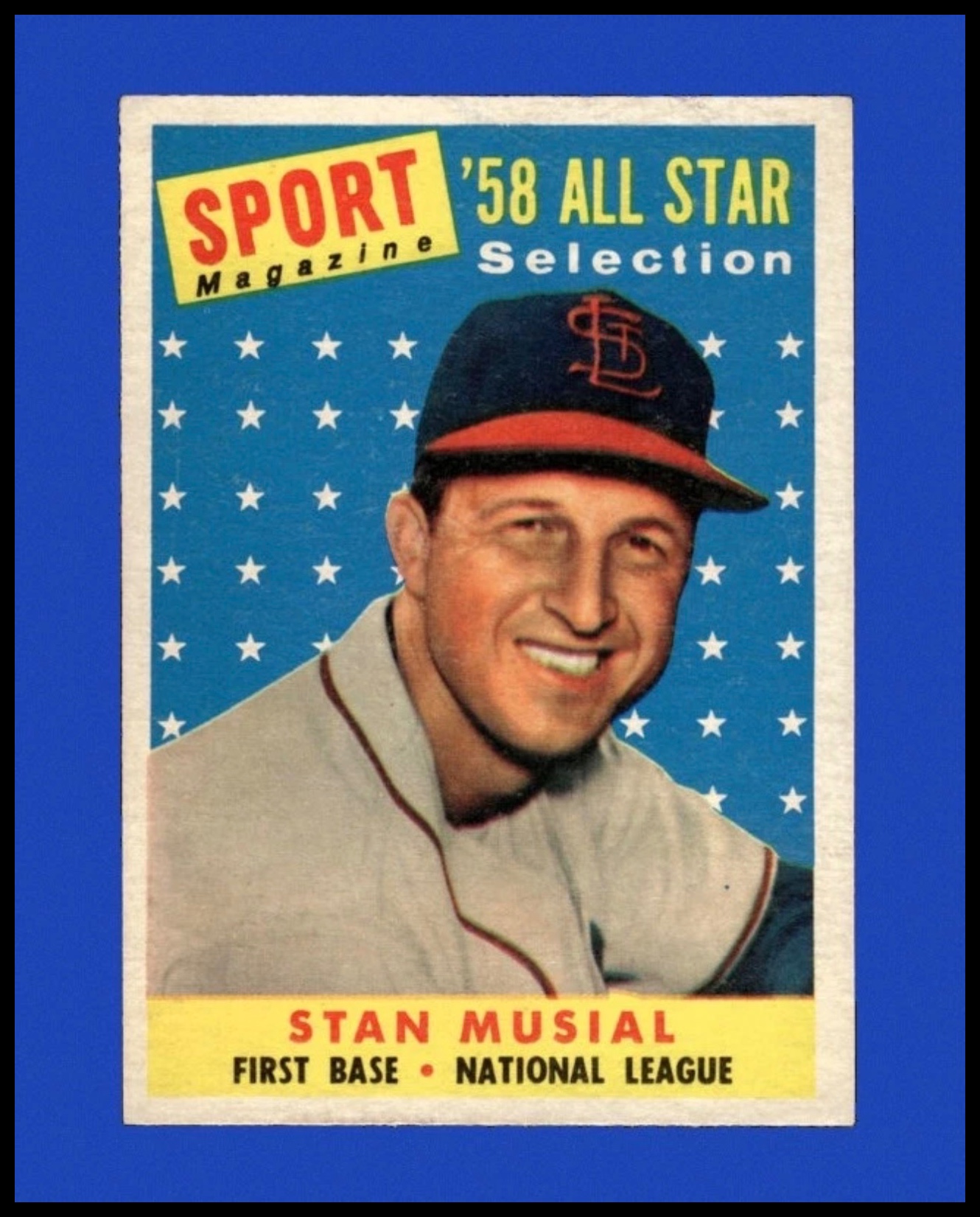
Market outlook
Stable Outlook 7/10
The card has steady collector demand because Musial is a blue-chip Hall of Famer, but the large supply of lower-grade copies keeps prices from moving sharply upward in the common grade range.[3][7]
Next months. Expect mostly stable prices with modest fluctuations in lower grades and stronger competition for high-grade examples.
Long term. Over 1-3 years, higher-grade copies should remain the best performers, while raw and low-grade examples likely track broader vintage baseball card demand with gradual appreciation.
History
Stan Musial, nicknamed 'Stan the Man,' was one of the greatest hitters in Major League Baseball history and spent his entire 22-season career with the St. Louis Cardinals. He was born Stanislaw Franciszek Musial and became a Hall of Fame icon known for exceptional consistency, elite batting average, and broad all-around offensive production. His career line included 3,630 hits, a .331 batting average, 475 home runs, and 1,951 RBI, along with seven National League batting titles and three MVP awards.[1]
This card first appeared in the 1958 Topps Baseball set, issued in 1958 in the United States as part of Topps' mainstream baseball card release.[1][2]
- Card #476 is a Stan Musial 'All Star' issue from the 1958 Topps Baseball set.[1][3]
- Musial did not appear on Topps baseball cards until 1958 after a contract arrangement that reportedly included a charitable donation in place of a standard licensing fee.[2]
- This card is a post-war vintage Hall of Famer issue and is widely collected because Musial is one of the most important players of the era.[1][7]
Rarity and print run
- Tier
- Common
- Print run
- Very High
- First printed in
- 1958 Topps Baseball
- Demand
- High
- Supply
- Abundant
- The card comes from a heavily printed mainstream Topps base set, so raw supply is abundant.
- High-grade copies are meaningfully scarcer because centering and edge wear are common issues on 1958 Topps cards.
- As a Hall of Fame player card, demand remains stronger than for a typical common, even though the base rarity is common.
Collector notes
Condition. Check centering carefully, especially left-right and top-bottom alignment, as vintage Topps cards often lose value quickly with poor centering. Common flaws include corner wear, edge chipping, surface print defects, light scratches, creasing, and off-center cuts; high-grade examples are much scarcer than raw copies.[3][5]
Storage. Store the card in a penny sleeve and rigid holder or semi-rigid card saver, keep it away from moisture, heat, and UV light, and avoid repeated handling. For long-term preservation, use archival-safe materials and maintain stable humidity and temperature.
Authenticity. Verify the stock, print quality, and aging characteristics expected for a 1958 Topps card. Reprints usually show sharper modern print patterns, unnatural gloss, or incorrect paper feel; authentic vintage copies typically show period-appropriate surface wear and aging. For valuable grades, third-party grading is strongly recommended.[5]
Sources: psacard.com, retrosimba.com, sportscardspro.com, sportscardinvestor.com, etsy.com