Market outlook
Stable Outlook 4/10
Demand is supported by set collectors and artwork fans, but Vanillish is not a major chase character, so prices usually move within a narrow band unless graded supply tightens.
Next months. Likely to remain stable with small fluctuations based on grade, condition, and local-language collector demand.
Long term. Over 1–3 years, gradual appreciation is possible for high-grade copies, but broad explosive growth is unlikely without a major set-wide resurgence.
History
Vanillish is a Pokémon character from the Unova region, first introduced in the core Pokémon video game series and known as the middle evolution in the Vanillite line. In the Trading Card Game, it represents the ice cream-inspired Ice-type Pokémon and is usually valued more for character appeal and artwork than competitive prominence.
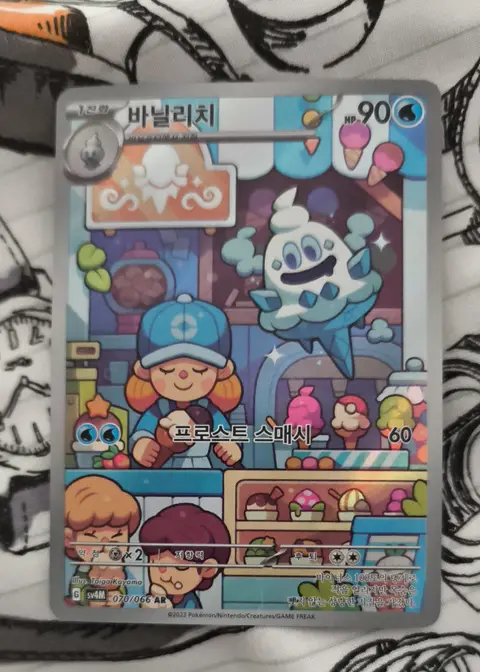
This specific card first appeared in the Japanese Scarlet & Violet-era set Ancient Roar as card 070/066 (an Art Rare/Illustration Rare style card), then appeared in Korean-language printings of the same set line.
- The card number 070/066 indicates an Art Rare-style secret slot beyond the main set checklist.
- Korean copies are part of the Scarlet & Violet-era regional release of Ancient Roar, parallel to the Japanese release.
- Vanillish is a middle evolution, which typically makes it less iconic than final-evolution chase cards but still collectible due to illustrated artwork.
Rarity and print run
- Tier
- Secret Rare
- Print run
- Medium
- First printed in
- Ancient Roar
- Demand
- Medium
- Supply
- Medium
- Appears in a higher-numbered slot beyond the standard set checklist
- Illustration Rare-style artwork increases collectible appeal
- Korean-language copies can be less commonly encountered than mass-market English releases
Collector notes
Condition. Check centering, corner whitening, edge wear, and surface scratches on the holo/foil layer. Illustration Rare cards often show print lines, scuffs, and whitening on dark borders or glossy art areas.
Storage. Sleeve immediately, then place in a top loader or semi-rigid card saver for long-term protection. Store away from heat, humidity, and direct light to prevent curling and surface wear.
Authenticity. Verify the correct Korean text, set symbol, numbering, and print finish. Counterfeits often have dull colors, poor text sharpness, incorrect font weight, weak texture/foil quality, or inconsistent back coloration. Compare against a known authentic Korean copy if possible.
Sources: k-tcg.com, japantradingcardstore.com, pricecharting.com, cartespokemon.com, pokecardworth.com