Market outlook
Rising Outlook 9/10
Long-term hobby demand for iconic rookie cards continues to outpace supply, especially for celebrated Hall of Famers with cultural significance. Clemente's legacy remains exceptionally strong, and the card is a blue-chip vintage staple.
Next months. Prices should remain firm with normal auction-to-auction variability, especially for attractive mid- and high-grade examples.
Long term. Expect continued appreciation over 1-3 years, with the strongest gains likely in better-centered, higher-grade, or well-authenticated copies.
History
Roberto Clemente (1934-1972) was a Hall of Fame right fielder for the Pittsburgh Pirates, widely regarded as one of the greatest players in baseball history and one of the sport's most respected humanitarian figures. Born in Carolina, Puerto Rico, Clemente became an icon for Latin American players, both for his elite five-tool play and for breaking barriers in Major League Baseball. His legacy extends beyond statistics due to his leadership, dignity, and charitable work, which culminated in the Roberto Clemente Award honoring MLB players who demonstrate sportsmanship and community service.
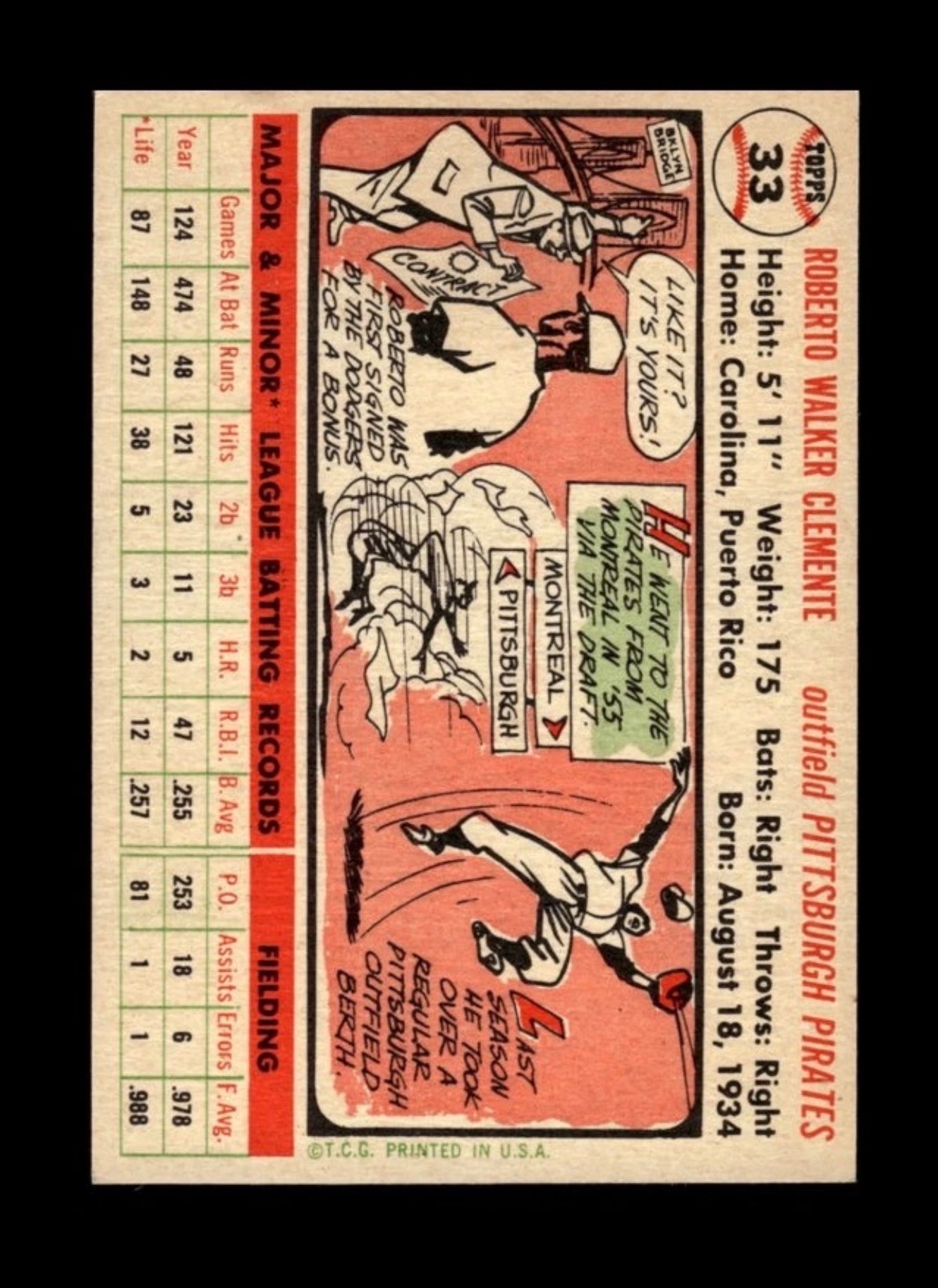
The card was first released in 1956 as part of the Topps Baseball set, distributed in the United States through retail wax packs and related hobby channels. The 1956 Topps set is known for its large horizontal player portraits and high appeal, and Clemente's rookie card appears as card #33. It is one of the key rookie cards from the 1950s hobby era.
- This is Roberto Clemente's widely recognized rookie card and one of the most important postwar baseball cards.
- The 1956 Topps issue includes both gray-back and white-back variations for some cards, and Clemente is found in the gray-back subset and is also cataloged in market references as a white-back parallel/variant for the set.
- Even in lower grades, the card commands strong prices due to Clemente's legendary status, rookie-card demand, and the card's significance as a cornerstone Hall of Fame issue.
Collector notes
Condition. 1956 Topps cards are highly prone to corner wear, surface scuffing, print defects, centering issues, and edge chipping. For Clemente specifically, look closely for clean borders, strong color on the portrait, minimal surface scratches, and sharp corners. Back condition matters as well, especially because the gray-back/white-back distinction can affect desirability and pricing. Centering and eye appeal are major value drivers, and even small flaws can significantly affect grade and market value.
Storage. Store in a penny sleeve inside a toploader or card saver for raw copies, then keep in a cool, dry, low-light environment with stable humidity. For graded copies, keep slabs away from heat, direct sunlight, and pressure. Because this card is valuable, use archival-safe materials, avoid frequent handling, and consider insured storage if the card is high grade.
Authenticity. Because this is a heavily counterfeited and reprinted rookie card, authentication is critical. Check print quality, paper stock, aging consistency, back stock color, and overall lithographic detail. Reprints may show overly crisp black lines, incorrect gloss, modern paper texture, or artificially aged surfaces. Cards should be authenticated and graded by major services such as graded, graded, or graded/Beckett for serious purchases. Any unusually cheap raw example should be treated with caution.