Market outlook
Stable Outlook 7/10
The base card has persistent collector demand because of Bonds’ Hall of Fame-level on-field legacy and its status as a key rookie card, but abundant supply keeps prices relatively steady in lower grades.
Next months. Expect mostly stable pricing with occasional spikes for pristine centered raw copies and certified gems.
Long term. Likely stable to gently rising for high-grade copies, while common raw examples should remain affordable due to supply.
History
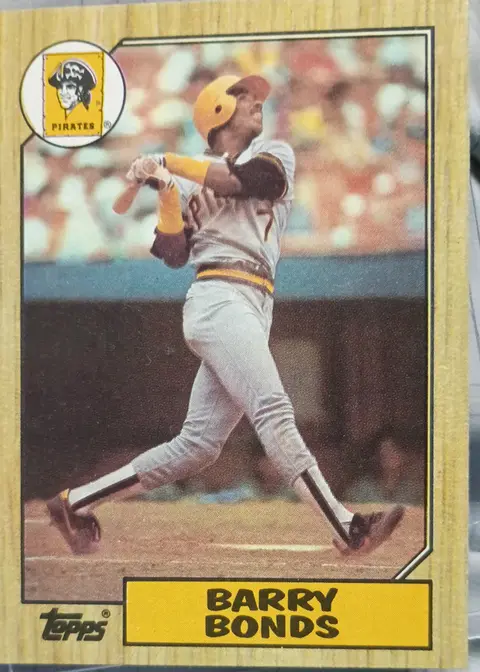
Barry Bonds is one of baseball’s all-time greats, debuting with the Pittsburgh Pirates in 1986 after starring at Arizona State University and being selected 6th overall in the 1985 MLB Draft. By 1987 he was already emerging as a premium young star, and his 1987 Topps Traded card became one of the most iconic cards of the junk-wax era and a key early Bonds rookie issue.
First issued in the 1987 Topps Traded boxed/limited update release, distributed in late 1987 as part of Topps’ Traded product line rather than the main 1987 Topps wax packs.
- Card #320 is widely treated as Barry Bonds’ flagship rookie card in the 1987 Topps Traded family.
- The card is part of a 132-card Traded issue and is one of the most collected baseball cards from the late 1980s.
- High-grade copies are notably scarcer due to typical Traded-set centering and edge wear issues, while the Tiffany version is much rarer and more valuable.
Collector notes
Condition. Check centering carefully, especially left-right borders; look for white edge wear, corner softness, surface scratching, print dots, and chipping along the woodgrain-style border. The dark photo area can hide surface flaws, so tilt the card under light.
Storage. Use a penny sleeve and semi-rigid holder or top loader, keep in a cool dry environment, avoid direct sunlight, and store vertically to reduce edge wear. For high-grade raw copies, use rigid protection immediately.
Authenticity. Compare the card stock, gloss, border pattern, and print sharpness to known authentic examples. Reprints often show softer image detail, wrong stock feel, or inconsistent color. For expensive graded copies, prefer major third-party grading and verify certification numbers.