Market outlook
Rising Outlook 7/10
Demand for iconic rookie cards remains strong, and Bob Gibson is a foundational Hall of Fame name for vintage baseball. Recent sales show active trading across multiple grade levels, while top-end examples continue to achieve strong prices.
Next months. Expect stable-to-slightly rising prices, with stronger movement in higher grades if auction competition remains active.
Long term. Likely gradual appreciation over 1-3 years, especially for eye-appealing mid-to-high grade graded, graded, and graded examples.
History
Bob Gibson is one of the greatest pitchers in Major League Baseball history, best known for his Hall of Fame career with the St. Louis Cardinals. A fierce competitor with an intimidating mound presence, Gibson won two Cy Young Awards, helped lead the Cardinals to World Series championships, and became famous for his dominance in high-pressure games, especially the 1968 season and the 1968 World Series. As a rookie-era card, the 1959 Topps issue captures the early part of a career that would become legendary.
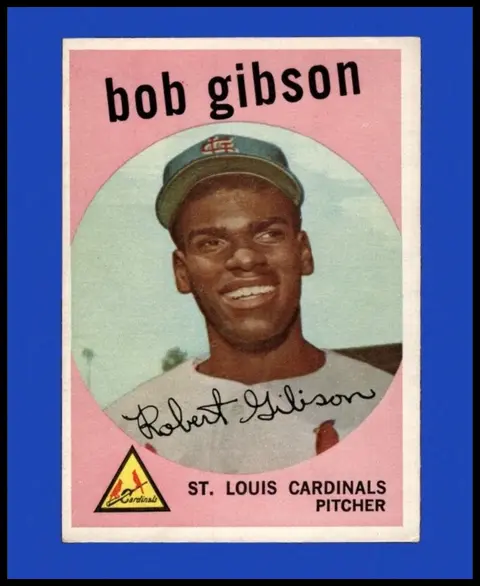
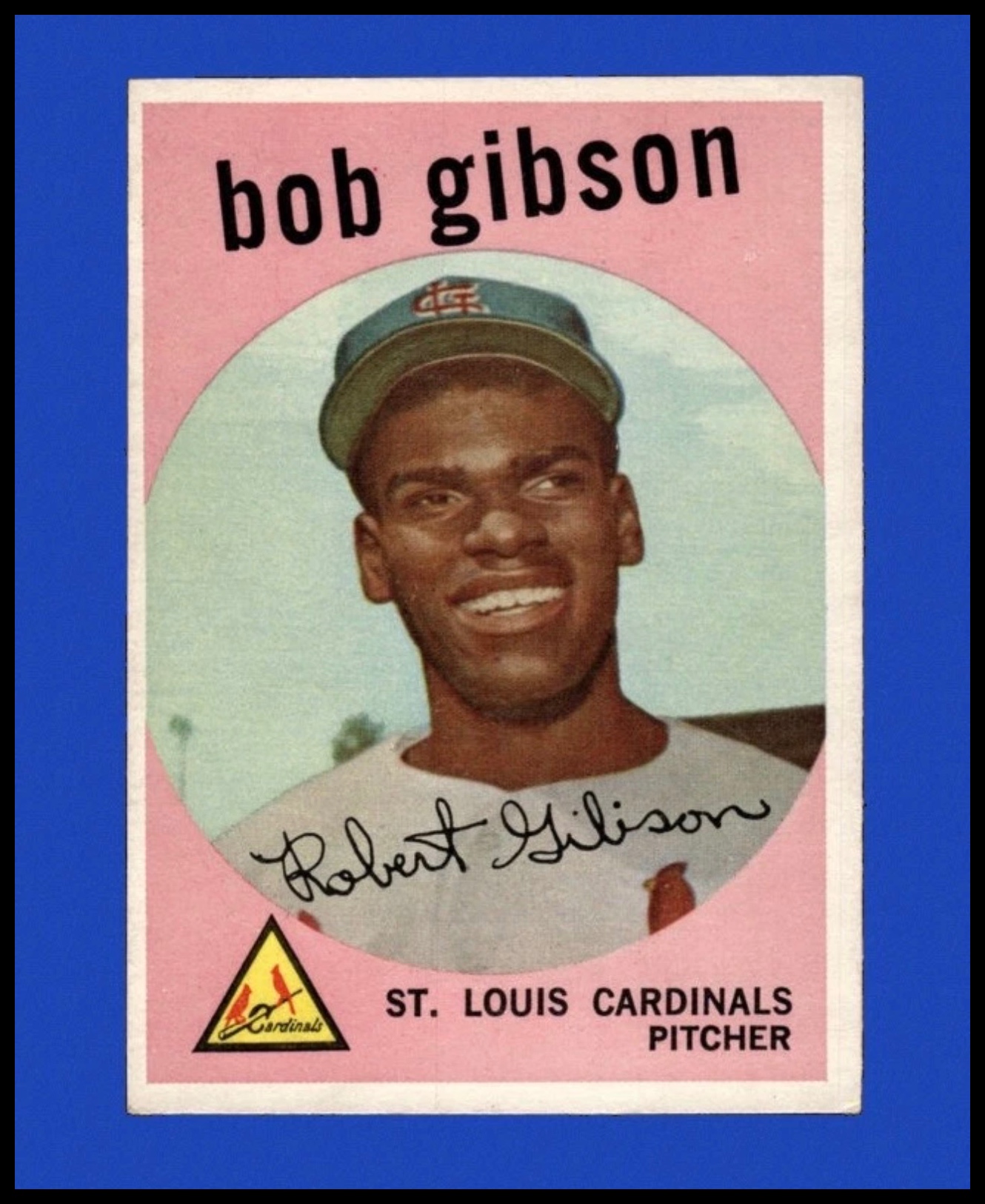
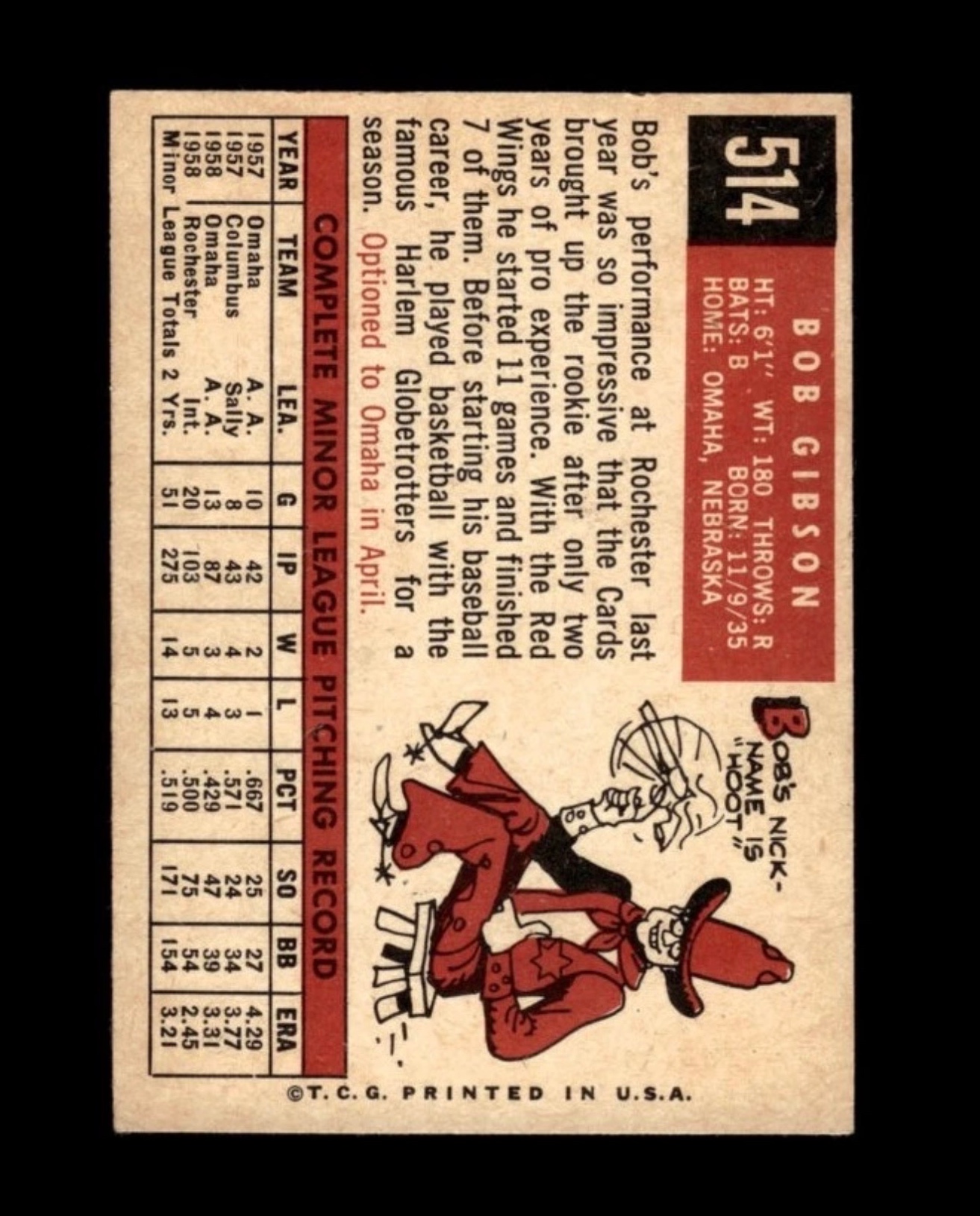
First released in 1959 as part of the Topps Baseball set, distributed in the United States through retail wax packs and vending formats common to the era. Card #514 is Bob Gibson's rookie card from the 1959 Topps series.
- This is Bob Gibson's true rookie card and one of the key rookie cards from the 1959 Topps set.
- The card is highly condition-sensitive, with high-grade examples commanding substantial premiums due to centering and print-quality issues.
- Bob Gibson is a Baseball Hall of Famer and his rookie card is a long-term blue-chip vintage baseball issue.
Rarity and print run
- Tier
- Uncommon
- Print run
- Very High
- First printed in
- 1959 Topps Baseball
- Demand
- High
- Supply
- Medium
- Not rare in absolute print terms, since 1959 Topps was mass-produced.
- High-grade copies are scarce because of centering, corner wear, and general vintage paper condition sensitivity.
- Rookie-card status and Hall of Fame stature create scarcity in premium collectible grades.
Collector notes
Condition. Check centering first, as 1959 Topps cards are notorious for being off-center. Also inspect corners for rounding, edges for chipping, and surface for print defects, wax staining, and loss of gloss. Gum/wax back staining and registration issues are common. High-grade examples are especially difficult to find.
Storage. Store in penny sleeves with rigid top loaders or semi-rigid holders for raw copies, and use graded/graded/graded grading for higher-value examples. Keep the card in a cool, dry, dark environment with low humidity to prevent paper degradation, staining, and warping.
Authenticity. Authentic 1959 Topps cards should show period-correct cardstock, aging, and print characteristics. Reprints often have overly sharp print, incorrect paper stock, or suspiciously clean edges. Compare font, color, and back stock to known authentic examples, and consider third-party grading for any card with significant value.