Market outlook
Rising Outlook 9/10
Long-term demand remains anchored by icon status, nostalgia, and elite collector competition. Even when prices soften at the top end, the card tends to recover because it is a core trophy asset in Pokémon collecting.
Next months. Prices are likely to remain firm for clean, well-centered graded copies, with premium examples outperforming lower-grade or damaged cards.
Long term. Over 1-3 years, the card is likely to hold blue-chip status and continue appreciating selectively, especially in graded 9 and graded 10 1st Edition grades, while lower-grade copies should grow more slowly.
History
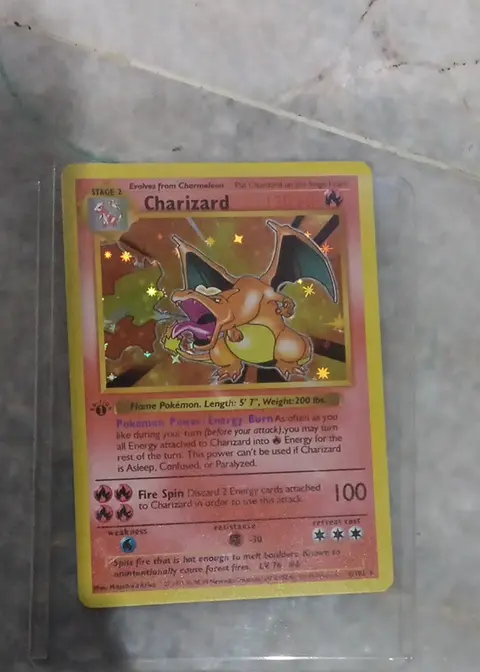
Charizard is the final evolution of Charmander in the original Pokémon video game and anime universe, introduced as one of the original 151 Pokémon. As a Fire/Flying-type icon, it became one of the franchise’s most recognizable mascots and a centerpiece of early Pokémon collecting culture.
The 1st Edition English Base Set Charizard 4/102 was first released in the United States on January 9, 1999, as part of the Wizards of the Coast Base Set launch. It originated in the first English-language print run of the Pokémon Trading Card Game and is the shadowless 1st Edition version of the card.
- It is one of the most famous and desired Pokémon cards ever printed, often treated as a flagship grail card for the hobby.
- The 1st Edition version is distinguished by the edition stamp and the shadowless layout used in the earliest print run.
- Charizard Base Set variants later appeared in Base Set Unlimited, Base Set 2, and Legendary Collection, but the 1st Edition Base Set copy remains the most iconic and valuable version.
Collector notes
Condition. Check for holofoil scratching, edge whitening, corner wear, surface dents, print lines, centering, and back-side scuffing. On 1st Edition copies, the stamp should be crisp and correctly placed, with no signs of alteration or recoloring.
Storage. Store in an archival sleeve and rigid top loader or slab, keep away from direct light, humidity, and heat, and avoid handling the card without clean hands or gloves. For high-value copies, use a low-humidity environment and consider professional grading and long-term slab storage.
Authenticity. Verify the 1st Edition stamp, correct Base Set copyright line, holo pattern, font consistency, and card stock. Common red flags include blurry text, incorrect coloring, overly glossy surfaces, off-size dimensions, and tampered corners or stamps. Compare with known authentic examples and use professional authentication for expensive copies.