Market outlook
Stable Outlook 7/10
The card is anchored by Hall of Fame demand and a steady vintage collector base, but it is also a widely available common from a heavily collected set. That combination usually produces gradual appreciation rather than sharp short-term movement, with the strongest upside concentrated in gem or near-gem copies.
Next months. Expect mostly stable pricing with modest movement in higher grades if broader vintage baseball demand remains healthy.
Long term. Over 1-3 years, likely gradual appreciation, especially for graded 8 to graded 10 copies and well-centered raw examples with strong eye appeal.
History
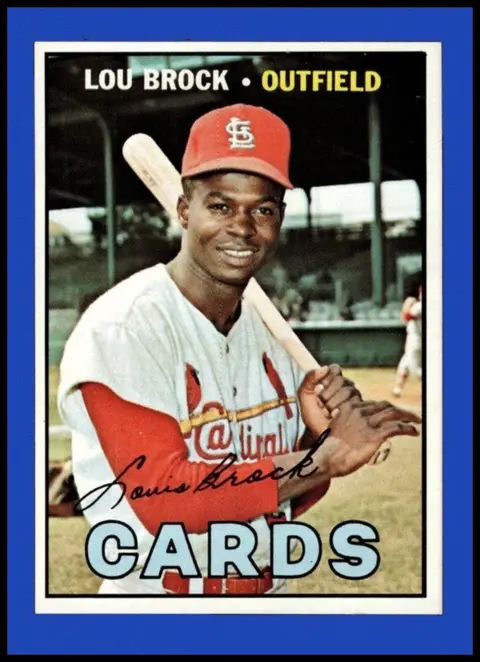
Lou Brock was a Hall of Fame Major League Baseball outfielder best known for his speed, base-stealing ability, and impact with the St. Louis Cardinals. He became one of baseball’s iconic leadoff hitters and base runners, finishing his career as one of the game’s all-time stolen-base leaders; his legacy makes his vintage cards particularly desirable to collectors. The 1967 Topps issue captures Brock during his Cardinals prime, after he had already established himself as a star and before his later Hall of Fame induction.
First released in the 1967 Topps Baseball set, distributed in wax packs and vending/cello formats through Topps' 1967 retail channels in the United States.
- The 1967 Topps Lou Brock #285 is one of Brock’s key mainstream vintage cards and is frequently collected as part of his pre-1970 run.
- graded’s card facts page for this issue shows a strong high-grade census, with a GEM MT 10 at the top of the population ladder.
- Collector guides commonly note the card’s photo/background coloration as a condition-sensitive area, with faded orange background tone being a common visual flaw.
Collector notes
Condition. Check centering carefully, especially left-right and top-bottom alignment, because vintage Topps issues from this era are often off-center. Also inspect corners for softening, edge wear, print snow/surface scratches, and the orange background area for fading or dullness; graded census and dealer listings show that higher grades command a major premium, so small flaws matter a lot. Creases, wax stains, and registration issues can sharply reduce value.
Storage. Store the card in an acid-free penny sleeve inside a rigid top loader or semi-rigid holder, and keep it in a cool, dry, dark environment with stable humidity. Avoid PVC materials, direct sunlight, and repeated handling; for high-grade examples, consider archival-grade storage or third-party grading to preserve marketability.
Authenticity. Authentic 1967 Topps cards should match the standard 2.5 x 3.5 inch vintage Topps stock, print style, and paper aging characteristics. Reprints often show overly sharp modern print, suspiciously clean edges, incorrect gloss, or altered back texture; compare the front and back print quality to known originals and verify grading certification when buying expensive high-grade copies. Because reprints of the 1967 Topps Brock card exist, check the issue source carefully and avoid items labeled as reprints or Dover reproductions if you want an original.