Market outlook
Stable Outlook 7/10
The base card has broad collector recognition but is already well-known and widely available, so price moves usually track grading demand and overall baseball card sentiment rather than true scarcity. The biggest premium remains in gem-mint copies, which can fluctuate with population data and grading-market momentum.
Next months. Likely to remain stable with modest movement in graded 9 and graded 10 prices depending on overall hobby demand.
Long term. Expect gradual appreciation in top grades, while raw and lower-grade copies should remain inexpensive and highly liquid.
History
Barry Bonds is one of baseball’s most iconic and controversial superstars, known for an elite all-around skill set, record-breaking power, and a career that made him a central figure in the sport’s modern era. He debuted in Major League Baseball in 1986 and became the face of the Pittsburgh Pirates before later starring for the San Francisco Giants; his 1987 Topps card is widely treated as his mainstream rookie card and is one of the key rookie cards from the late-1980s junk-wax era.
First issued in the 1987 Topps Baseball set, released in 1987 in the United States as part of Topps’ flagship baseball card distribution.
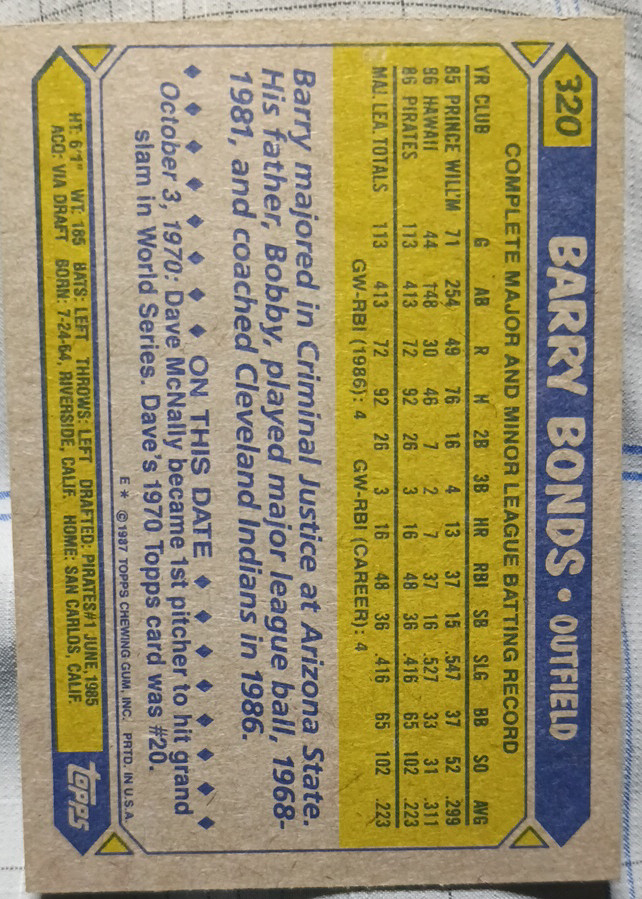
- Card #320 is Barry Bonds’ key 1987 Topps rookie card and one of the most collected rookie cards of the era.
- The base card is common in raw form because the 1987 Topps set was mass-produced, but high-grade examples are notably more valuable due to centering and corner sensitivity.
- This card is part of the famous 1987 Topps design with a wood-grain border, which makes edge wear, chipping, and print defects especially visible.
Collector notes
Condition. Check centering carefully, since 1987 Topps cards are notorious for off-center fronts and backs. Look for white border chipping, corner softening, surface print lines, wax staining, and edge wear; even minor flaws can hurt grade because the design shows defects easily.
Storage. Store in a penny sleeve and rigid top-loader or semi-rigid holder, keep the card away from heat, humidity, and direct sunlight, and avoid stacking unprotected cards because dark-border-era cards can show scuffing quickly.
Authenticity. Authentic copies should match the standard 1987 Topps stock, color, and print quality. Watch for reprint giveaways such as overly glossy surfaces, incorrect paper stock, muddy print, or noticeably different back text and alignment; grading-holdered copies from major services are the easiest route for high-value examples.