Market outlook
Rising Outlook 7/10
Price guides show upward movement in recent periods, and Clemente remains a blue-chip Hall of Fame name with durable demand. The card’s market is supported by nostalgia, player significance, and the challenge of finding sharp-centered high-grade examples.[1][4]
Next months. Likely stable to mildly rising, especially for clean mid-grade and high-grade examples.
Long term. Expected to continue appreciating gradually, with the strongest gains concentrated in graded 7+ and unusually well-centered copies.
History
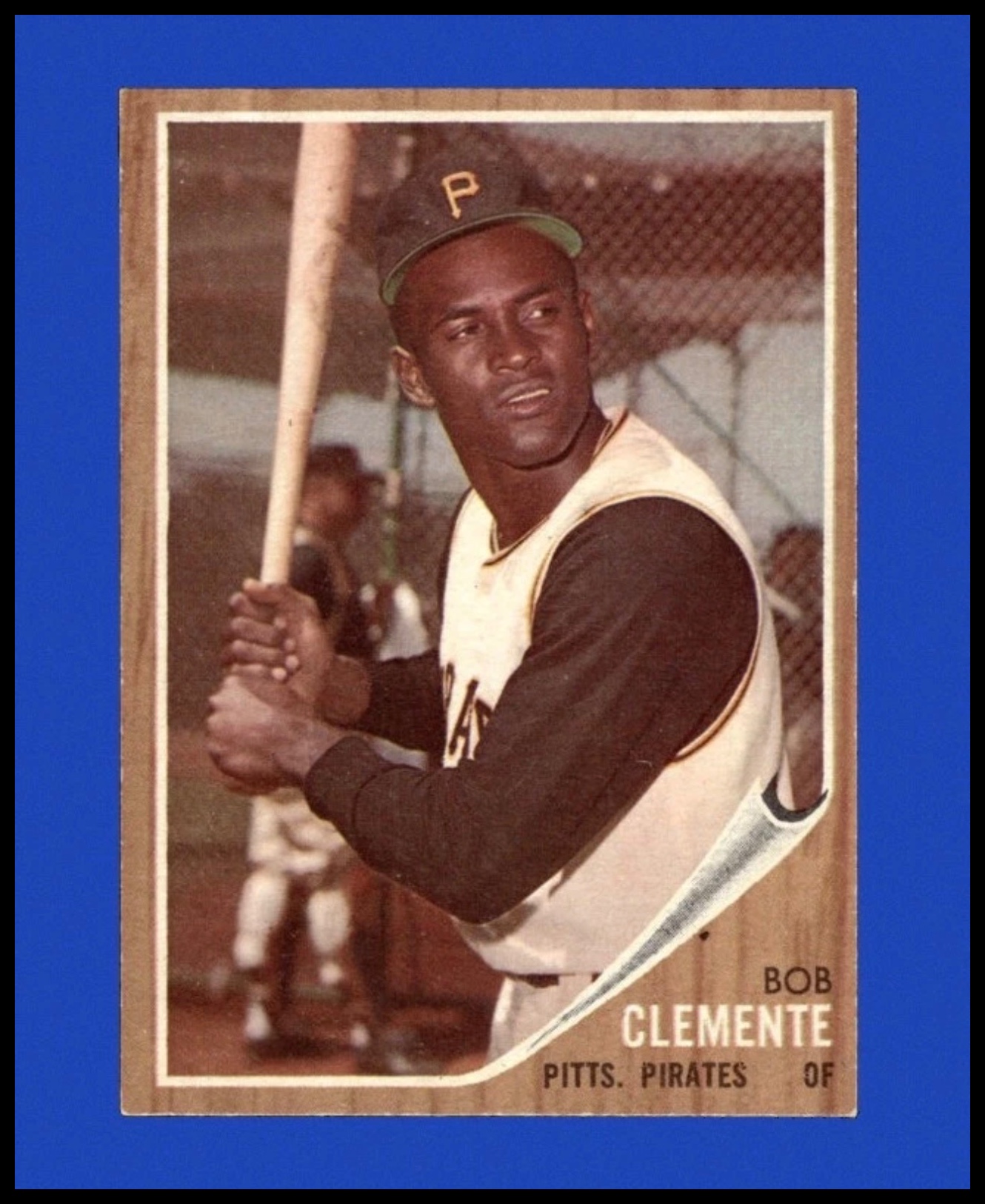
Roberto Clemente (often listed on early cardboard as "Bob Clemente") was a Puerto Rican right fielder who became one of baseball’s most celebrated stars, known for elite hitting, throwing, defense, and humanitarian work. His importance extends beyond statistics: he became a pioneering Latino icon in Major League Baseball and was later inducted into the Hall of Fame. The 1960 Topps issue captures him during his early Pittsburgh Pirates career, before he became the legendary All-Star and World Series champion remembered today.[3][5]
First released in the 1960 Topps Baseball set, originally issued in the United States in 1960. This card is cataloged by graded as Bob Clemente #326 and appears in price guides as 1960 Topps Roberto Clemente #326.[3][5]
- This is Clemente’s 1960 Topps card, one of the key early-career issues for Hall of Fame collectors.[1][3]
- The card is commonly cataloged as #326 in the 1960 Topps set, and many guides use both "Bob Clemente" and "Roberto Clemente" naming.[3][4]
- Market guides show meaningful demand even in mid-grade and high-grade copies, indicating strong long-term collector interest.[1][4]
Collector notes
Condition. Check centering carefully, especially left-right and top-bottom centering, which is a major value driver on 1960 Topps cards. Common flaws include corner wear, edge chipping, surface print defects, wax stains, minor creasing, and off-centering; high-grade examples are much harder to find than average raw copies.[1][4]
Storage. Store the card in an archival penny sleeve and rigid holder or semi-rigid card saver, then keep it in a cool, dry, dark environment. Avoid PVC sleeves, high humidity, and repeated handling, since 1960 Topps cards are prone to corner and edge wear.
Authenticity. Authentic 1960 Topps cards should show period-appropriate printing, paper stock, and aging; reprints may look too sharp, too white, or have inconsistent color. Compare the fonts, borders, image clarity, and back printing against verified examples from graded or reputable dealers, and watch for trimmed edges or altered corners on higher-value copies.[2][3]