Market outlook
Stable Outlook 7/10
The card's price has shown minimal fluctuation over the last 30 days, with a last sale at $29.99 and no significant change. The Prime variant maintains steady collector interest without explosive growth.
Next months. Prices expected to remain stable over the next 3–6 months, with potential minor increases if high-grade inventory thins further.
Long term. 1–3 year outlook suggests gradual appreciation to $40–$50 for ungraded copies and $3,000+ for graded 10s, driven by nostalgic demand and shrinking supply.
History
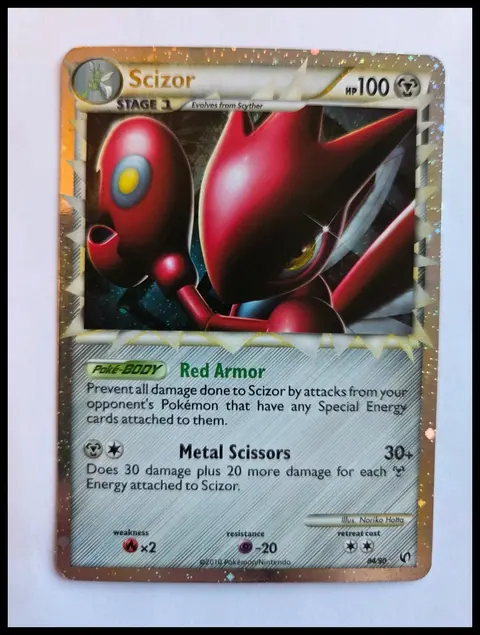
Scizor is a Metal/Bug-type Pokémon introduced in Generation II, known as the evolved form of Scyther. It wields massive scissor-like arms and is characterized by its defensive 'Red Armor' ability that prevents all damage. In the TCG, it is depicted as a Stage 1 Pokémon with 100 HP, emphasizing its role as a durable fighter in battle.
This card was first released in the Pokémon TCG 'Undaunted' set in May 2010 in North America, part of the HeartGold & SoulSilver expansion series.
- Scizor in Undaunted is a 'Prime' variant card, featuring an alternate artwork style typical of the Prime sub-series.
- The card has the ability 'Red Armor,' which prevents all damage done to Scizor from attacks, making it strategically unique.
- It is numbered 84/90 and classified as an Ultra Rare Prime card in the set.
Rarity and print run
- Tier
- Ultra Rare
- Print run
- Medium
- First printed in
- Undaunted
- Demand
- Medium
- Supply
- Low
- Prime variant cards were printed in limited quantities compared to standard holos
- 84/90 numbering often correlates with slightly lower print runs
- High-grade graded 10 copies are extremely rare due to foil susceptibility and centering challenges
Collector notes
Condition. Key things to check include centering (84/90 cards often have slight misalignment), edge wear on the holo foil, and any creases or scratches on the Prime artwork. Common flaws include haloing around the foil and corner dings.
Storage. Store in a rigid top loader with a penny sleeve, keep in a climate-controlled environment away from direct sunlight, and avoid stacking cards to prevent pressure damage.
Authenticity. Fakes often have duller foil, incorrect font on the text box, and misaligned card edges. Authentic cards show crisp Prime artwork, proper holographic shimmer, and consistent printing quality. Authentication via graded or graded grading is recommended for high-value copies.
Sources: wexfordpa.paymore.com, sportscardinvestor.com, tcgplayer.com, fanaticscollect.com, pricecharting.com