Market outlook
Stable Outlook 7/10
The card has steady demand from both players and Boa Hancock collectors, but starter-deck sourcing keeps overall supply fairly broad. Parallel and gem-mint copies should hold value better than raw base copies, while the base version is more likely to remain modestly priced.[1][3][5]
Next months. Base copies should remain relatively affordable, while premium foil or high-grade copies may fluctuate around current collector levels.
Long term. Over 1 to 3 years, the card is likely to stay stable to mildly rising in premium grades, with the strongest performance in pristine Japanese foil variants rather than raw base copies.
History
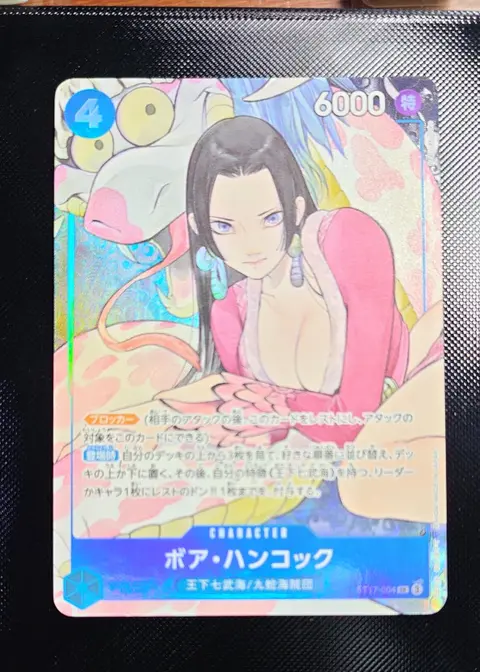
Boa Hancock is a major character from Eiichiro Oda’s One Piece, where she is the captain of the Kuja Pirates, ruler of Amazon Lily, and one of the Seven Warlords of the Sea. She is known for combining overwhelming combat ability, royal status, and a pivotal role in Luffy’s story, making her one of the most recognizable female characters in the franchise. In One Piece Card Game, she is frequently printed as a blue-card support piece for Seven Warlords strategies.[5][7][8]
The card first appeared in Starter Deck 17: BLUE Donquixote Doflamingo, released in Japanese on October 25, 2024.[8] The official card list for this starter deck confirms the set’s existence, and third-party card databases identify ST17-004 as Boa Hancock from that product line.[4][8]
- This version is a 4-cost, 6000-power blue Character with the [Blocker] keyword.[5][7]
- Its effect supports blue/top-deck manipulation and Seven Warlords of the Sea synergy, fitting the Donquixote Doflamingo starter deck’s game plan.[4][5]
- Market data shows a notable parallel/foil variant tied to the same card, with higher collector interest than the base version.[1][3][6]
Rarity and print run
- Tier
- Ultra Rare
- Print run
- High
- First printed in
- Starter Deck 17: BLUE Donquixote Doflamingo (ST17)
- Demand
- High
- Supply
- High
- Starter-deck inclusion makes the base card relatively accessible.
- Parallel/full-art variants are scarcer than the base printing and attract premium collector demand.
- High-grade copies are harder to find because starter deck foils are prone to surface wear and edge whitening.
Collector notes
Condition. Check for whitening on corners and edges, surface scratches on the full-art/foil surface, centering, and any print lines or scuffing in the holo area. Starter deck foils often show edge wear quickly because they are commonly handled and sleeved after opening. For Japanese copies, clean borders and an intact foil surface matter most to collectors.
Storage. Use a fresh penny sleeve and a rigid top loader or card saver immediately after opening. Keep the card away from humidity, friction, and direct light, and avoid repeated re-sleeving because the foil surface can scratch. For a high-value parallel or full-art version, long-term storage in an acid-free holder or graded slab is preferable.
Authenticity. Verify crisp Japanese text, correct card numbering as ST17-004, and the official One Piece Card Game layout. Counterfeits often have blurred text, incorrect color saturation, poor foil alignment, or off-sized borders. Parallel/full-art versions should match the known official finish and texture rather than a flat or cheaply stamped imitation.
Sources: snkrdunk.com, youtube.com, pricecharting.com, en.onepiece-cardgame.com, reddit.com