Market outlook
Stable Outlook 7/10
The card has a well-established collector base and consistent trade activity, but it is also a common-card issue in raw form. Most near-term movement is likely to come from high-grade demand rather than broad scarcity-based spikes[1][2][4].
Next months. Prices should remain stable to slightly firm, with premium copies likely to outperform lower grades.
Long term. Over 1-3 years, the card is likely to continue gradual appreciation, especially in graded 8+ and graded 9+ condition.
History
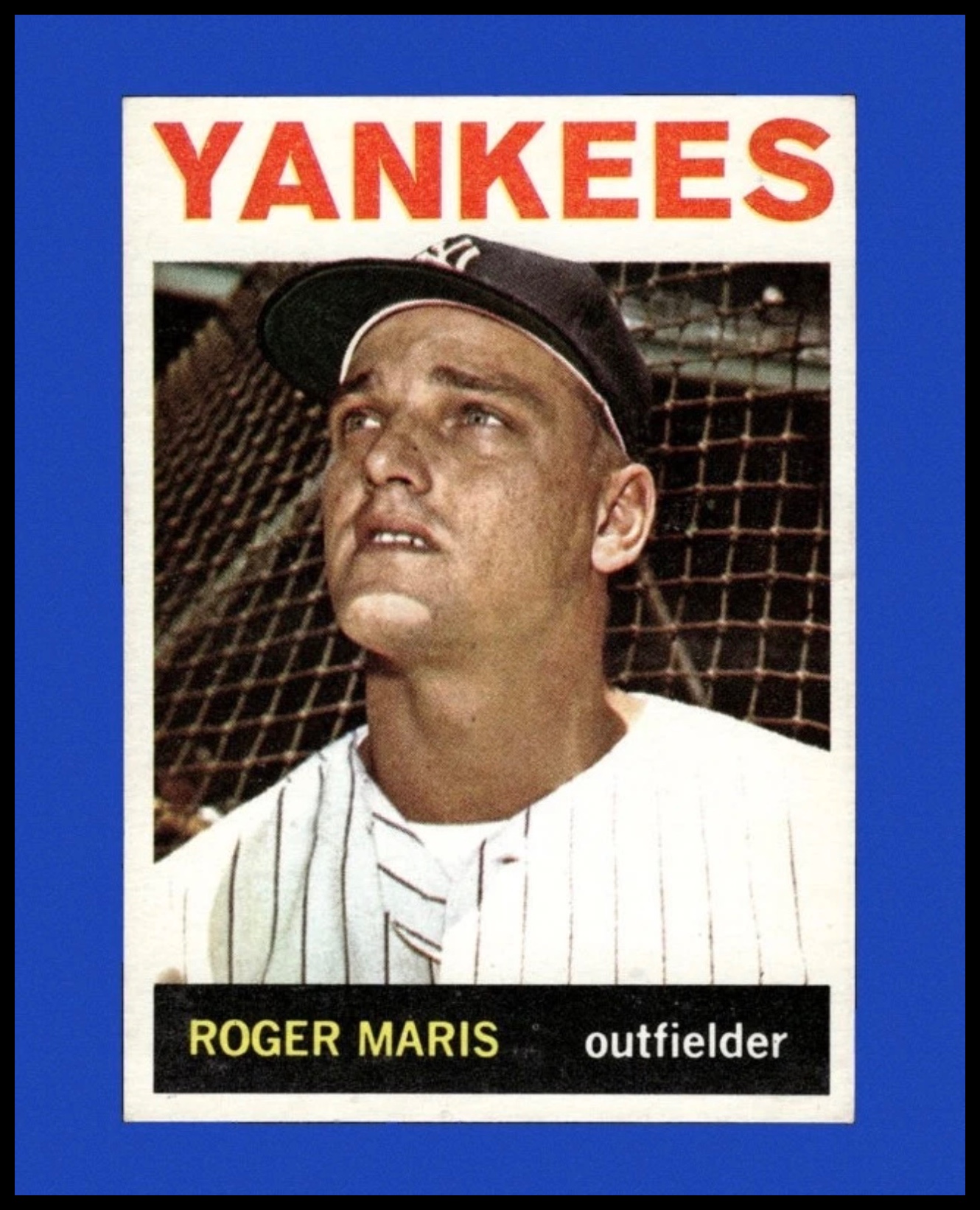
Roger Maris was a Major League Baseball outfielder best known for his historic 1961 season with the New York Yankees, when he hit 61 home runs and broke Babe Ruth’s single-season record. He won the American League MVP in 1960 and 1961, and his legacy remains strongly tied to the Yankees and to one of the most famous records in sports history. By 1964, Maris was still a high-profile veteran star, and his cards from this period are collected for both his on-field significance and his place in the post-record era of baseball history.
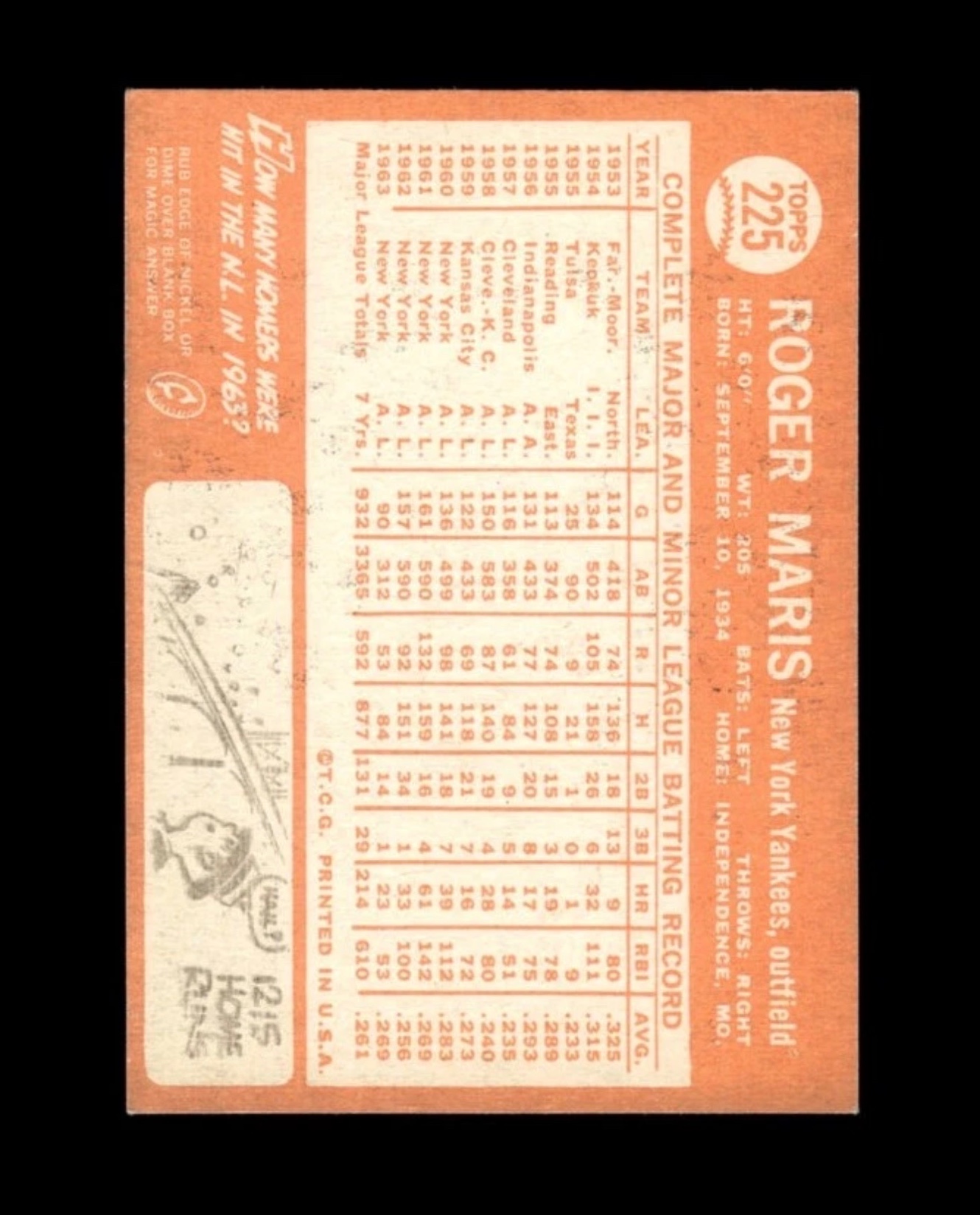
This card was first released in 1964 as part of Topps Baseball, the flagship Topps major league set for that year, distributed in traditional wax-pack and rack-pack format across the United States. The card is number #225 in the 1964 Topps Baseball set and is a standard base-card issue[1][3].
- This is not a rookie card; it is a later-career Roger Maris issue from the 1964 Topps set[1].
- The card is a standard base card from Topps, not a special insert, parallel, or short print[1][3].
- Collector pricing shows strong premium for high-grade examples, with graded 8 and above rising sharply in value compared with lower grades[1][2].
Collector notes
Condition. Check centering carefully, as 1960s Topps cards are often off-center. Also inspect the black borders for chipping, the corners for softness, the surface for wax staining, print snow, and any edge wear or discoloration. High-grade copies command major premiums, so even minor flaws materially affect value[1][2].
Storage. Store the card in a penny sleeve and rigid top loader or card saver, away from humidity, heat, and direct sunlight. For long-term preservation, keep it in an acid-free, archival holder and avoid frequent handling because edge and corner wear quickly reduce grade on 1960s Topps issues.
Authenticity. Authenticating this card relies on paper stock, print quality, border wear patterns, and comparison to known original 1964 Topps examples. Reprints often have different gloss, color saturation, or modern paper feel. Third-party grading from graded, graded, graded, or graded is the most reliable authentication route, especially for higher-value graded copies[1][2][4].