Market outlook
Stable Outlook 7/10
Base Set vintage Pokémon cards have stabilized in value after explosive growth in early 2020s. Market has matured and prices reflect fundamentals of condition and scarcity rather than speculation.
Next months. Prices expected to remain stable over next 3-6 months. Market factors including Pokemon Company initiatives, competitive TCG activity, and broader collectible trends may create minor fluctuations. Graded high-condition copies likely to hold value better than lower grades.
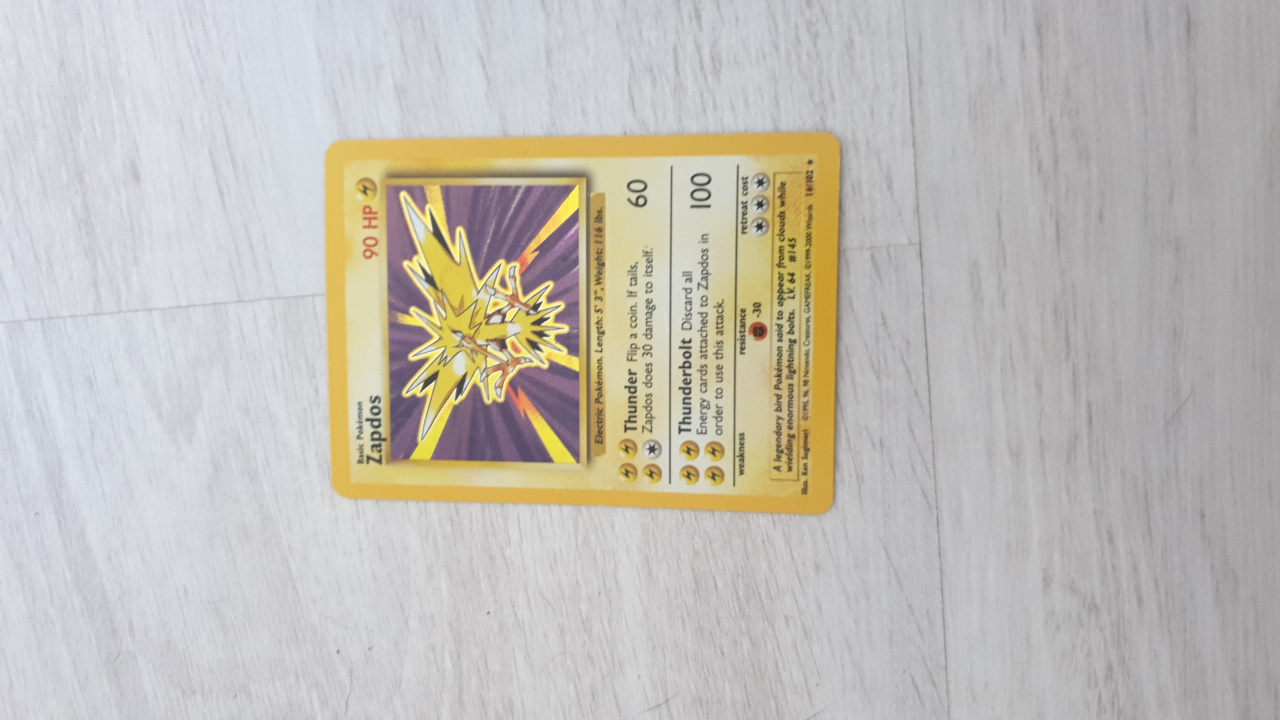
Long term. 1-3 year outlook appears positive for Base Set Zapdos given its vintage status and legendary character appeal. 1999-2000 copyright variant should maintain value as collectible tier between common unlimited copies and scarcer 1st Edition copies. Potential for modest appreciation if vintage Pokémon market strengthens, though extreme price increases unlikely given current market maturity.
History
Zapdos is one of the three Legendary Birds from Generation I Pokémon, representing the Electric-type. It first appeared in Pokémon Red and Blue games and has been a central figure in Pokémon lore as a powerful legendary creature sought by trainers.
Zapdos was first printed in the Pokémon Base Set in 1999 as card #16/102. The 1999-2000 copyright variant represents a later print run of the Base Set.
- The Base Set Zapdos #16 has become one of the most iconic and valuable cards in Pokémon TCG history
- Multiple copyright date variants exist, with 1999-2000 copyright representing 4th print run cards
- Different holofoil patterns exist across variants (Galaxy holofoil for standard Base Set)
- First Edition Base Set Zapdos commands significantly higher prices than unlimited versions
Rarity and print run
- Tier
- Rare Holo
- Print run
- High
- First printed in
- Base Set (1999)
- Demand
- High
- Supply
- Low
- 1999-2000 copyright variant represents a specific later print run, making it less common than earliest printings
- High grade copies are scarce due to age and condition challenges
- Base Set Zapdos is heavily collected, creating strong demand relative to available supply
- WOTC production quality control varied, affecting surviving high-condition copies
Collector notes
Condition. Key evaluation factors include: centering of the card image and borders, surface condition of the holo pattern (look for scratches and wear), corner and edge condition (Base Set cards commonly show wear), print quality and ink consistency. Common flaws include holo scratching, edge wear, and centering issues typical of 1999 Base Set production.
Storage. Store in acid-free card sleeves within a rigid holder (graded or graded slab for valuable copies, or a top loader for raw cards). Maintain in cool, dry environment away from direct sunlight. Avoid rubber bands and regular card sleeves which can damage the holo. For long-term preservation, use archival-quality storage materials.
Authenticity. Verify copyright date on card (1999-2000 for this variant). Check holofoil pattern against known standards (Galaxy pattern for Base Set). Examine printing quality, color saturation, and card stock thickness compared to authenticated examples. Be aware of counterfeit Base Set cards in circulation—authentic WOTC cards have specific printing characteristics including font styles and spacing. Check the Shadowless vs. Unlimited characteristics if examining 1st Edition.