Market outlook
Stable Outlook 7/10
The card has steady demand from Hall of Fame collectors, player collectors, and 1950s Topps set builders, but abundance in lower grades limits rapid appreciation. High-grade examples should continue to command strong premiums.
Next months. Likely to remain stable with modest movement, especially in graded 8-10 examples.
Long term. Expected to appreciate gradually over 1-3 years, with the strongest gains likely in certified high-grade copies.
History
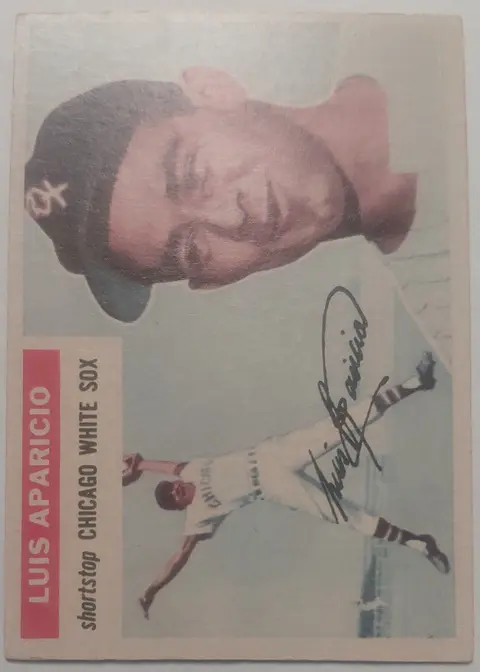
Luis Aparicio was a Venezuelan shortstop who became one of Major League Baseball’s most important defensive infielders and a pioneering Latin American star. He debuted in 1956 with the Chicago White Sox and quickly became known for elite range, speed, and base-stealing ability, later earning Hall of Fame induction. The 1957 Topps card is significant because it captures him in the early phase of a career that helped broaden MLB’s international and Latin American presence.
First released in the 1957 Topps Baseball set in 1957, distributed in the United States through Topps baseball wax packs and hobby circulation.
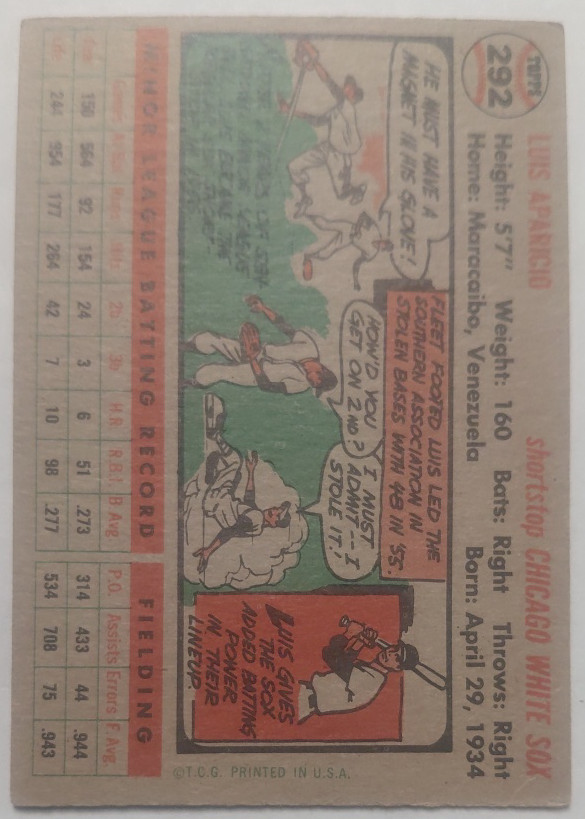
- The 1957 Topps card number for Luis Aparicio is #7; #292 in 1957 Topps is Billy Klaus, so the supplied card number appears mismatched with the player.
- Aparicio’s 1956 Topps card is widely recognized as his true rookie card (#292), while 1957 Topps is his second-year issue.
- 1957 Topps is one of the iconic 1950s flagship Topps baseball sets and Aparicio is one of its key Hall of Fame stars.
Collector notes
Condition. Check centering first, then corners, surface gloss, and print registration. Common flaws include tilt, rough or fuzzy edges, corner wear, surface print snow, wax staining, and back damage from gum or album storage.
Storage. Store in a penny sleeve and semi-rigid holder or top-loader with a clean team bag. Keep away from humidity, direct sunlight, and temperature swings; for higher grades, use archival sleeves and graded encapsulation.
Authenticity. Authentic 1957 Topps cards should show period-correct paper stock, printing pattern, and aging consistent with age. Watch for overly bright paper, modern print dots, trimmed edges, counterfeit backs, and suspiciously sharp corners on an otherwise vintage card. Comparing the card number and player pairing is also important because the requested number-player combination is incorrect for 1957 Topps.