Market outlook
Stable Outlook 3/10
The card’s market is anchored by low raw value and modest demand. Any movement is more likely to come from broader vintage TCG interest, German-language collecting, or graded 10 scarcity than from the card itself.
Next months. Likely to remain around current low raw prices with minor fluctuations.
Long term. Expected to stay stable with gradual, collector-driven movement rather than meaningful investment growth.
History
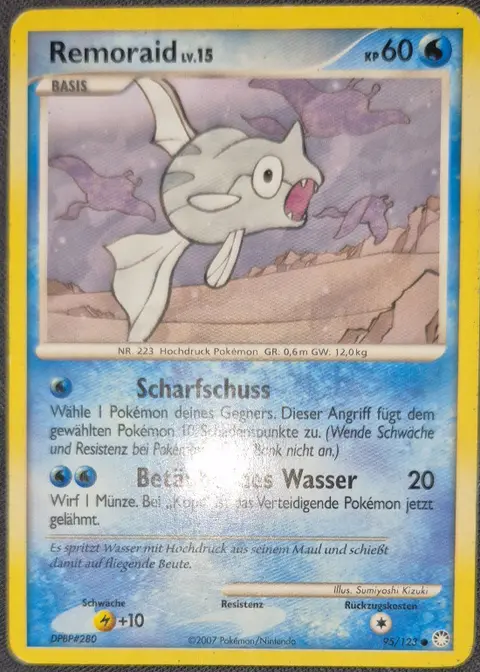
Remoraid is a Generation II Pokémon introduced in the Johto region. It is known as the Jet Pokémon and is a Water-type species that later evolves into Octillery. In the trading card game, it commonly appears as a basic Water Pokémon with simple attack utility and is often used as a low-rarity filler or evolutionary starter card.
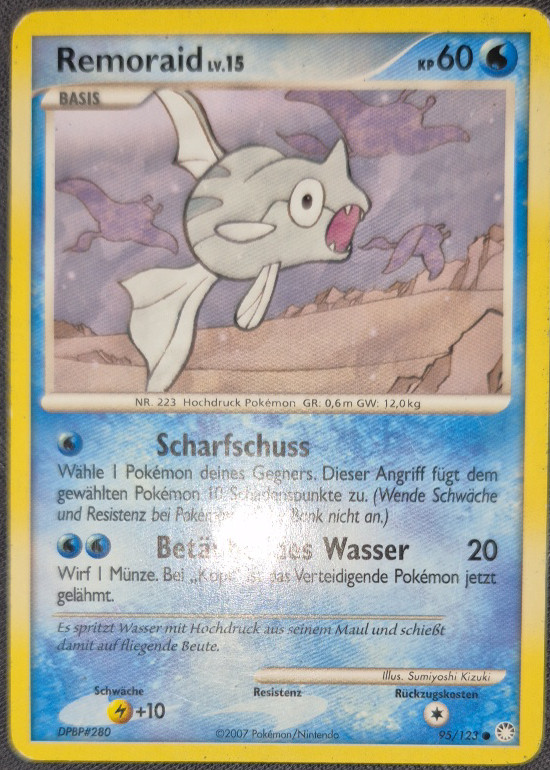
This card was first released in the Diamond & Pearl—Mysterious Treasures expansion, published in 2007; the English set release date is listed as August 22, 2007, and the card appears as #95/123 in that set. The German-language print is part of the same era's localization.
- The card is a Common Basic Pokémon with 60 HP and the attacks Sharpshooting and Numbing Water.
- The set checklist shows Remoraid as card 95/123 in Diamond & Pearl—Mysterious Treasures.
- German copies are collectible because the set name and localization differ from the English release, but the card itself is still a mass-printed common.
Collector notes
Condition. Check for edge whitening, corner wear, light scratches, surface print lines, centering, and any bends or creases. Common cards from this era often show minor edge wear quickly, so a clean surface and sharp corners matter most for higher-grade copies.
Storage. Store in a penny sleeve and rigid top loader or semi-rigid holder, keep away from humidity and direct light, and avoid loose binder storage if long-term condition preservation matters. Use clean hands or gloves when handling.
Authenticity. Authentic copies should match the original Diamond & Pearl-era card stock, printing quality, font sharpness, and set numbering. Watch for fuzzy text, off-color printing, incorrect energy symbols, and counterfeit gloss or texture; compare against a verified scan of the German version when possible.