Market outlook
Stable Outlook 7/10
Launch hype and franchise popularity support demand, but modern print volume and the existence of even rarer parallel versions usually limit sustained explosive growth for the standard Full Art. Price action is likely to stabilize after initial release volatility unless competitive relevance or grading scarcity materially improves interest.[1][2][3][5]
Next months. Expect post-release volatility followed by a gradual settling of prices as supply from openings reaches the market.
Long term. Over 1-3 years, the card should hold value reasonably well if Mega Lucario remains a top-tier collector favorite, with the strongest gains most likely in high-grade copies rather than raw cards.
History
Lucario is a Fighting/Steel Pokémon introduced in Generation IV and one of the franchise’s most recognizable battle-focused mascots, known for aura sensing, speed, and a disciplined martial-arts style. Mega Lucario is Lucario’s Mega Evolution form, first introduced in the mainline games as a stronger, aura-amplified transformation that became especially popular in both competitive play and merchandise; in the TCG, Mega Lucario cards are typically sought after because the species has strong fan appeal and the Mega Evolution era created premium chase cards around iconic Pokémon.[3][5][6]
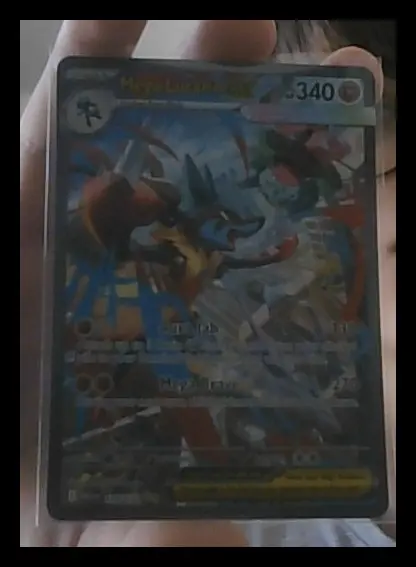
This card was first released in the English-language Mega Evolution expansion in 2025 as Mega Lucario ex #77, appearing as a Full Art Ultra Rare version within the set.[3][5]
- It is a Stage 1 Mega Evolution Pokémon ex that evolves directly from Riolu, which is a notable rules change from older Mega cards that often evolved from a prior ex card.[1][3]
- The card has 340 HP and the attacks Aura Jab and Mega Brave, with Aura Jab accelerating Basic Fighting Energy from the discard pile to the Bench and Mega Brave imposing a next-turn attack lock.[1][3][4]
- When a Mega Evolution Pokémon ex is Knocked Out, the opponent takes 3 Prize cards, increasing the risk-reward profile compared with standard Pokémon ex cards.[1][3]
Collector notes
Condition. Check the usual Full Art pressure points: corner whitening, edge wear, surface scratches on the textured foil, print lines, centering, and any waviness or dings from pack-out or handling. For modern high-value cards like this, graded/graded/graded candidates are especially sensitive to factory defects such as foil scratches, miscuts, and off-centering.[3][4]
Storage. Use a penny sleeve followed by a rigid card saver or magnetic holder, keep the card out of sunlight and humidity, and avoid repeated handling of the textured foil surface. For mint copies, store upright in a cool, dry place and consider grading if the card is a chase copy.[3][4]
Authenticity. Verify the exact set symbol, card number, texture pattern, font consistency, and holo treatment against official images and known authentic copies. Modern fakes often show flat or incorrect texture, poor color saturation, blurry text, incorrect energy symbols, or a wrong-backed card; for a premium chase card, comparison against official product listings and graded exemplars is important.[3][5]