Market outlook
Stable Outlook 6/10
Prices are supported by evergreen Pikachu demand, but abundant supply and the card’s common rarity cap growth. Graded gem-mint examples may edge upward if Pikachu collecting remains strong, while raw copies should stay inexpensive.
Next months. Likely to remain stable with modest grade-driven movement, especially for graded 10 and premium subgrades.
Long term. Over 1-3 years, gradual appreciation is possible for top-graded copies, but raw and midgrade copies should remain broadly flat unless broader Pikachu demand spikes.
History
Pikachu is the franchise mascot of Pokémon, originally introduced in 1996 as an Electric-type mouse Pokémon created by Ken Sugimori and central to the global popularity of the series. It is one of the most recognizable characters in Japanese and international pop culture, strongly associated with Ash Ketchum in the anime and with the broader Pokémon brand across games, cards, and merchandise.
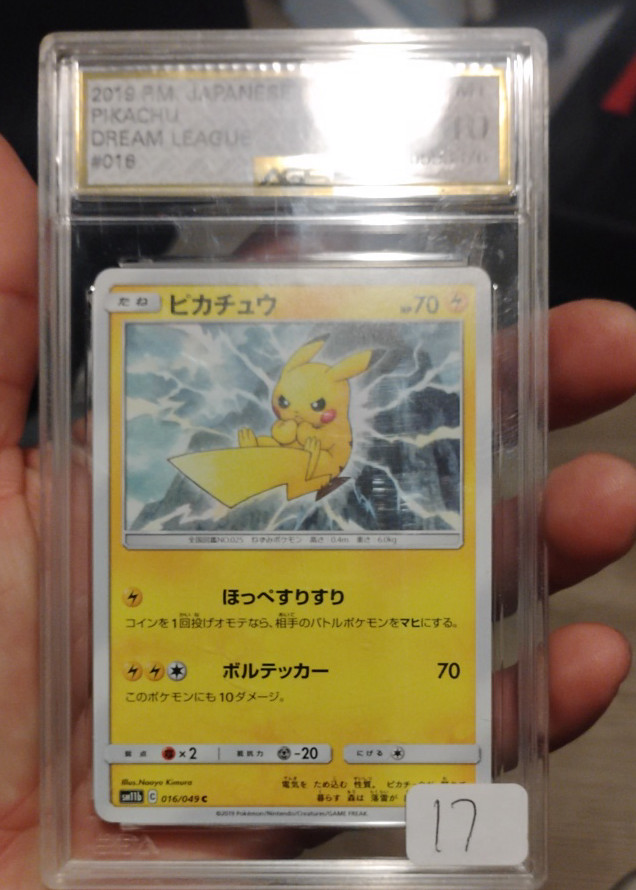
This Japanese Pikachu card was first released in Miracle Twin (SM11) in Japan on August 2, 2019; the specific card is numbered 016/049 and is the common Pikachu from the subset/parallel numbering used in Dream League, which is reflected by market listings and database records.
- The card is a Japanese common Pikachu from the 2019 Sun & Moon era and is widely cataloged as 016/049 with Lightning typing.
- Database and marketplace records show it is associated with Dream League / SM11b rather than the main Miracle Twin 016/094 numbering, suggesting the supplied set label likely points to the broader release era rather than the exact set code.
- It is a low-end collectible in raw condition but a popular graded chase for Pikachu collectors, with graded 10 copies trading far above raw copies.
Rarity and print run
- Tier
- Common
- Print run
- High
- First printed in
- Dream League
- Demand
- High
- Supply
- High
- Common card slot in a modern set means high pull volume.
- Japanese printing quality and strong collector demand can still make gem-mint copies harder to find than raw copies.
- Pikachu character demand increases competition despite the card’s non-rare status.
Collector notes
Condition. Check for whitening on edges and corners, surface scratching, print lines, and centering; Japanese commons are often pulled raw and can show minor factory edge wear. Holofoil is not expected on this card, so clean borders and strong centering matter most for grading.
Storage. Store in a penny sleeve and rigid top loader or semi-rigid holder, keep away from humidity and sunlight, and avoid binder rings pressing on edges. For long-term preservation, use an archival sleeve inside a graded slab or magnetic case if already certified.
Authenticity. Authentic copies should have crisp Japanese text, proper font weight, correct card numbering, and clean print registration. Fakes often show blurry text, off-color yellow borders, incorrect texture or sheen, poor cut quality, and inconsistent set symbol placement; comparing against a known authentic Japanese common is the fastest check.
Sources: pricecharting.com, papermoonjapan-annex.com, tcgcollector.com, decktradr.com, bulbapedia.bulbagarden.net