Market outlook
Stable Outlook 4/10
Supply is abundant and demand is steady but modest. Market movement is primarily driven by condition rarity in graded 9/10 rather than broad card appreciation. As a common player card from a heavily printed era, it is unlikely to see sustained major price acceleration.
Next months. Prices should remain broadly stable, with minor fluctuations depending on grading population updates and auction visibility.
Long term. Likely to remain a low-dollar common card in raw form, while top-grade copies may continue to command a small premium due to scarcity in gem condition.
History
Chuck Finley (Charles Edward Finley) is a former Major League Baseball left-handed pitcher best known for his long run with the California/Los Angeles Angels and for being one of the most durable and effective lefties of the 1990s. He debuted in the majors in 1986 and built a reputation as a strikeout pitcher with strong command, finishing with over 2,600 strikeouts and 200 wins. His place in the hobby is tied more to his sustained MLB success and fan recognition than to being a high-end rookie-era chase card.
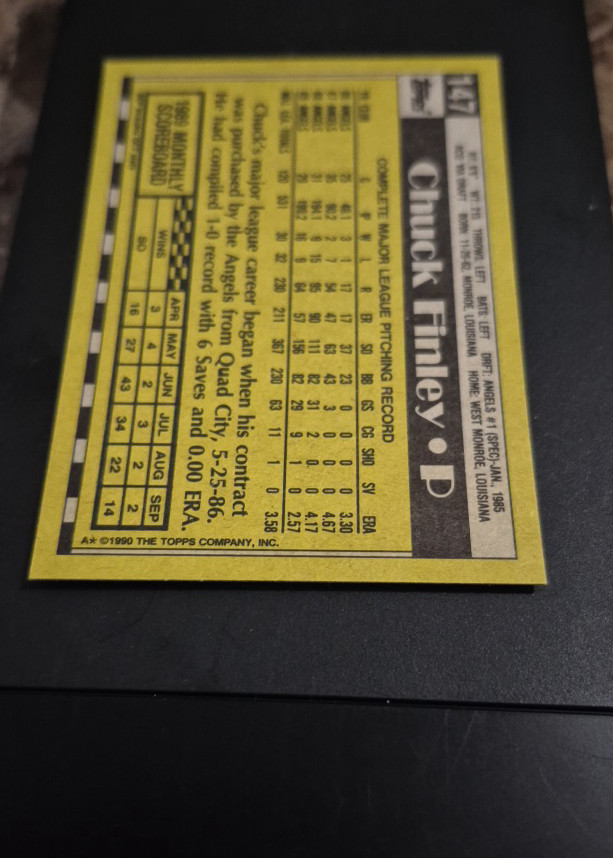
First released in 1990 as part of the 1990 Topps Baseball set, a nationwide U.S. cardboard release from Topps. Card #147 features Finley during the early prime of his MLB career, before his peak statistical seasons later in the decade.
- Card #147 appears in the base 1990 Topps flagship set, one of the most heavily distributed baseball card products of the era.
- Finley’s 1990 Topps card is not considered a rookie card; his key rookie-era cards were issued in 1987.
- The card is widely available in ungraded form, making high-grade examples more relevant to collectors than raw copies.
Collector notes
Condition. Check for common flagship-era issues such as centering, sharp corners, edge wear, and surface print defects. Topps cards from this period often show soft corners, wax staining, and minor print snow/roller marks. High-grade graded 9/10 examples are notably harder to find than raw copies, so centering and clean surfaces matter most.
Storage. Store in penny sleeves and semi-rigid holders or top loaders, keep away from humidity and heat, and avoid direct sunlight. For higher-grade candidates, use archival-quality sleeves and rigid boxes, and do not stack loose cards face-to-face without protection.
Authenticity. 1990 Topps base cards are generally easy to authenticate because of their mass-produced look and standard stock. Watch for altered corners, recolored edges, trim jobs, and reprints from mixed lots. Compare print dots, gloss, cardstock feel, and exact dimensions against a known authentic example.