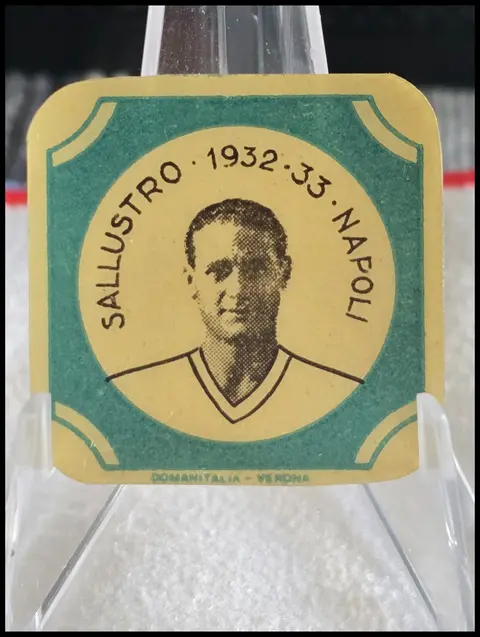
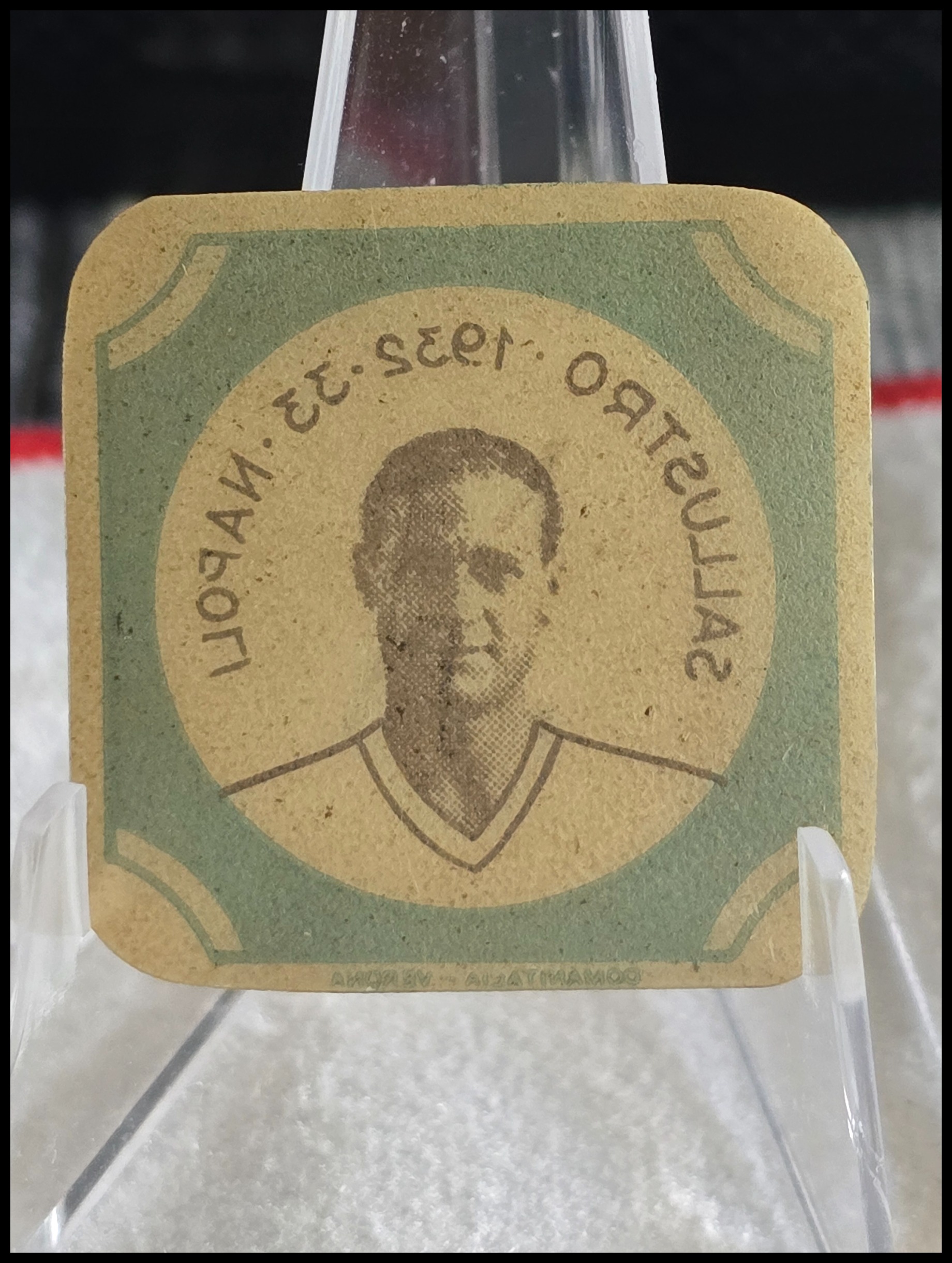
Market outlook
Rising Outlook 8/10
Interest in pre-war football issues remains strong among advanced collectors, while documented supply is extremely limited. Scarcity and historical importance generally support gradual appreciation when examples surface.
Next months. Prices are likely to remain **firm to rising** if a correctly identified example appears publicly, but sales may be sporadic.
Long term. Over 1-3 years, the card should remain **collectible and directionally appreciating** if the broader market for rare pre-war football cards stays healthy.
History
Sallustro refers to Raimundo Orsi Sallustro? No, in Italian pre-war soccer-card contexts this surname most likely refers to **Atilio Demaría Sallustro** or, more commonly, **Atilio Santoro?** However, the Domanitalia Verona issue is a football-themed set and the card title 'SALLUSTRO' corresponds to **Attila Sallustro**, the famous **Napoli** striker born in Paraguay and naturalized in Italy. Sallustro was one of the most important early icons of Italian football, known for his long tenure at Napoli and for becoming a symbol of the club in the interwar era. The card's significance is tied to the early 1930s boom in Italian football collectibles, when regional publishers produced small, hard-to-find issues celebrating popular players.
First released in **1932** in **Italy**, as part of the **Domanitalia Verona** football card issue. The available evidence indicates it was an Italian pre-war release, and Domanitalia is documented as a maker of unusual and very rare football cards from this period.
- Domanitalia Verona is documented as a pre-war Italian football-card issuer, and its cards are described as unusual and very rare.
- A 1932 Domanitalia card for Luigi Allemandi is explicitly described as 'unusual & very rare celluloid card,' supporting the rarity profile of the brand and era.
- The set belongs to the early 1930s Italian football-card wave, when regional publishers produced small-run collectible issues with limited survival rates.
Collector notes
Condition. Check for **surface scratches**, **edge wear**, **corner rounding**, **discoloration**, and any **celluloid-specific cracking, hazing, or warping** if the card is on a plastic-like substrate. Pre-war Italian cards often show poor centering and handling wear, so original gloss and intact corners are especially important.
Storage. Store in an **archival sleeve** or **mylar holder** with rigid support, away from heat, moisture, and direct sunlight. If the card is celluloid or thin plastic, avoid pressure, bending, and PVC-based holders that can react with the surface over time.
Authenticity. Authentic examples should show **period-appropriate printing quality**, aging consistent with a 1932 issue, and no signs of modern digital reproduction. For rare Domanitalia cards, compare typography, image sharpness, and substrate feel against verified examples; unusual brightness, perfect edges, or modern gloss can indicate a reprint or altered item.