Market outlook
Stable Outlook 6/10
The card benefits from Michael Jordan’s enduring icon status, but abundant supply and a common-base-card designation limit strong appreciation in lower grades. Prices are most likely to remain supported by collector demand rather than scarcity.
Next months. Expect mostly range-bound pricing for raw and mid-grade copies, with occasional spikes in gem examples when strong sales occur.
Long term. Over 1-3 years, the card should remain liquid and collectible, with gradual appreciation most likely in high-grade copies rather than common raw examples.
History
Michael Jordan is widely regarded as one of the greatest basketball players of all time. He rose from UNC star to NBA global icon with the Chicago Bulls, and his popularity helped make late-1980s basketball cards a major part of the hobby. The 1989-90 Hoops issue is especially significant because it was among the first mainstream NBA sets of the modern mass-produced era and includes one of Jordan’s most collected base cards.
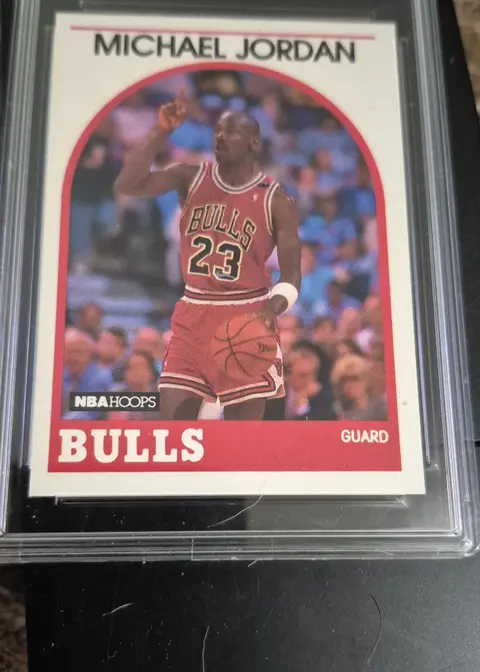
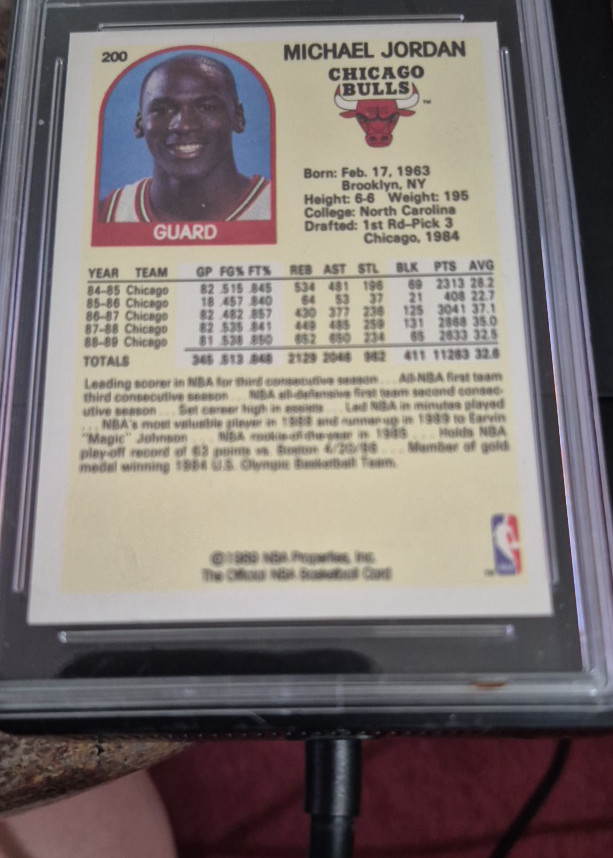
First released in the 1989-90 NBA Hoops basketball set, issued for the 1989-90 NBA season. graded identifies the card as Michael Jordan #200 from 1989 Hoops, and price-guide sources track it as the base card from that set.
- Card #200 is Michael Jordan’s base card in the 1989-90 NBA Hoops set.
- The card is one of the most recognizable Jordan commons from the late 1980s and is widely collected as an entry-level Jordan card.
- Graded examples show a very wide spread between raw/low-grade copies and high-grade graded 10 copies, reflecting strong condition sensitivity and collector demand.
Collector notes
Condition. Check centering carefully, especially left-right and top-bottom alignment, since late-1980s Hoops cards are often off-center. Common flaws include rough or dinged corners, edge whitening, print specks, surface scratches, and wax or handling wear. Because the card is inexpensive in raw form but much more valuable in gem condition, small defects can materially affect value.
Storage. Store the card in a penny sleeve and rigid holder or card saver, keep it away from moisture and heat, and avoid repeated handling of the edges and corners. For higher-grade copies, use a semi-rigid holder for submission or a sealed slab for long-term preservation. Keep it out of direct light to reduce surface fade and wear.
Authenticity. Authenticity checks should focus on print quality, cardstock feel, and sharpness of the text and image. Because the card is mass-produced and relatively common, the main concern is usually altered condition rather than sophisticated counterfeits, but buyers should still compare font, image clarity, and borders against verified examples. For valuable graded copies, third-party grading from graded, graded, graded, or graded is the most practical authentication safeguard.