Market outlook
Stable Outlook 7/10
The market trend is stable due to consistent collector demand for early ONE PIECE holograms, but the high original print run prevents sharp price increases. The card's value remains anchored by nostalgia and the enduring popularity of the Straw Hat crew[1][4][6].
Next months. Stable prices around 1,300–2,200 JPY for good condition copies over the next 3–6 months, with minor upward movement if a mint copy appears in auction[2][4].
Long term. Modest appreciation over 1–3 years, potentially reaching 2,500–3,000 JPY for pristine copies, driven by aging demographic collectors and anniversary ONE PIECE events[8].
History
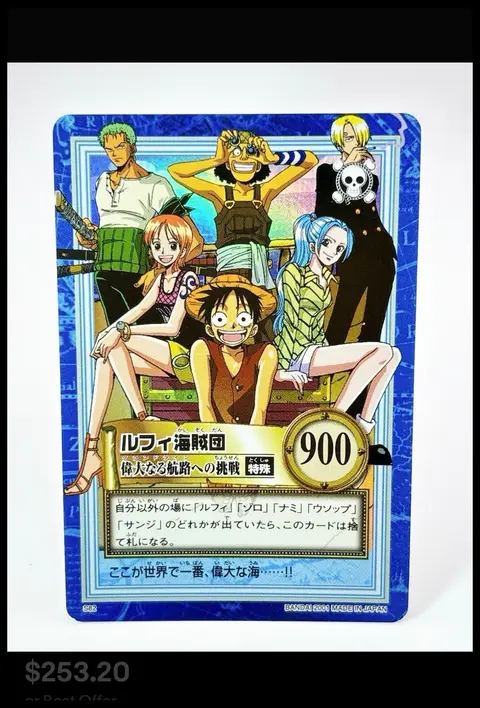
This card depicts the Luffy Pirates (also known as the Straw Hat Pirates), the central crew from the ONE PIECE manga and anime created by Eiichiro Oda. The group was formed by Monkey D. Luffy after he gathered members with diverse dream, including Zoro, Nami, Usopp, Sanji, Chopper, Robin, Franky, and Brook. Their origin story begins in East Blue, where Luffy sets out to become the King of Pirates, eventually conquering the Grand Line and gaining global notoriety[1][3].
This card was first printed in 2001 by Bandai in Japan as part of the 'Carddas Hyper Battle' trading card series for ONE PIECE, specifically the 'Luffy Pirates S82' variant depicting the crew's journey toward the Grand Line[1][3].
- The card is a hologram ('Kira Card') featuring the full crew of the Luffy Pirates, making it a visually distinct collectible from the 2001 Bandai line[3][4].
- It was released in the 'Hyper Battle' set under the subtitle 'Challenge to the Grand Line' (偉大なる航路への挑戦), highlighting the crew's next major arc in the story[2][8].
- A 2002 reprint or variant of S82 Luffy Pirates exists, indicating multiple print runs and increased rarity for the 2001 original[6].
Rarity and print run
- Tier
- Common
- Print run
- High
- First printed in
- Carddas Hyper Battle - Luffy Pirates S82 (Challenge to the Grand Line)
- Demand
- High
- Supply
- High
- Although classified as Common, the 2001 hologram version is more sought than the 2002 reprint due to its originality and superior hologram quality[3][6]
- The crew-wide design makes it a standout card in the Hyper Battle set, increasing collector interest despite common status[1][4]
- Over 20 years since release, well-preserved copies are becoming scarcer, especially with intact holograms[8]
Collector notes
Condition. Key things to check include the holographic surface for scratches, edge wear, and corner creases, especially since many copies are 20+ years old. Common flaws include surface dulling on the hologram and minor whitening on edges due to storage wear[3][8].
Storage. Best practices include storing the card in a rigid top loader or penny sleeve placed inside a sealed Mylar bag, kept in a cool, dry environment away from direct light to preserve the hologram's luster[8].
Authenticity. Fakes can be spotted by inspecting the hologram quality—originals have a deep, vibrant 'Kira' effect, while reprints often appear flat or dull. The 2001 version should show 'Bandai 2001' on the back, whereas the 2002 reprint states '2002'. Authentication is confirmed by comparing the card's print number (OP072) and hologram pattern with verified listings[2][6].
Sources: paypayfleamarket.yahoo.co.jp, hatatoy.shop, jp.mercari.com, onepiece-cardgame.com, fullahead-onepiece-cardgame.com