Market outlook
Stable Outlook 7/10
Vintage Hall of Fame cards from flagship Topps sets usually maintain durable collector demand, but a common-base-card profile keeps rapid appreciation in check. Prices are most sensitive to grade, centering, and overall eye appeal rather than scarcity alone.
Next months. Expect relatively stable pricing with small fluctuations based on availability of graded inventory and dealer asking prices.
Long term. Over 1-3 years, the card should remain a dependable vintage Hall of Fame collectible, with the strongest gains likely concentrated in top-graded examples.
History
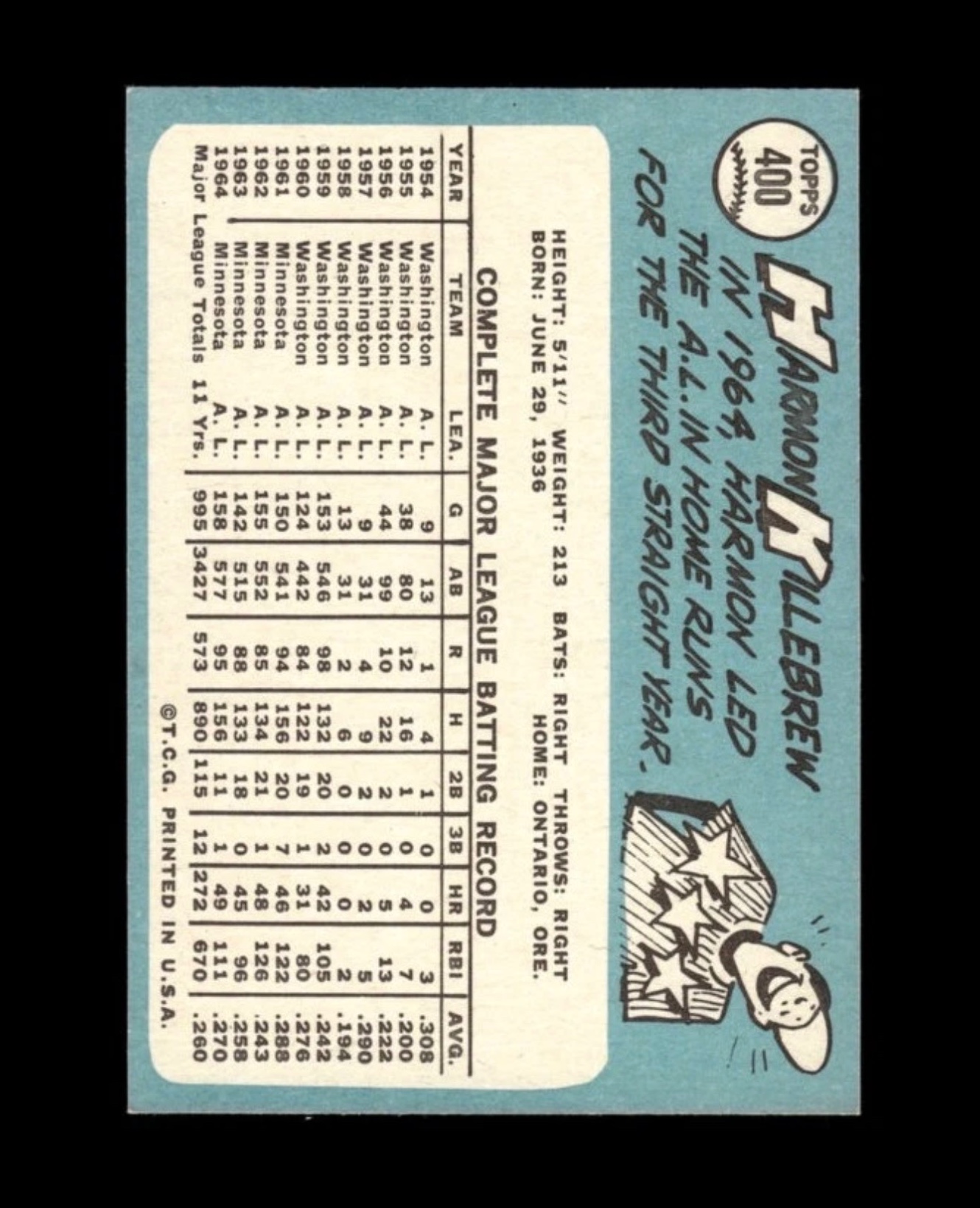
Harmon Clayton Killebrew Jr. was one of the premier power hitters in Major League Baseball history and a cornerstone star of the Minnesota Twins and earlier the Washington Senators. graded notes his career totals of 573 home runs, 2,086 hits, 1,584 RBI, a .509 slugging percentage, and a .256 batting average, underscoring why he is remembered as one of the defining sluggers of the 1950s and 1960s.[4] By 1965, Killebrew was already established as a Hall of Fame-caliber star, and his presence in the 1965 Topps set reflects his status as one of the sport’s marquee players.[4][5]
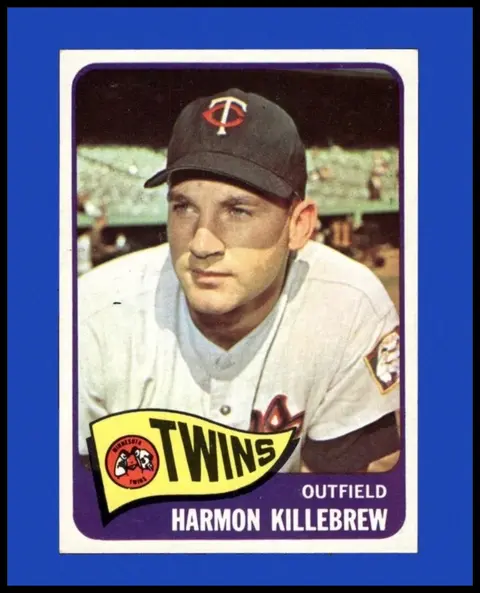
This card was first released in the 1965 Topps Baseball set, Topps’ annual major-league issue for the 1965 season, with card #400 listing Harmon Killebrew for the Minnesota Twins.[5] As with other 1965 Topps cards, it was distributed through wax packs and hobby circulation during the 1965 baseball card release cycle in the United States.
- Card #400 in the 1965 Topps Baseball set features Harmon Killebrew of the Minnesota Twins.[5]
- Killebrew is one of baseball’s iconic power hitters and finished his career with 573 home runs.[4]
- The 1965 Topps card design is a classic mid-1960s issue and remains widely collected as part of Topps’ flagship vintage run.[5]
Rarity and print run
- Tier
- Common
- Print run
- Very High
- First printed in
- 1965 Topps Baseball
- Demand
- High
- Supply
- Medium
- It is a base card from a mass-produced 1965 Topps flagship set.
- Lower-grade examples are relatively available through dealers and marketplaces.
- High-grade, well-centered copies are much less common than average raw copies.
Collector notes
Condition. For this card, centering is a major value driver, followed by corner wear, edge chipping, surface scratches, and print defects. Vintage Topps cards from this era often show waxing, minor paper loss, and OC-related grade penalties. Check for snow-like print spots, tinting issues, and back wear from album removal or stacking.
Storage. Store the card in a penny sleeve and rigid top loader or semi-rigid holder, then keep it in a cool, dry environment away from sunlight and humidity. For higher-grade examples, use archival-quality holders and avoid PVC materials to reduce long-term surface damage.
Authenticity. Authentic copies should show vintage paper stock, period-correct print dots, and natural aging consistent with a 1965 Topps card. Reprints often look too clean, have modern gloss or overly sharp digital printing, and may have inconsistent card stock thickness. graded and other major grading services are commonly used to confirm authenticity for higher-value examples.
Sources: sportlots.com, sportscardspro.com, deanscards.com, psacard.com, throwbacksportscards.com