Market outlook
Rising Outlook 8/10
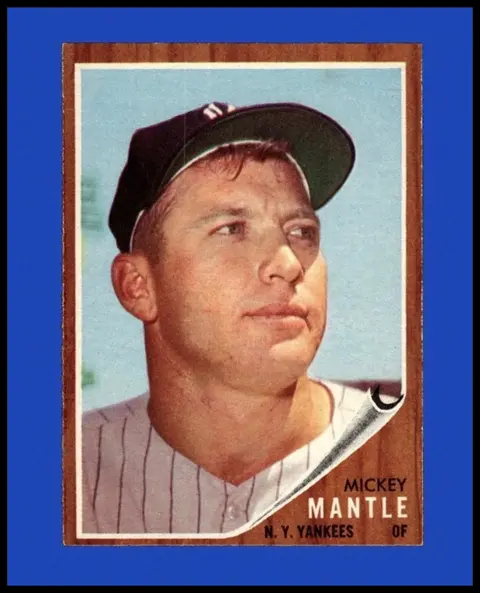
Vintage Mantle cards generally benefit from long-term blue-chip demand, historical importance, and broad collector recognition. While the 1962 Topps issue is not rare, high-grade examples remain desirable and price support is strong for iconic players.
Next months. Likely to remain firm to slightly higher, especially for graded/graded/graded examples in strong eye appeal grades.
Long term. Expected to continue appreciating over 1-3 years, with the best-condition examples likely outperforming lower grades.
History
Mickey Mantle (1931-1995) was one of the greatest and most popular players in baseball history, a switch-hitting center fielder for the New York Yankees. He became a cultural icon due to his power, speed, postseason success, and larger-than-life presence. Mantle was a 20-time All-Star, 3-time American League MVP, and 7-time World Series champion, and his cards remain among the most collected in the hobby.
First released in 1962 as part of the Topps Baseball set, distributed in wax packs and vending/cello product across the United States during the 1962 baseball card season.
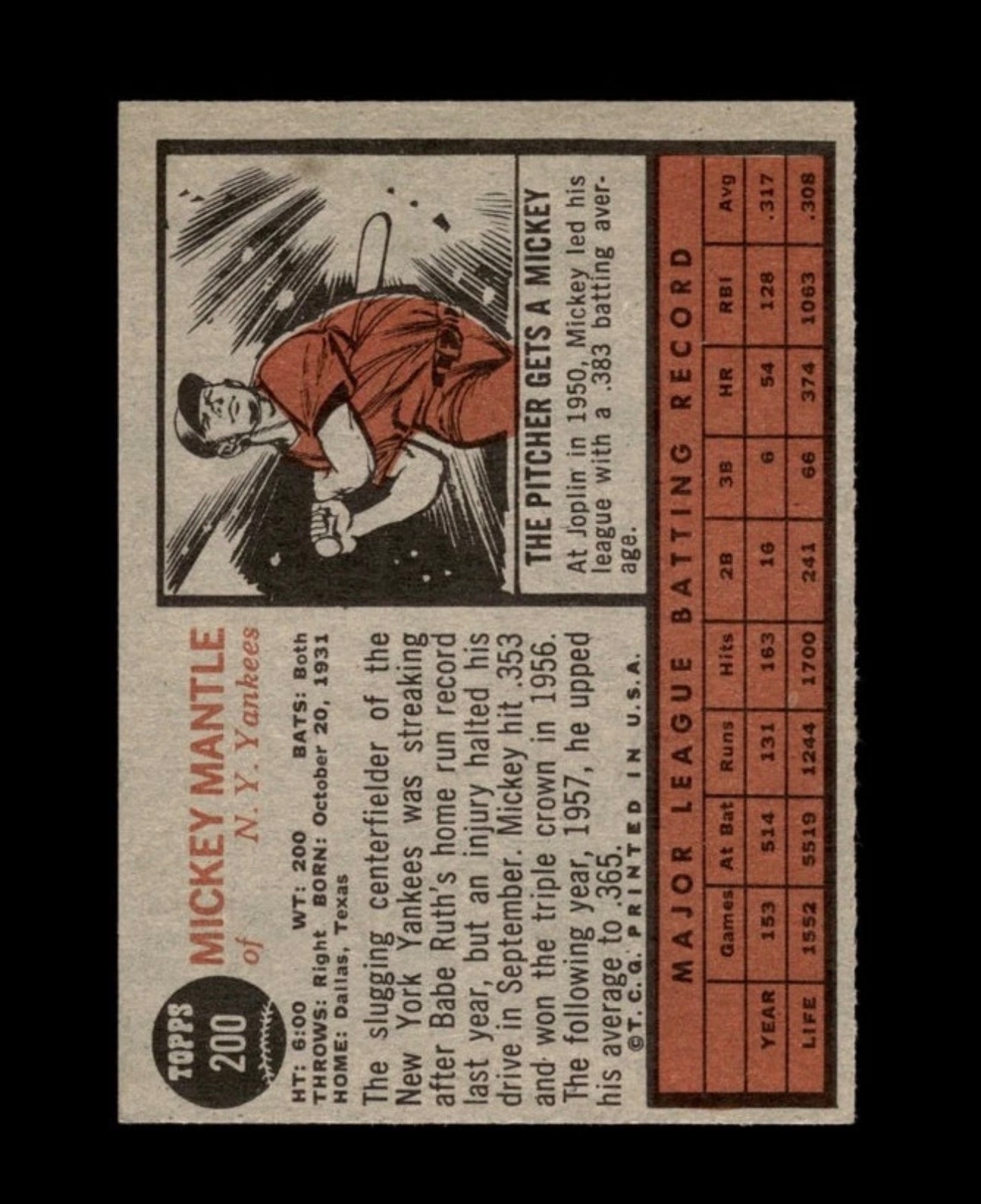
- This is Mickey Mantle's Topps #200 card from the 1962 Topps set, one of the key Mantle issues of the postwar era.
- It is not a rookie card; Mantle's rookie is the 1951 Bowman #253 and 1952 Topps #311 is his most famous early Topps card.
- Market data shows strong collector demand, with graded 8 recent sales around the mid-$14K to mid-$16K range and high-end graded 10 pricing far above that.
Collector notes
Condition. This card is notoriously difficult in high grade. Common issues include off-centering, print snow/print defects, edge chipping, corner wear, wax staining, light surface scratches, and poor registration. The darker border areas can make edge wear and chipping more visible. Centering is especially important for premium value.
Storage. Store in an archival penny sleeve inside a rigid toploader or semi-rigid holder, away from heat, humidity, and direct sunlight. For higher-value copies, use a graded slab or submit to a major grading service. Keep the card in a stable, dry environment and avoid handling the surface directly.
Authenticity. Authentic 1962 Topps cards should show period-correct printing characteristics, aging, and stock. Reprints often look too crisp, too glossy, or have incorrect paper stock and color tone. Compare font sharpness, image resolution, and back design to known authentic examples. For valuable copies, third-party grading from graded, graded, graded, or graded is strongly recommended.