Market outlook
Stable Outlook 7/10
Gronkowski’s career achievements are already well established, which tends to anchor his key rookie cards at a relatively stable value level rather than subject them to extreme volatility. While he is no longer in his prime playing years, his legacy as a multiple-time Super Bowl champion and one of the greatest tight ends of all time supports consistent collector interest. The broader football card market has matured and generally rewards true rookie patch autographs of star players, but much of the speculative growth has already occurred during his peak playing years, so near-term price action is more likely to be driven by macro hobby trends, Hall of Fame discussions, and overall demand for 2010-era RPAs than by new on-field accomplishments.
Next months. Over the next 3–6 months, the card’s value is likely to remain broadly stable with modest fluctuations tied to football season sentiment, general hobby market conditions, and occasional strong auction results for high-grade or visually appealing patch examples. Short-term price spikes are possible around periods of renewed media attention on Gronkowski or Patriots dynasty retrospectives, but large, sustained moves are not expected barring major market shifts.
Long term. Over a 1–3 year horizon, the card has a moderate upside profile driven primarily by Gronkowski’s continuing legacy, potential Hall of Fame induction, and enduring interest in 2010s Patriots stars. As supply of high-grade copies entering the market remains limited and more collectors shift focus to established legends, demand for premier rookie patch autographs like this one should remain solid. Prices are likely to trend gradually upward or at least hold value, with the strongest appreciation concentrated in top-grade or particularly attractive patch/autograph examples, while lower-grade or heavily worn copies may see slower growth.
History
Rob Gronkowski is a former NFL tight end best known for his time with the New England Patriots, who selected him in the second round (42nd overall) of the 2010 NFL Draft. He quickly became one of the most dominant tight ends in league history, known for his combination of size, strength, route running, and red-zone production. As a central weapon in the Patriots offense alongside Tom Brady, he won multiple Super Bowls, earned All-Pro selections, and set numerous records for tight ends, cementing his status as a future Hall of Famer and a key figure in the 2010s Patriots dynasty.
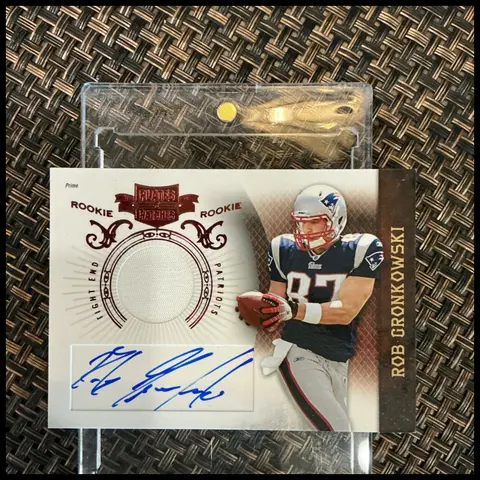
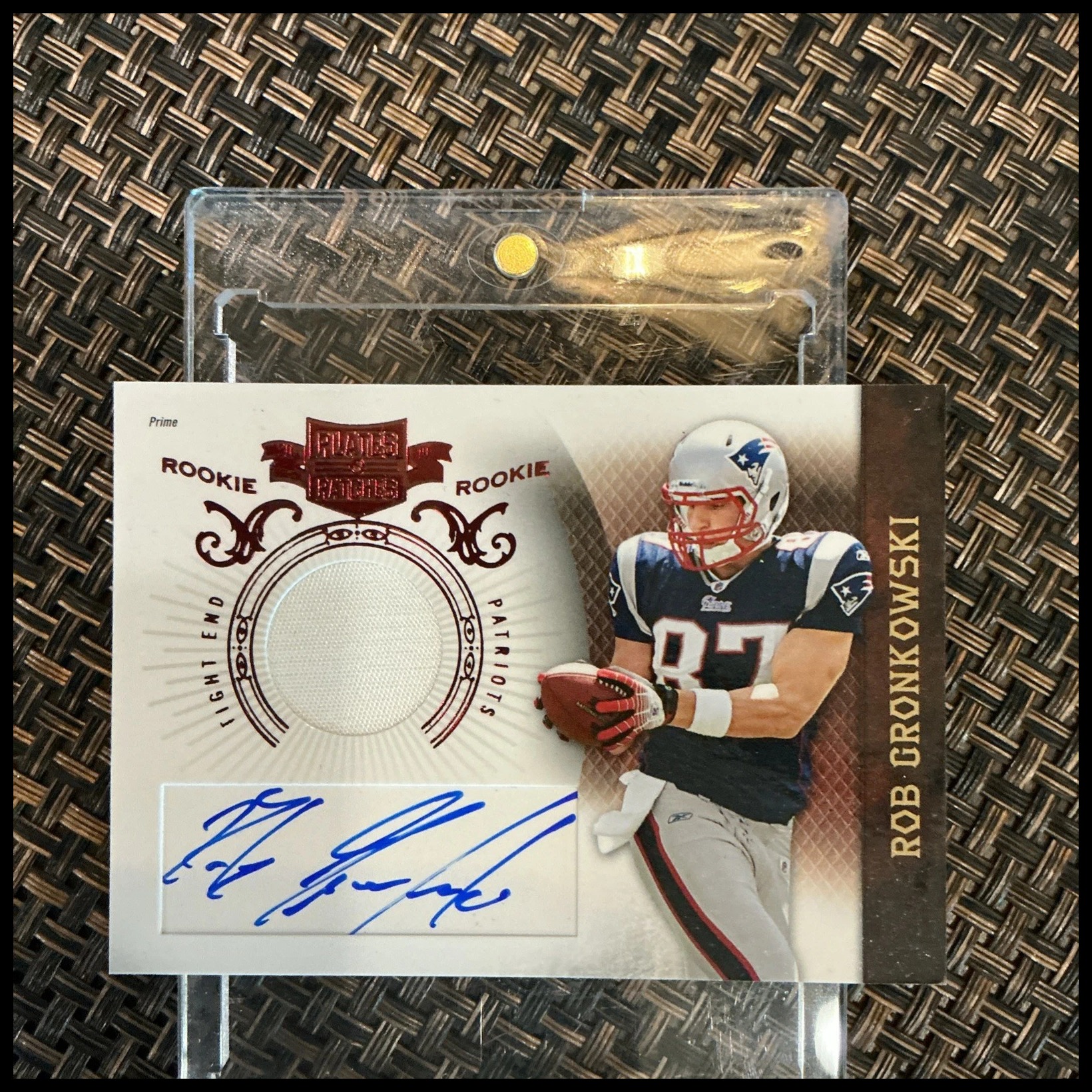
The Rob Gronkowski 2010 Panini Plates & Patches #229 Rookie Patch Autograph was first released as part of the 2010 Panini Plates & Patches Football product, which came out during the 2010 NFL season as one of Panini’s higher-end rookie-focused releases. The card is a rookie patch autograph (RPA), featuring an on-card autograph and a memorabilia patch, serial numbered to 699 copies.[1][6]
- This card is a true rookie patch autograph from Gronkowski’s first NFL season, released in 2010 and designated as card #229 in the 2010 Panini Plates & Patches checklist.[6]
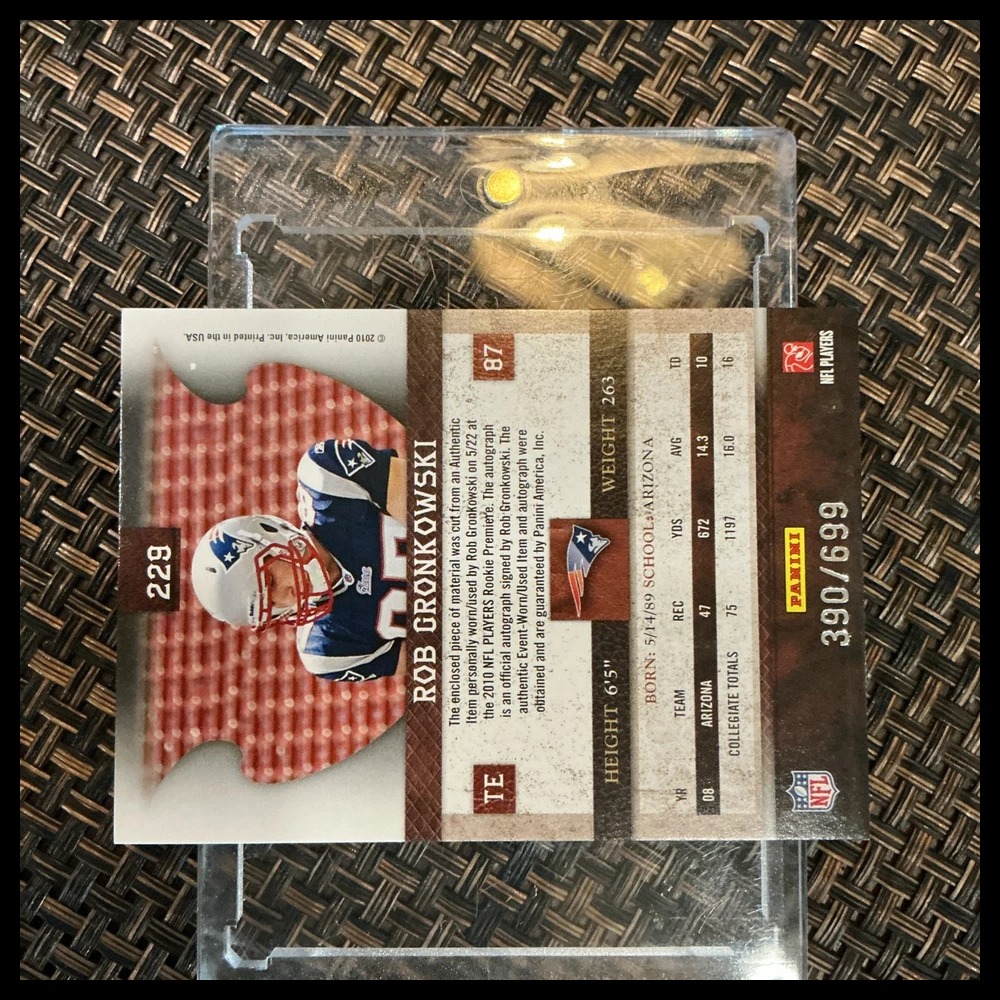
- The card is serial numbered out of 699 total copies, making it a limited but not ultra-scarce RPA, with individual copies often noted by their exact print number such as #130/699.[1]
- High-grade examples and authenticated autographed copies have achieved notable auction prices, including a graded 10 auto example selling for around $360 in March 2025, indicating sustained collector interest in this specific rookie issue.[4]
Rarity and print run
- Tier
- Rare
- Print run
- Low
- First printed in
- 2010 Panini Plates & Patches Football
- Demand
- High
- Supply
- Low
- Serial numbered print run limited to 699 copies, making it significantly scarcer than mass-produced base rookies from the same era.[1][6]
- Patch-autograph rookie format, which naturally has a lower supply than standard rookie inserts or base cards and is highly targeted by player and set collectors.
- Condition sensitivity due to thick card stock, edges, corners, and surface issues, which reduces the population of high-grade copies over time.
- Competition from collectors who focus on rookie patch autographs and Hall of Fame–level players, which keeps a substantial portion of the total print run locked away in personal collections rather than on the open market.
Collector notes
Condition. When evaluating this card, pay close attention to all four corners and edges, as thicker, patch-style cards from 2010 Panini Plates & Patches are prone to edge chipping and corner wear out of the pack. Glossy surfaces on the front can show surface scratches, small print lines, or minor indentations, which are heavily weighted in grading. The foil elements around the nameplate and set logo can show micro-chipping. Also check centering, both of the main image panel and the patch window; off-center cuts are a common issue with many early-2010s Panini releases. Inspect the memorabilia patch window carefully for fraying, loose threads, or separation between the patch and the card frame. Because the card is autographed, examine the signature area for smudging, fading, streaking, or bubbling from the pen; a strong, bold signature without breaks is more desirable. Finally, verify that the serial numbering (out of 699) is clearly printed and not rubbed or damaged, as this can affect both aesthetic appeal and perceived authenticity.[1][6]
Storage. Due to its thicker stock and patch construction, this card is best stored in a properly sized magnetic one-touch holder or an appropriately sized top loader with a soft inner sleeve designed for thick cards, avoiding too-tight holders that can compress corners. For long-term stability and to protect the autograph, keep the card out of direct sunlight and fluorescent light to reduce the risk of fading, and store it in a cool, dry environment with relatively stable humidity. For higher-value copies, particularly graded examples, keep slabs in protective team bags or graded card sleeves to prevent scratches on the case. Avoid frequent handling; if the card must be handled raw, use clean, dry hands or gloves and hold by the edges to minimize the risk of surface oils and fingerprints. Store cards upright in a sturdy storage box or graded card case that prevents shifting during transport. As an autograph patch rookie, this card can be a candidate for professional grading and authentication, which also provides a protective encapsulated holder and can help preserve condition and market value.[4]
Authenticity. Authentic copies of the 2010 Panini Plates & Patches #229 Rob Gronkowski RPA will feature a serial number stamped on the card front (or occasionally back, depending on configuration) out of 699, with consistent Panini font and spacing; irregular or misaligned numbering can be a red flag.[1][6] The patch window should be cleanly cut and flush with the surrounding card surface; homemade or altered patches often show uneven edges or glue residue. The Panini branding, logos, and fine print on the back should be crisp and not blurry; counterfeit prints may have fuzzier text or incorrect color tones. The autograph should match known Gronkowski signature patterns from 2010 (often a stylized "R G" and number) and be signed in the correct type of ink commonly used on this release. Because this card is popular and carries a premium as a rookie patch autograph, buyers should strongly consider examples graded and authenticated by major third-party grading companies (such as graded, graded, or graded), as these services authenticate both the card and the autograph in many cases.[4] When purchasing raw copies from online auctions, compare images carefully to known authentic examples from reputable auction houses and price databases, and be cautious of cards with replaced patches, altered serial numbers, or re-applied autographs.
Sources: pristineauction.com, sportscardspro.com, beckett.com, psacard.com, sportlots.com