Market outlook
Stable Outlook 8/10
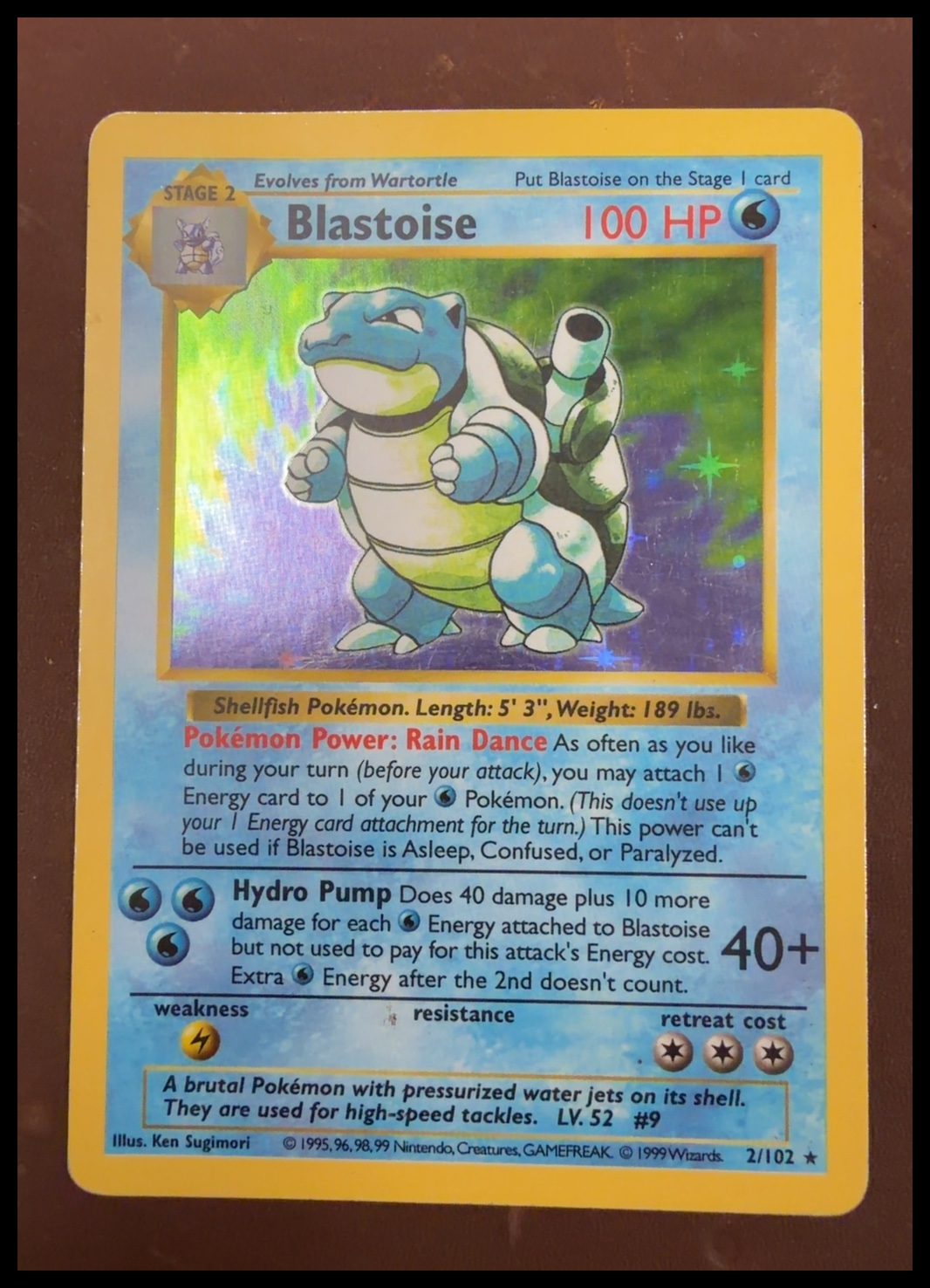
Vintage Base Set holos tend to hold value well because demand is driven more by long-term collector nostalgia than short-term metagame play. The unlimited English Blastoise is liquid and widely recognized, but its price is less explosive than scarcer 1st Edition variants, so the most likely path is gradual stability with selective gains for graded and premium-condition copies.
Next months. Over the next 3-6 months, prices are likely to remain broadly stable, with the strongest performance in graded 9-10 and well-centered authenticated copies.
Long term. Over 1-3 years, the card should continue to appreciate slowly if vintage Pokémon demand remains strong, with the largest gains likely concentrated in top-graded examples and verified scarce variants.
History
Blastoise is the final evolution of Squirtle, one of the original first-generation Kanto starter Pokémon introduced in the Pokémon franchise. In the trading card game, Blastoise became one of the most iconic Water-type Pokémon because it was a powerful Stage 2 evolution with strong gameplay relevance and a highly recognizable Ken Sugimori illustration.
This card was first released in the English Base Set in 1999 as card number 2/102, and it was distributed through the original Pokémon TCG Base Set printings in the United States and other English-language markets.
- It is one of the three original Base Set starter evolutions alongside Charizard and Venusaur, making it one of the most collected vintage Pokémon cards.
- The card is a Rare Holo with HP 100, Stage 2 typing, and an iconic holographic finish that is heavily associated with early Pokémon TCG collecting.
- Base Set Blastoise is considered a high-counterfeit-risk card because valuable vintage holo cards are commonly faked, especially in the English Base Set format.
Collector notes
Condition. Check for holofoil scratches, edge whitening, corner wear, centering, surface scuffs, and print line or factory roller marks. On vintage Base Set holos, the front holo area is especially prone to micro-scratching, while the back often shows whitening from handling and binder wear.
Storage. Store the card in a penny sleeve and rigid top loader or semi-rigid holder, keep it away from humidity and direct light, and avoid repeated removal from protection. For higher-value copies, use archival-quality materials and consider professional grading for long-term preservation and authentication.
Authenticity. Common fake indicators include incorrect back coloring, a missing or weak black inner layer when held to light, poor rosette dot structure under magnification, off-font text weight or spacing, and an inaccurate holo pattern. Genuine copies should be compared against authenticated exemplars, and expensive copies should be submitted to graded, graded, or graded for verification.