Market outlook
Stable Outlook 7/10
Current pricing data shows active demand and a clear premium for graded copies, but no evidence of a dramatic sustained spike beyond normal modern chase-card behavior. As with most modern Illustration Rares, prices are likely to fluctuate around collector demand, pull rates, and gem-mint population trends.
Next months. Likely to trade in a relatively tight range, with raw copies moving modestly and graded 10 copies retaining a strong premium.
Long term. Over 1-3 years, value should hold best in top grades if population remains limited; lower-grade raw copies may soften if supply increases.
History
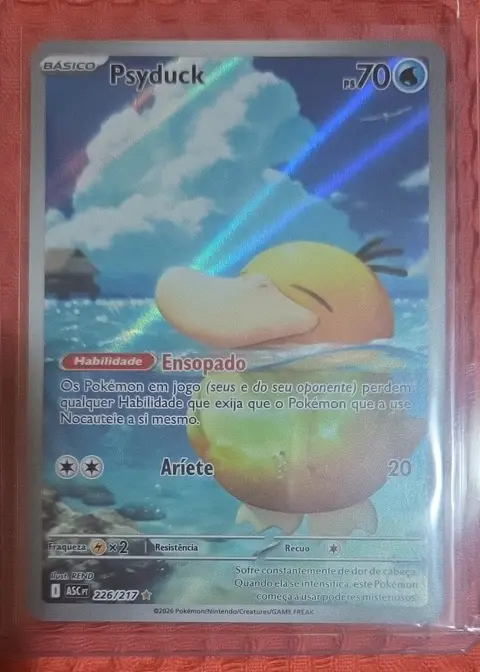
Psyduck is a first-generation Pokémon introduced in the original Pokémon Red and Green era and is known for its chronic headaches, confused expression, and eventual evolution into Golduck. In the franchise, Psyduck is significant as a recurring comic-relief character that also became widely recognized through the anime, where its unpredictable psychic power and headache-triggered abilities made it memorable. The card listed here is a modern high-rarity illustration variant from the 2026 Ascended Heroes expansion, presented in Portuguese.
This Psyduck card was first released in the Ascended Heroes set on January 30, 2026, as card 226/217, according to secondary-market cataloging sources. It appears to have been distributed as a Portuguese-language printing within the 2026 Ascended Heroes release window.
- It is numbered 226/217, making it a secret-rare slot card rather than a standard set-numbered card.
- The card is cataloged as an Illustration Rare and appears to exist only as a holofoil print variant.
- Market trackers report strong grade premiums, with graded 10 copies trading far above raw copies.
Rarity and print run
- Tier
- Secret Rare
- Print run
- High
- First printed in
- Ascended Heroes
- Demand
- High
- Supply
- Medium
- Secret-rare numbering 226/217 places it beyond the main set count.
- Illustration Rare treatment generally attracts collector demand.
- High-grade copies are meaningfully scarcer than raw copies due to centering and surface sensitivity.
Collector notes
Condition. Check for centering, corner wear, edge whitening, surface scratches, print lines, and holofoil scuffing. Illustration Rare cards can also show texture wear and small indentations that are easy to miss under normal light. Because the card has strong grade premiums, graded 10-level surface quality and centering matter especially.
Storage. Store the card in a penny sleeve followed by a rigid top loader or semi-rigid holder, and keep it in a cool, dry, low-light environment. Avoid repeated handling of the holo surface, and use clean hands or gloves when inspecting. For long-term value, consider immediate grading if the card is near-mint and well-centered.
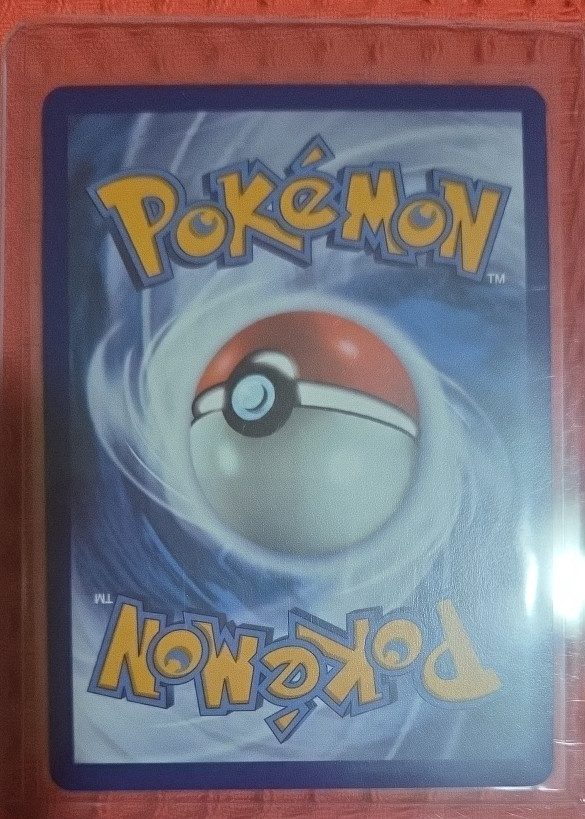
Authenticity. Verify the back printing, rosette dot pattern, font weight, and kerning, and confirm the holofoil texture matches authentic Pokémon production. Counterfeit checks should include light transmission testing, since authentic cards typically have an opaque inner core. For high-value copies, third-party grading by graded, graded, or graded is the most reliable authenticity safeguard.
Sources: chasedex.com, cardrake.com, pokescope.app, sportscardinvestor.com, thegametraders.com