Market outlook
Stable Outlook 7/10
The card benefits from Hall of Fame-level player demand and rookie-card status, but its large supply keeps the overall market more stable than explosive. Premiums should remain strongest for graded 9/10 and other top-graded copies.[1][4]
Next months. Prices are likely to remain steady, with occasional spikes for top-pop or auction-visible high-grade examples.
Long term. Over 1-3 years, gem-mint and pristine copies should hold strong value better than raw copies, while lower-grade examples are likely to track broader vintage-card demand rather than experience major gains.
History
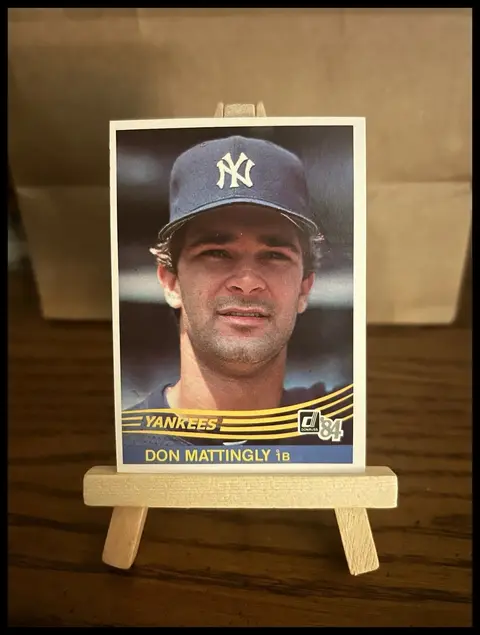
Don Mattingly is a former New York Yankees first baseman and captain whose 1980s peak made him one of the defining hitters of his era. He entered the major leagues in 1982 and became the 1985 American League MVP, later earning widespread recognition for his batting title, Gold Glove defense, and Yankees legacy. His 1984 Donruss card is significant because it is one of his key rookie-era cards and part of the first mainstream cardboard documenting the early career of a future Yankees icon.[1][2]
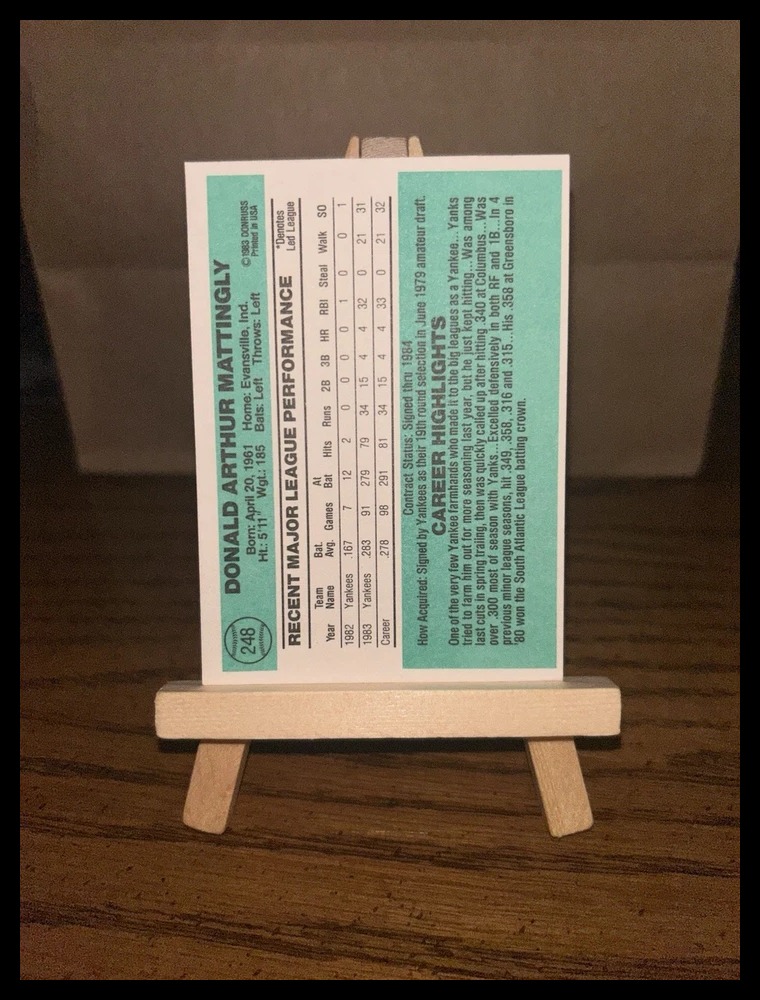
The card was first issued in the 1984 Donruss baseball set, a mass-market release from Donruss for the 1984 baseball card season. The Donruss #248 Don Mattingly rookie card is identified by pricing guides as a rookie card from that set.[1][2]
- This card is widely recognized as Don Mattingly’s rookie card in the 1984 Donruss set.[1][2]
- Sports Card Pro lists strong grade-based market separation, with graded 10 and other gem-mint grades selling for much more than raw or lower-grade copies.[1]
- Card Ladder records a graded 10 sale of $5,612.00, showing meaningful collector demand for high-grade examples.[4]
Collector notes
Condition. Check for centering, sharp corners, clean edges, and surface gloss. Common flaws on 1980s Donruss cards include off-centering, corner wear, print defects, edge chipping, and wax stains or light surface scuffing. High-grade copies are difficult to find because small defects sharply reduce value.[1][4]
Storage. Store the card in a penny sleeve and rigid top loader or semi-rigid holder, keep it away from moisture, heat, and direct sunlight, and avoid repeated handling. For better long-term protection, use an archival-quality binder only if pages are PVC-free and the card will not be moved frequently.
Authenticity. Authentic 1984 Donruss cards should match the known size, stock, color, print quality, and back design of the original issue. Because this card is widely collected, inspect for modern reprint gloss, blurry print, incorrect stock thickness, and altered corners. Third-party grading is the safest route for expensive high-grade examples; graded, graded, graded, and graded population/market data are commonly used for this card.[1][4]