Market outlook
Rising Outlook 8/10
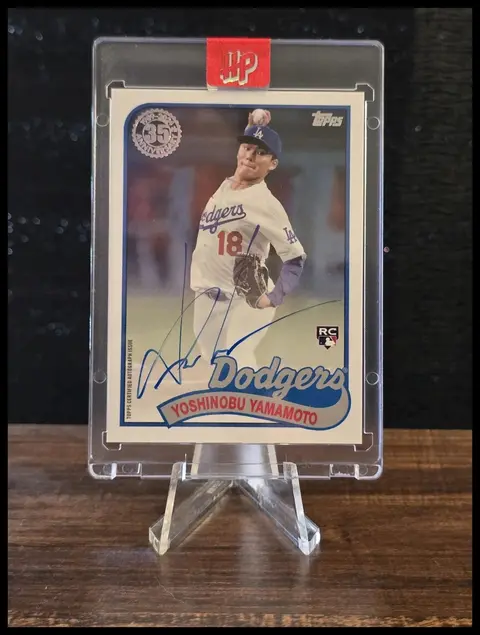
Demand for Yamamoto's rookie autograph continues to grow as he establishes himself in MLB. Top-grade copies are increasingly scarce, driving up prices[1][4].
Next months. Next 3–6 months: Prices expected to rise 10–20% for graded 10 and higher grades as spring training and early season stats boost interest[1].
Long term. 1–3 years: Long-term value could increase 30–50% if Yamamoto remains a top-tier pitcher, with Black variants potentially doubling in value due to extreme scarcity[1][6].
History
Yoshinobu Yamamoto is a Japanese professional baseball pitcher for the Los Angeles Dodgers, debuting in MLB in 2024 after winning the Pacific League MVP three times in Japan. He was born in Higashi Osaka, Osaka, Japan, and became one of the most sought-after international free agents in history, signing a record $325 million contract[1].
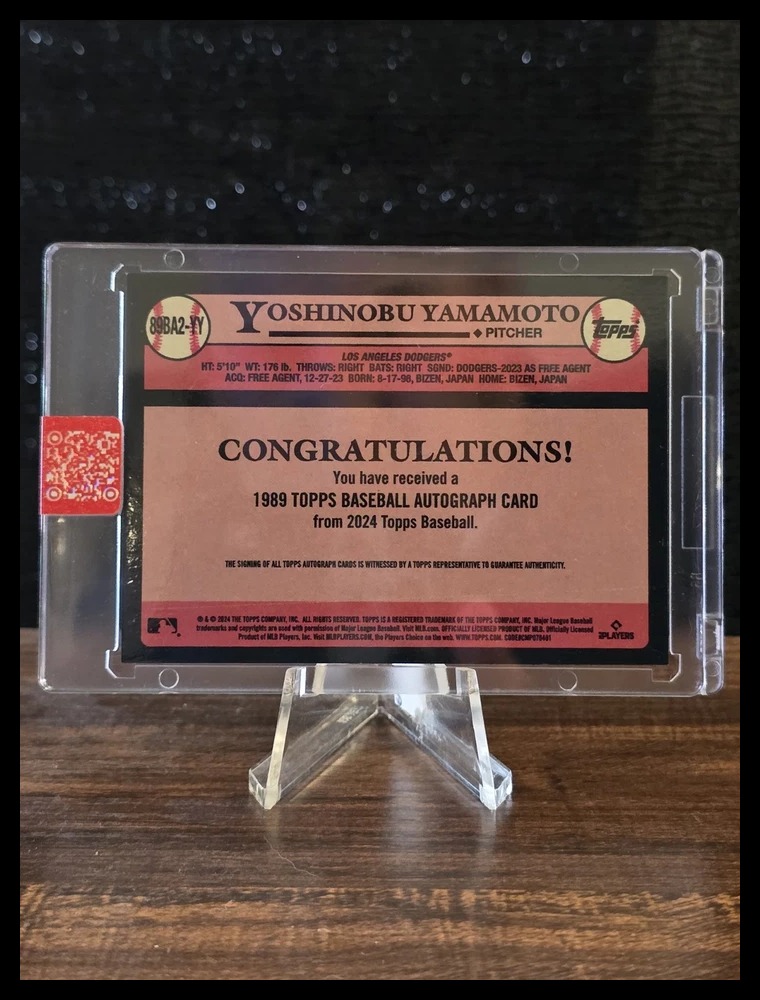
This card was first released in 2024 as part of the 2024 Topps 1989 Autograph Series 2, a commemorative set celebrating the 35th anniversary of the original 1989 Topps Baseball line, distributed by Topps in the United States[1].
- Yamamoto's autograph card is considered a rookie card (RC) despite some sources listing it as non-RC, as it features his first on-card autograph in an MLB product[1][4].
- A graded 10 graded copy sold for $650 in early 2026, with a graded 10 Black version reaching $4,225[1].
- An graded 10 graded copy was sold for $415 in May 2026, highlighting strong demand for top-grade examples[1].
Rarity and print run
- Tier
- Rare
- Print run
- Medium
- First printed in
- 2024 Topps 1989 Autograph
- Demand
- High
- Supply
- Low
- Autograph rarity due to limited on-card signings
- Rookie designation increases collector interest
- Black and Red variants are more scarce than standard version[2][6]
Collector notes
Condition. Key flaws include autograph ink smudging, off-center printing, and surface scratches on the card front. Check for creases, especially near corners, and ensure the autograph is fully legible without fading[1].
Storage. Store in a rigid, top-loading card holder or magnetic one-touch case. Keep away from humidity and direct sunlight. Use a UV-protected sleeve for long-term display to prevent fading[1].
Authenticity. Fakes often have blurry or inconsistent autograph ink, misaligned card borders, and lack official Topps holograms or certification labels. Verify the card number (#89BA2-YY) and compare with verified graded/graded/graded copies[1].
Sources: sportscardspro.com, toywiz.com, fanaticscollect.com, facebook.com, sportscardinvestor.com