Market outlook
Stable Outlook 8/10
This card has enduring demand as a vintage Hank Aaron flagship issue, but it is also a well-known, relatively liquid card with enough supply in lower grades to keep prices from spiking dramatically absent broader vintage market strength.
Next months. Likely to remain steady to moderately firm, with best results for cleanly centered high-grade copies.
Long term. Expected to appreciate gradually over time, especially in strong grades, as vintage Hall of Fame collector demand continues and high-grade population scarcity supports pricing.
History
Hank Aaron (Henry Louis Aaron, 1934-2021) was one of the greatest baseball players in history, best known for his legendary power-hitting, consistency, and long career that culminated in breaking Babe Ruth's career home run record. Nicknamed 'Hammerin' Hank,' Aaron became a cultural icon well beyond baseball because of his quiet perseverance, excellence under pressure, and enduring impact as a Hall of Famer and civil rights-era figure.
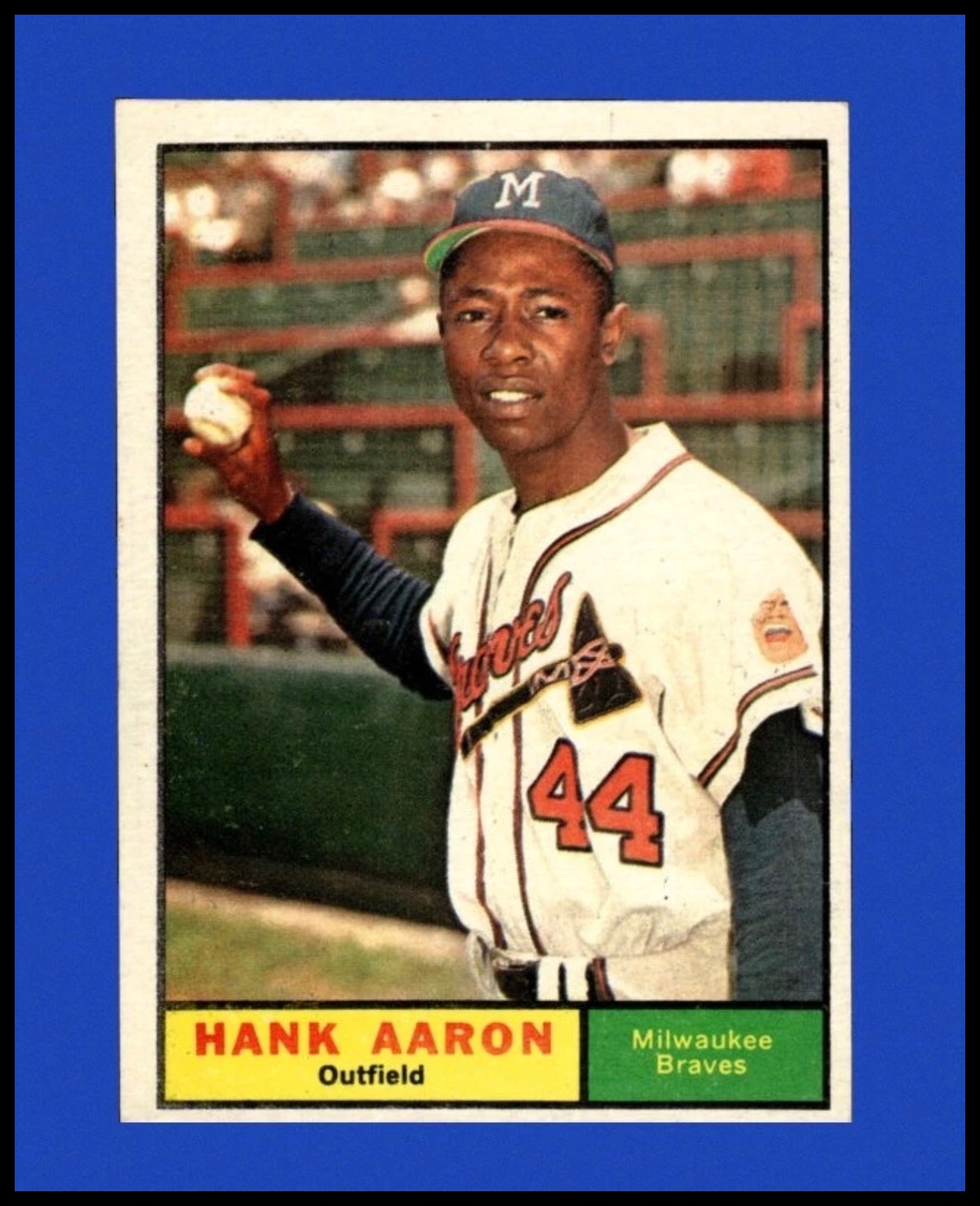
First released in 1961 as part of the Topps Baseball series in the United States, produced for the 1961 baseball card market and distributed through wax packs and related retail channels. Card #415 is Aaron's base Topps card from that year and is one of the key Hall of Fame singles from the set.
- 1961 Topps #415 is one of the most collected Hank Aaron cards due to the iconic portrait design and Hall of Fame importance.
- Aaron's 1961 Topps issue is a mainstream vintage key from the early 1960s and is widely recognized as a core Blue-Chip baseball card.
- High-grade examples are strongly affected by centering, print quality, and corner wear, with graded 8/9 copies attracting major collector attention.
Collector notes
Condition. Check centering carefully, as 1961 Topps cards are notorious for off-center fronts and backs. Look for sharp corners, clean borders, no surface print snow, no wax staining, no creases, and strong color on the portrait. Edge chipping is common on vintage Topps, and the gray card stock can show corner touches quickly. Missing color, registration issues, and back wear can materially affect grade and value.
Storage. Store in a penny sleeve and rigid holder or top loader, ideally inside a semi-rigid card saver for submission. Keep the card in a cool, dry, stable environment away from sunlight and humidity. For long-term preservation, use archival-quality supplies and avoid frequent handling by the edges only. Vintage cards should never be exposed to tape, stickers, or adhesive holders.
Authenticity. Authentic 1961 Topps cards should show period-correct stock, printing patterns, and aging consistent with a 1961 issue. Be cautious of reprints with overly crisp color, modern gloss, or artificially aged surfaces. Examine print dots under magnification, card stock thickness, and back print alignment. Grading by graded, graded, graded, or graded can help confirm authenticity and identify trimming or alteration.