Market outlook
Rising Outlook 8/10
The trend is rising due to Shohei Ohtani's continued MVP performances, growing global popularity, and the scarcity of high-grade rookie cards. Market data shows consistent price increases over the last 30 days (+35.9%)[1][3][5].
Next months. Next 3-6 months: Continued upward trend with potential price increases of 10–20% as demand for top-grade copies grows[1][5].
Long term. 1-3 years: Strong appreciation expected, with graded 10 copies potentially reaching $10,000+ due to Ohtani's legacy and global impact[3][5].
History
Shohei Ohtani is a Japanese professional baseball player who became a two-way star as both a pitcher and outfielder, playing for the Los Angeles Angels in MLB. He gained international fame for his record-breaking hitting power and pitching velocity, and was the first Japanese player to win the MLB Rookie of the Year Award (2018) and later the MVP Award (2024). His impact on baseball culture and global interest in the sport is unprecedented[1][2].
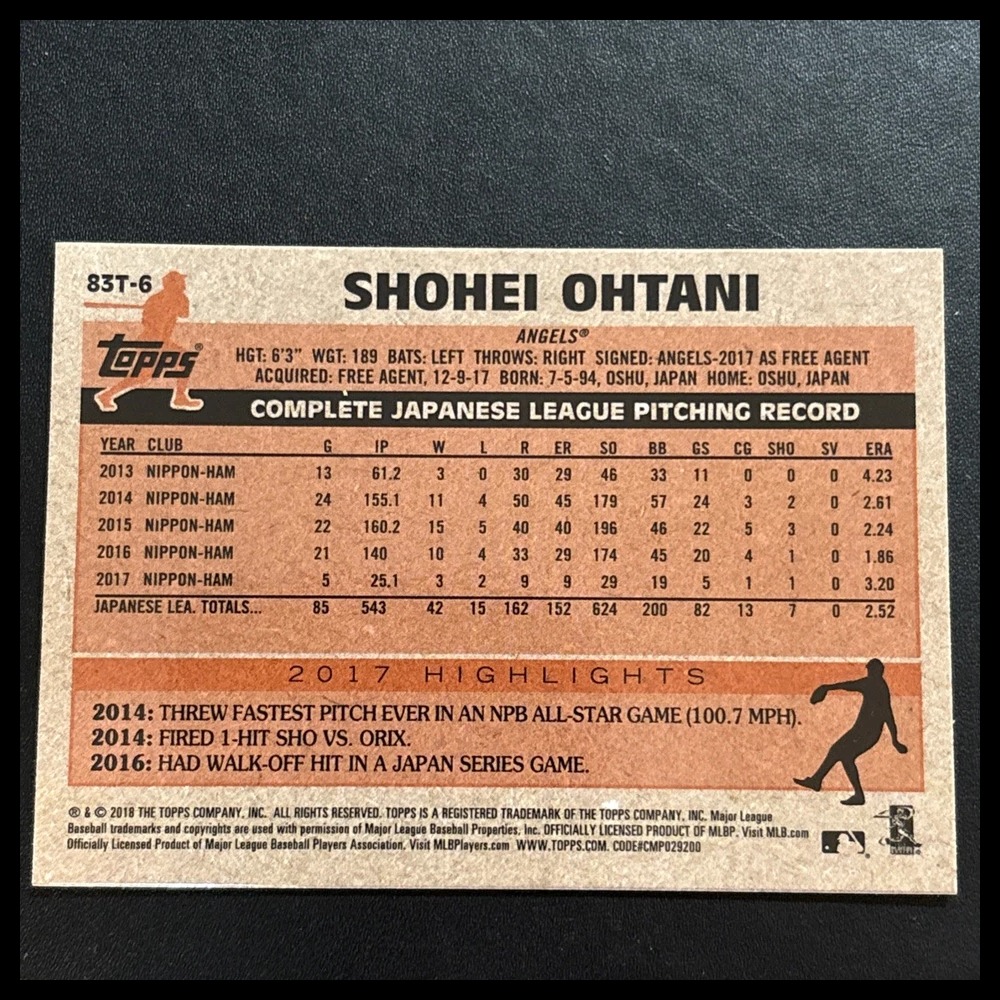
This card was first released in the United States in 2018 as part of the 2018 Topps Chrome 1983 set, specifically as a rookie refractor insert card for Shohei Ohtani[1][2].
- It is Shohei Ohtani's official rookie card in the 2018 Topps Chrome 1983 set, commemorating his debut season in MLB[1].
- The card features a refractor finish (Chrome variant), making it visually distinct and more collectible[2].
- A graded 10 graded copy of this card has sold for $6,600, and a graded 9 for $1,900, indicating high value for top grades[3].
Rarity and print run
- Tier
- Ultra Rare
- Print run
- Low
- First printed in
- 2018 Topps Chrome 1983
- Demand
- High
- Supply
- Scarce
- It is a rookie refractor insert card with a low print run, making it inherently scarce[1][2].
- The chrome/refractor finish is prone to micro-scratches, reducing the number of high-grade copies available[2][4].
- Shohei Ohtani's status as a two-way star and MVP further increases demand for his rookie cards[1][2].
Collector notes
Condition. Key flaws to check include centering issues, edge wear, surface scratches, and refractor coating damage. The chrome/refractor finish is prone to micro-scratches that reduce value significantly. Also verify that the card is not a reprint by checking for original product packaging markers[2][4].
Storage. Store the card in a rigid, non-acidic holder (like a top loader) and keep it in a climate-controlled environment away from humidity and direct sunlight. Use a card sleeve inside the top loader for added protection. Avoid stacking cards without protection[4][6].
Authenticity. To spot fakes, check for original product packaging references (e.g., 'CARD CAME FROM THIS PRODUCT' with hobby pack link[2]), verify the holographic refractor pattern is consistent, and look for accurate printing details. Authentic cards will have a graded or graded certification number if graded. Reprints may lack these markers or have inconsistent colors[2][4].
Sources: sportscardinvestor.com, youtube.com, psacard.com, sportscardspro.com, reddit.com