Market outlook
Stable Outlook 8/10
The card remains a core blue-chip Pokémon collectible, with enduring demand and established grading-market liquidity. Original Base Set versions should hold steady to gradually rise over time, while modern reprints usually move more with general nostalgia cycles than true scarcity.
Next months. Likely stable to slightly rising for authenticated, well-graded original Base Set copies; modern 25th Anniversary reprints should remain comparatively accessible.
Long term. Original Base Set Charizard copies in strong grades are likely to appreciate gradually, with top-condition and correct-printing examples maintaining the strongest demand.
History
Charizard is the final evolution of Charmander and one of the original 151 Pokémon introduced in Generation I. It became the signature fire-type mascot of the franchise's early era, known for its dragon-like design, powerful attacks, and enduring popularity among collectors and players. The Base Set Charizard artwork is especially iconic because it was illustrated by Mitsuhiro Arita and helped define the visual identity of early Pokémon TCG cards.
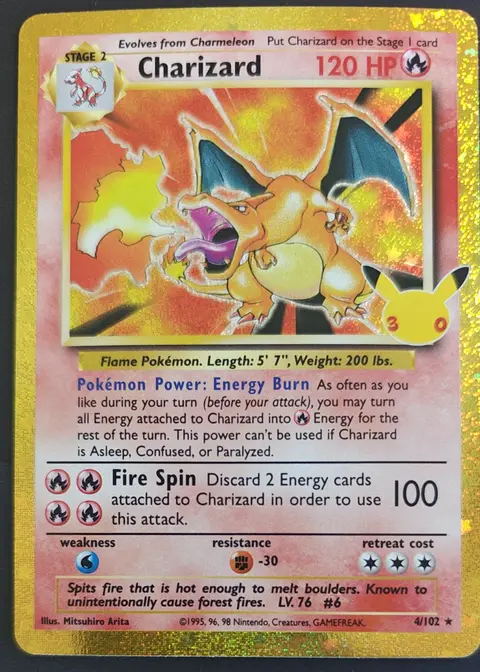
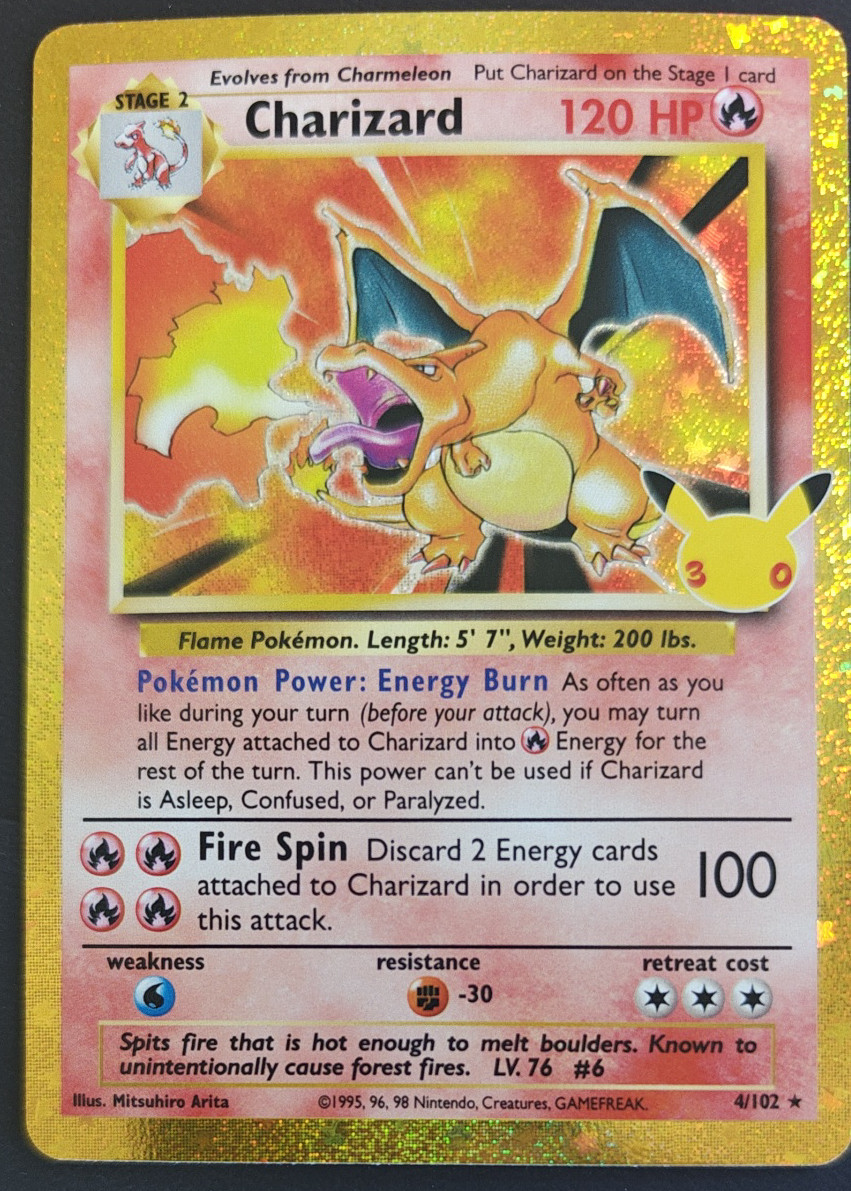
The original English printing of Charizard #4/102 appeared in the 1999 Pokémon Base Set released by Wizards of the Coast in North America. The base card was later reprinted in multiple English Base Set printings and as a 25th Anniversary-era reissue in Celebrations.
- Base Set Charizard #4/102 is one of the most famous Pokémon cards ever printed and remains a flagship collectible for the hobby.
- The original Base Set card exists in multiple printings, and identifying the correct printing is critical because values differ dramatically by version.
- The 25th Anniversary stamp indicates the Celebrations reissue, which uses the same card number 4/102 but is not the original 1999 Base Set print.
Collector notes
Condition. Check for holo scratching, edge whitening, corner wear, surface dents, print lines, centering, and binder ring wear. For Charizard specifically, the holofoil is highly prone to visible scratching, and even light edge wear can materially affect grade and value. Confirm whether the card has the correct printing traits for the claimed version, since mismatched traits are a red flag.
Storage. Use a penny sleeve plus a rigid top loader or semi-rigid holder for raw copies, and store in a cool, dry, low-light environment. Avoid pressure, friction, and temperature swings. For high-value copies, consider immediate grading and long-term storage in a tamper-evident slab or archival sleeve.
Authenticity. Verify the card number, font, holo pattern, copyright line, and set-specific traits. Original 1999 Base Set printings should not be confused with the 25th Anniversary Celebrations reprint, which has a special anniversary stamp and different modern printing tells. Watch for altered cards, fake holofoil patterns, incorrect color saturation, poor card stock, off-center borders, and stamp/printing combinations that do not exist in legitimate Base Set versions.