Market outlook
Stable Outlook 7/10
The underlying collector demand for Umbreon and Gold Star cards remains strong, but the German market has limited transparent transaction data and frequent mixing of the 2007 original with the Celebrations reprint. This makes short-term pricing appear inconsistent rather than showing a clear directional trend.
Next months. Over the next 3-6 months, authenticated high-grade German POP Serie 5 examples are likely to remain firm, with sporadic sales producing wide price variation because supply is limited. Celebrations copies should remain much more affordable and liquid.
Long term. Over 1-3 years, the original 2007 card has favorable appreciation potential if the Pokémon vintage and Gold Star markets remain strong. The best prospects are professionally graded copies with strong centering and clean holo surfaces; ungraded or poorly identified listings will continue to trade at a wide discount.
History
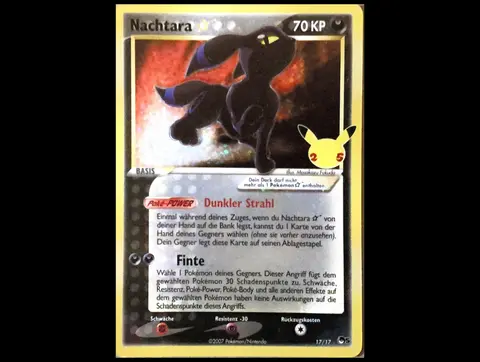
Nachtara is the German name for Umbreon, a Dark-type Pokémon introduced in Generation II. It evolves from Evoli when friendship is high at night and is associated with moonlight, nocturnal behavior, and poisonous sweat secretions. In the Pokémon Trading Card Game, Nachtara is especially popular because of its distinctive dark design and its status as one of the most collectible Evoli evolutions.
The card is the German-language version of Nachtara Star from POP Serie 5, numbered 17/17, released in Germany on March 3, 2007. The set contains 17 cards and was distributed through the Pokémon Organized Play promotional-card program.[1]
- The card is commonly identified in English-language databases as Umbreon Star or Umbreon Gold Star.
- It is numbered 17/17 and features illustrator Masakazu Fukuda.[1]
- The card has a gold-star Pokémon designation, but German catalog listings may describe its rarity as Rare or Promo rather than using the English Gold Star terminology.[1][9]
- The 17/17 number is also used by the much later German Celebrations Umbreon Gold Star reprint, so the year, set symbol, copyright line, and card layout must be checked carefully.
- Some online listings incorrectly or ambiguously describe the card as a normal rare holo; the original POP Serie 5 card is a special promotional Gold Star card.
Collector notes
Condition. Inspect front and back centering, whitening along the edges, corner wear, surface scratches, holo scratches, dents, print lines, silvering, and any creases or bends. Gold Star cards are particularly sensitive to holofoil scratching and edge whitening. Check the reverse for stains, roller marks, indentations, and discoloration. A card listed as 17/17 from 2007 should have the POP Serie 5 design and identifying details, not the Celebrations 25th-anniversary layout.
Storage. Use a properly sized archival penny sleeve followed by a rigid semi-rigid holder or a quality toploader. For high-value copies, use a card-safe graded slab or submit the card to a reputable grading company. Store upright in a cool, dry, dark environment away from sunlight, humidity, heat, PVC materials, and pressure. Avoid loose storage and do not use adhesive, tape, or non-archival plastic.
Authenticity. Compare the card against verified scans for the German POP Serie 5 17/17 version, including font, holo pattern, borders, copyright information, card thickness, texture, and reverse coloration. Check that the holofoil and ink registration look natural and that the card is not a proxy or modern counterfeit. A very low price, incorrect set symbol, unusually bright colors, weak or missing texture, overly glossy surface, incorrect back color, or mismatch between the stated 2007 release and Celebrations artwork are warning signs. For expensive purchases, use clear high-resolution photos, an established seller, a return policy, and professional grading or authentication.