Market outlook
Stable Outlook 3/10
The card is a common early-2000s base issue with steady but limited collector demand. Prices are more likely to move with broader golf-card interest, Padraig Harrington nostalgia, or grading-population attention than with true scarcity.
Next months. Likely to remain in a low-price, stable trading range with only small fluctuations for graded or high-grade copies.
Long term. Over 1-3 years, the card is likely to track general golf-card market interest and remain stable unless a broader resurgence in early-2000s golf collecting lifts demand.
History
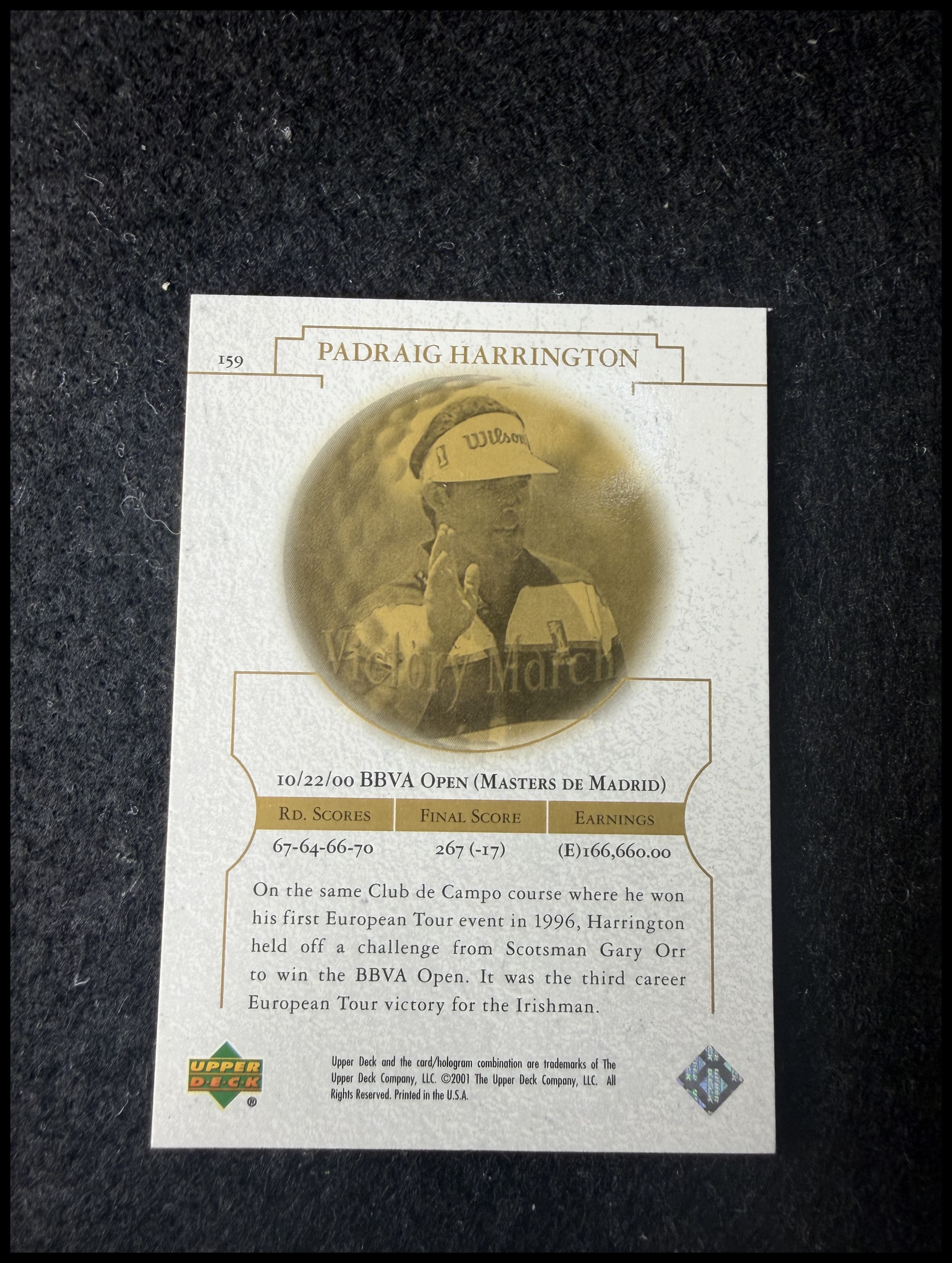
Padraig Harrington is an Irish professional golfer from Dublin, best known for becoming one of the leading European golfers of his era and later winning major championships including The Open Championship and the PGA Championship. In the context of early-2000s golf card collecting, his 2001 Upper Deck Golf rookie-era base card reflects his emergence onto the international pro golf stage and the broader surge in golf-card production driven by the Tiger Woods boom.[3][4]
This card was first released in the 2001 Upper Deck Golf base set, distributed in hobby/rack pack product formats in 2001.[3][4]
- Card number 159 is part of the 2001 Upper Deck Golf base checklist, where Padraig Harrington is listed as a rookie card (RC) in the set checklist.[4]
- 2001 Upper Deck Golf was a large-format release with a broad checklist and multiple inserts, including guaranteed Tiger Woods content in rack packs, which increased overall collector attention to the product.[1][4]
- Padraig Harrington cards from this year have recorded auction activity, indicating ongoing collector interest in his early-career issues.[2]
Collector notes
Condition. Check for centering, sharp corners, clean edges, and surface gloss, as early-2000s Upper Deck stock can show edge wear and minor print defects. Base cards from this era are especially prone to corner softening, light surface scratches, and factory print lines.
Storage. Store the card in a penny sleeve and rigid top loader or semi-rigid holder, keep it away from humidity and heat, and avoid repeated handling of the glossy surface. For long-term preservation, use archival-quality storage and keep it flat to prevent warping.
Authenticity. Authenticity is usually straightforward because this is a standard mass-produced base card. Verify the exact card number, photo, printing quality, and stock texture against known originals; obvious signs of fake/reprint issues would include blurry text, off-color printing, incorrect gloss, or inconsistent trimming.