Market outlook
Rising Outlook 7/10
Demand for vintage Hall of Famers remains strong, and premium-condition copies of 1970 Topps cards continue to benefit from scarcity in high grades. Lower-grade copies should stay liquid but largely track the broader vintage market rather than surge dramatically.
Next months. Expect stable to slightly higher prices for graded copies, with the strongest movement in graded 8-9 examples.
Long term. Likely gradual appreciation, especially for well-centered, high-grade slabs; raw low-grade copies should remain common and relatively affordable.
History
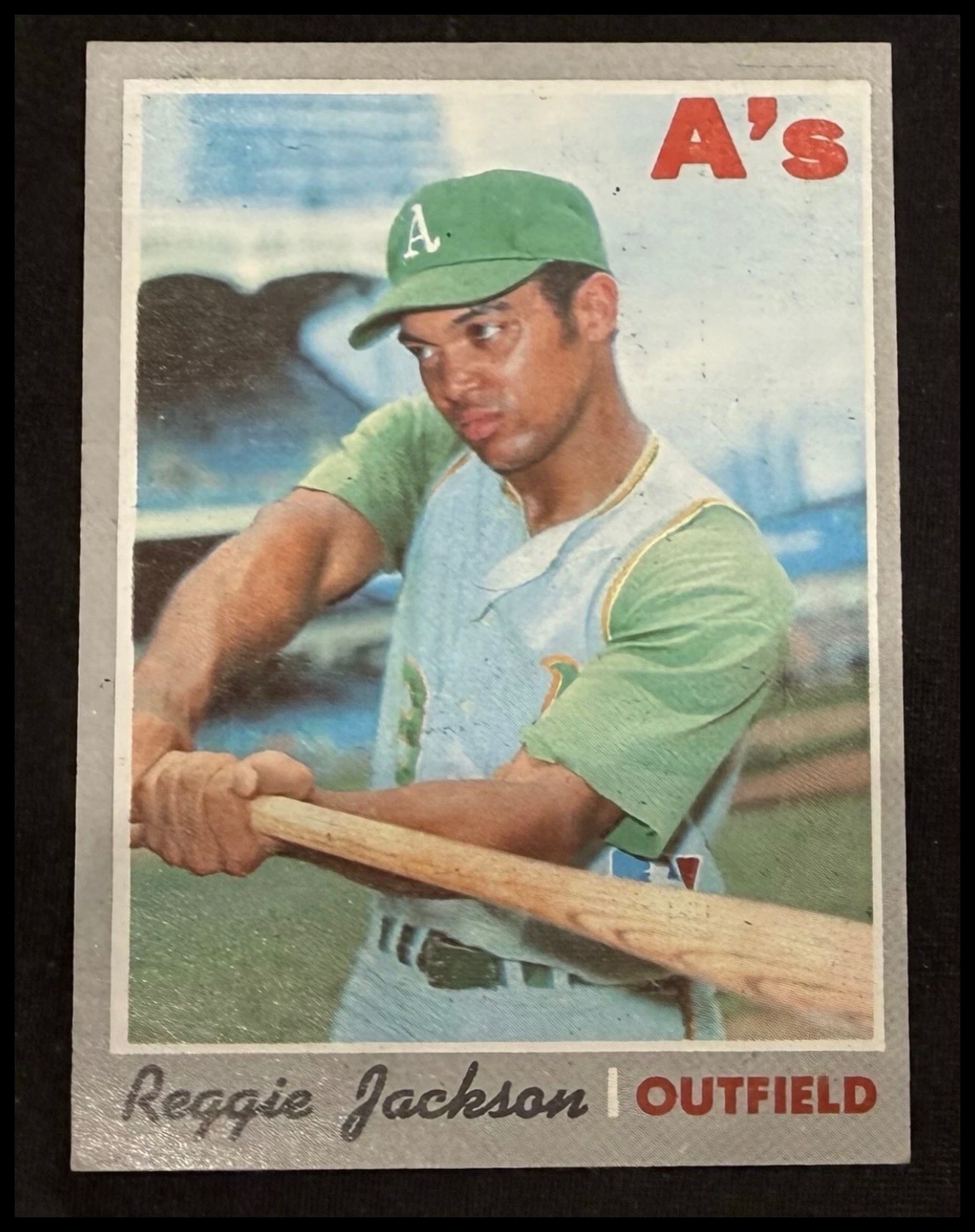
Reggie Jackson is a Hall of Fame right fielder known as one of baseball’s greatest power hitters and a defining postseason star, earning the nickname “Mr. October” for his clutch October performances. He was born in 1946, signed with the Kansas City/Oakland Athletics organization as a teenager, debuted in the majors in 1967, and by 1970 had become one of the sport’s premier young sluggers with the Oakland Athletics.
First released in the 1970 Topps Baseball set in 1970, distributed in wax packs and hobby channels in the United States as part of Topps’ annual flagship baseball card issue.
- This is Reggie Jackson’s second Topps base card and one of the key early-career cards for Hall of Fame collectors.
- The card is #140 in the 1970 Topps Baseball checklist and pictures Jackson as an Oakland Athletics player.
- 1970 Topps cards are well known for centering issues, making high-grade examples harder to find than the raw population suggests.
Collector notes
Condition. Check centering carefully first, since 1970 Topps is notorious for off-center examples. Also inspect corner sharpness, edge wear, surface print defects, wax staining, and any front or back creases; the dark borders and off-white stock can make wear easy to spot.
Storage. Store in an acid-free sleeve and rigid holder or top loader, keep it away from humidity, direct sunlight, and heat, and avoid frequent handling. For higher-grade copies, use penny sleeve plus semi-rigid holder or slabbed storage to preserve corners and surface.
Authenticity. Authentic cards should match the standard 1970 Topps card stock, size, print texture, and aging characteristics. Watch for overly glossy surfaces, suspiciously sharp modern paper, incorrect back stock tone, misaligned fonts, or reprint characteristics; third-party grading is the safest route for higher-value copies.