Market outlook
Rising Outlook 7/10
The market trend is rising due to the increasing popularity of ONEPIECE, the card's unique Alt Art variant, and the high value of the manga variant, which suggests potential for appreciation in the standard Alt Art version[2][3].
Next months. In the next 3-6 months, the price is expected to remain stable with a slight upward trend, driven by new acquisitions and competitive play demand[2][4].
Long term. Over the 1-3 year period, the price is likely to rise significantly, especially if the manga variant continues to appreciate and the standard Alt Art becomes more sought by collectors[2][3].
History
Sakazuki, also known as Akainu, is a central character in the ONEPIECE universe, serving as the Fleet Admiral of the Marines. He is infamous for his extreme sense of justice, ruthless tactics, and the Bōryoku Hell attack that destroyed much of the island of Lets. His role as a Navy Admiral and his pursuit of the remnants of the Gul Imperial highlight his significance as a primary antagonist and a symbol of uncompromising authority[1][2][3].
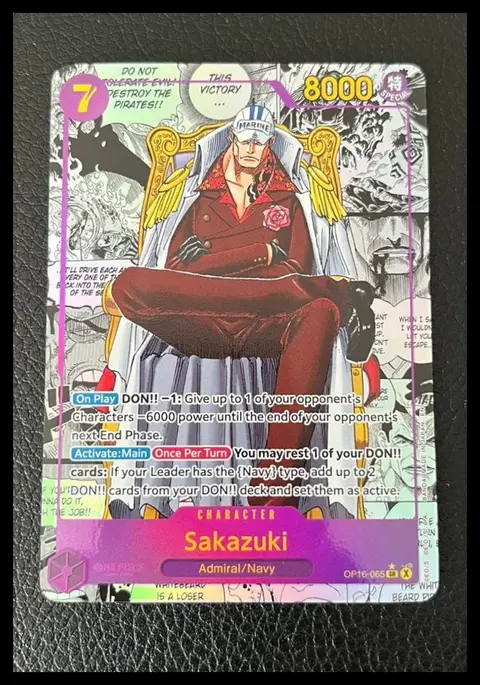
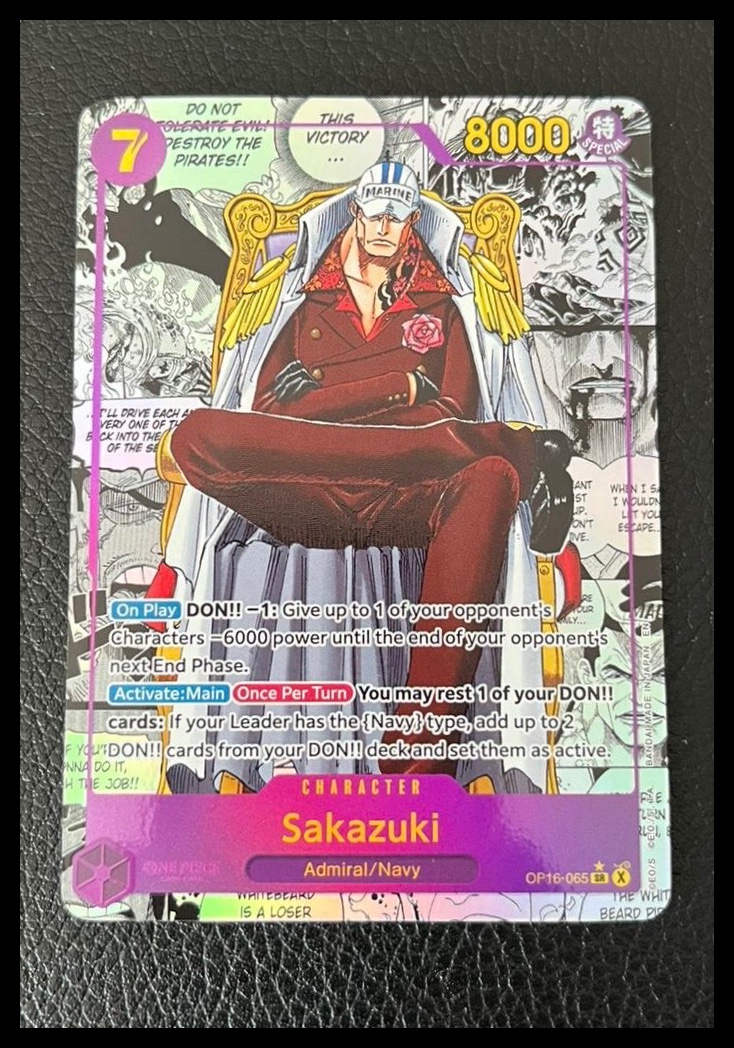
This specific Alternate Art version of Sakazuki (OP16-065) was first released in the ONEPIECE Trading Card Game set 'The Time of Battle' (OP16) in 2025. The card is an English-language Secret Rare with an Alt Art variant, illustrated by Hayaken-sarena[1][2].
- The card features a unique Alternate Art illustration by Hayaken-sarena, distinct from the standard print[1][2].
- It has a high cost (7) and high power (8000), making it a powerful late-game character in the TCG[1][2].
- The Manga Alt Art variant of this same card is significantly more expensive, with prices reaching over $1,199, indicating a strong collector market for this variant[2][3].
Rarity and print run
- Tier
- Secret Rare
- Print run
- Low
- First printed in
- The Time of Battle (OP16)
- Demand
- Medium
- Supply
- Scarce
- The Alt Art variant is a limited print, making it scarcer than the standard version[1][2].
- The manga variant is even more rare, with significantly higher prices due to its limited production[2][3].
- The card's high cost and power level make it desirable for competitive players, increasing demand[1][2].
Collector notes
Condition. Key things to check include centering, edge wear, and surface scratches on the foil. Common flaws for Alt Art cards include printing misalignments or minor scuffs on the artwork. The foil finish can be prone to micro-scratches if not handled carefully[2][4].
Storage. Best practices include storing the card in a rigid top loader or a high-quality sleeve, then placing it in a sealed bag. Avoid exposure to direct sunlight, humidity, or extreme temperatures to prevent foil degradation and color fading[2][5].
Authenticity. Fakes can be spotted by checking the card's weight, the quality of the foil, and the clarity of the artwork. Authentication tips include comparing the card to a known genuine copy, verifying the publisher's logo, and looking for any inconsistencies in the print run numbers or holographic elements[2][4].
Sources: gamenerdz.com, onepiece.limitlesstcg.com, fujicardshop.com, tcgplayer.com, mambacollectibles.com