Market outlook
Stable Outlook 7/10
The card has established itself as a blue-chip Hall of Fame rookie, but the market is already mature and supply remains adequate in lower grades. Growth tends to come from elite-condition copies rather than broad appreciation across all grades.[1][5]
Next months. Prices for mid- and high-grade copies are likely to remain firm with occasional spikes when premium examples appear at auction.
Long term. Over 1-3 years, the card should remain a stable high-demand football rookie, with the strongest gains concentrated in graded 10 and exceptional eye-appeal copies.
History
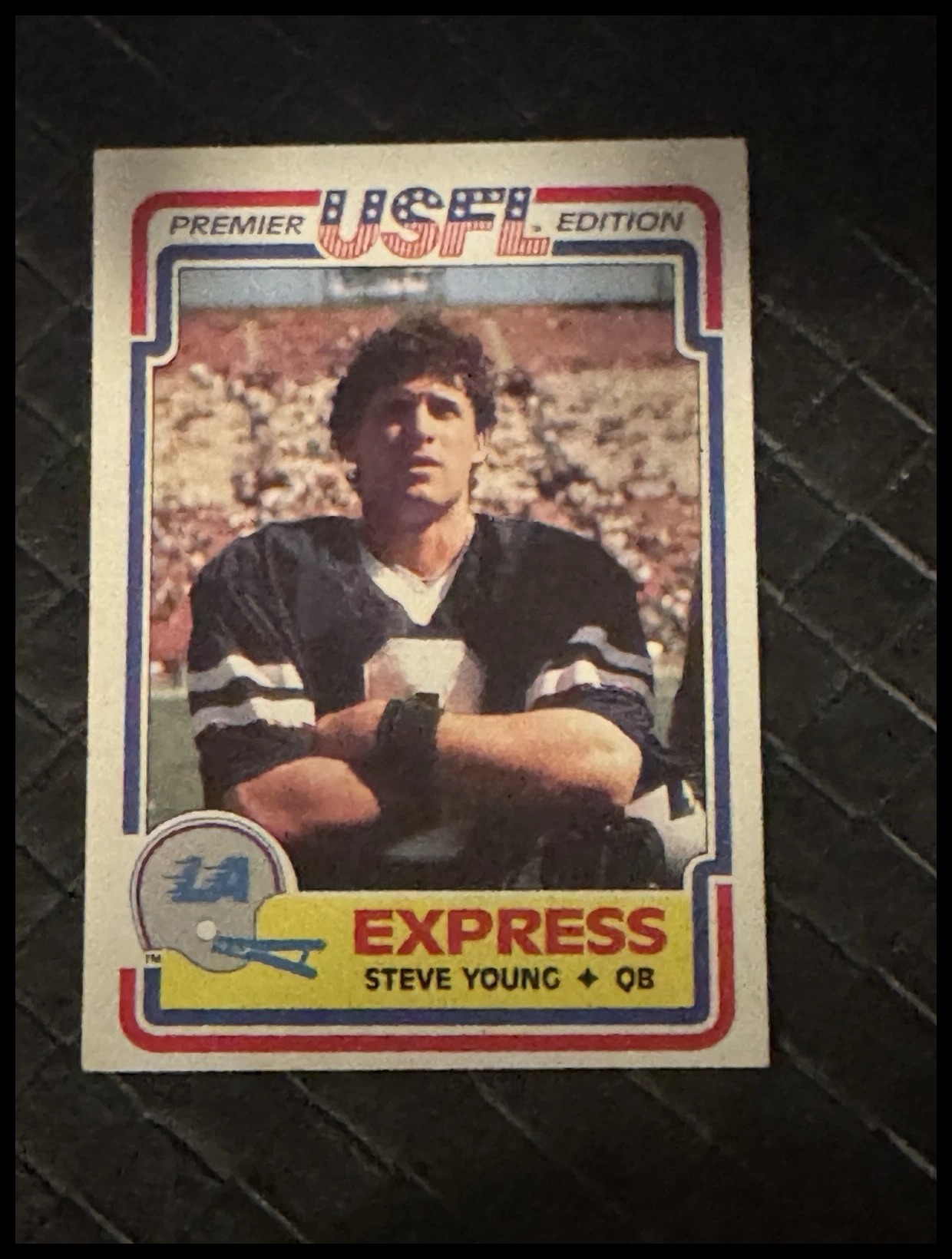
Steve Young is a Hall of Fame quarterback whose early professional career began in the United States Football League (USFL) with the Los Angeles Express before his NFL stardom with the San Francisco 49ers. Born Jon Steven Young on October 11, 1961, he became known as one of football's greatest dual-threat quarterbacks, and graded notes that he was the first professional quarterback to throw for more than 300 yards and rush for more than 100 yards in a single game while with the Los Angeles Express.[1]
This card was first released in the 1984 Topps USFL set, Topps' football product for the USFL, issued in 1984 and featuring Steve Young as card #52 from his Los Angeles Express period.[1]
- This is Steve Young's first official trading card and is widely treated as his rookie card.[1][2]
- graded's card facts page shows a population of 30 graded 10s and a graded 10 most recent price of $9,300, indicating strong demand at the top end of the market.[1]
- Auction and price-guide listings show major premium disparity by grade, with graded 10 sales reported as high as $15,616 and graded 9 values far lower, reflecting heavy condition sensitivity.[2][5]
Rarity and print run
- Tier
- Common
- Print run
- High
- First printed in
- 1984 Topps USFL
- Demand
- High
- Supply
- High
- Raw copies are widely available because the 1984 Topps USFL set was a mainstream mass-produced issue.
- True scarcity appears only in top-graded/graded examples, where centering and corner quality are difficult to find.
- As a rookie card of a Hall of Fame quarterback, demand is much stronger than the card's base rarity would suggest.[1][2][5]
Collector notes
Condition. Check centering, corner sharpness, edge wear, and surface gloss; early-1980s Topps football cards are especially sensitive to print defects, soft corners, and off-centering, and high-grade examples drive most of the value.[1][2]
Storage. Store in a penny sleeve and rigid top loader or semi-rigid holder, keep cards in a cool dry environment away from light, and use binder pages only if the card is already well protected; for investment-grade copies, consider professional grading and long-term slab storage.[1][2]
Authenticity. Authentic examples should show the original 1984 Topps USFL print characteristics and stock quality; be cautious with cards advertised as 'rookie' but altered, recolored, or reprinted. Because the card is common in raw form but valuable in high grade, verification of original print texture, edges, and slab certification is important.[1][4]
Sources: psacard.com, sports.ha.com, steinersports.com, footballcollectible.com, sportscardinvestor.com