Market outlook
Rising Outlook 7/10
The card has shown consistent price growth, with graded 9 rising 8% in the last 30 days, indicating strong market demand for high-grade copies. Limited supply of top-tier grades (graded 10) supports long-term value appreciation[1][2].
Next months. Next 3–6 months: Continued upward movement, with graded 9 likely to reach $6,500–$7,000 as demand remains strong[1][2]
Long term. 1–3 years: Steady appreciation, especially for high-grade copies, with potential to reach $8,000+ if top-tier scarcity persists and market interest in vintage baseball cards grows[1][5]
History
Nolan Ryan was a legendary American professional baseball pitcher who played 27 seasons in Major League Baseball (1966–1993). Known for his incredible speed, longevity, andrecord-breaking 5,714 strikeouts, he holds the record for most one-hundred-strikeout seasons (13) and is one of the most iconic pitchers in baseball history[5].
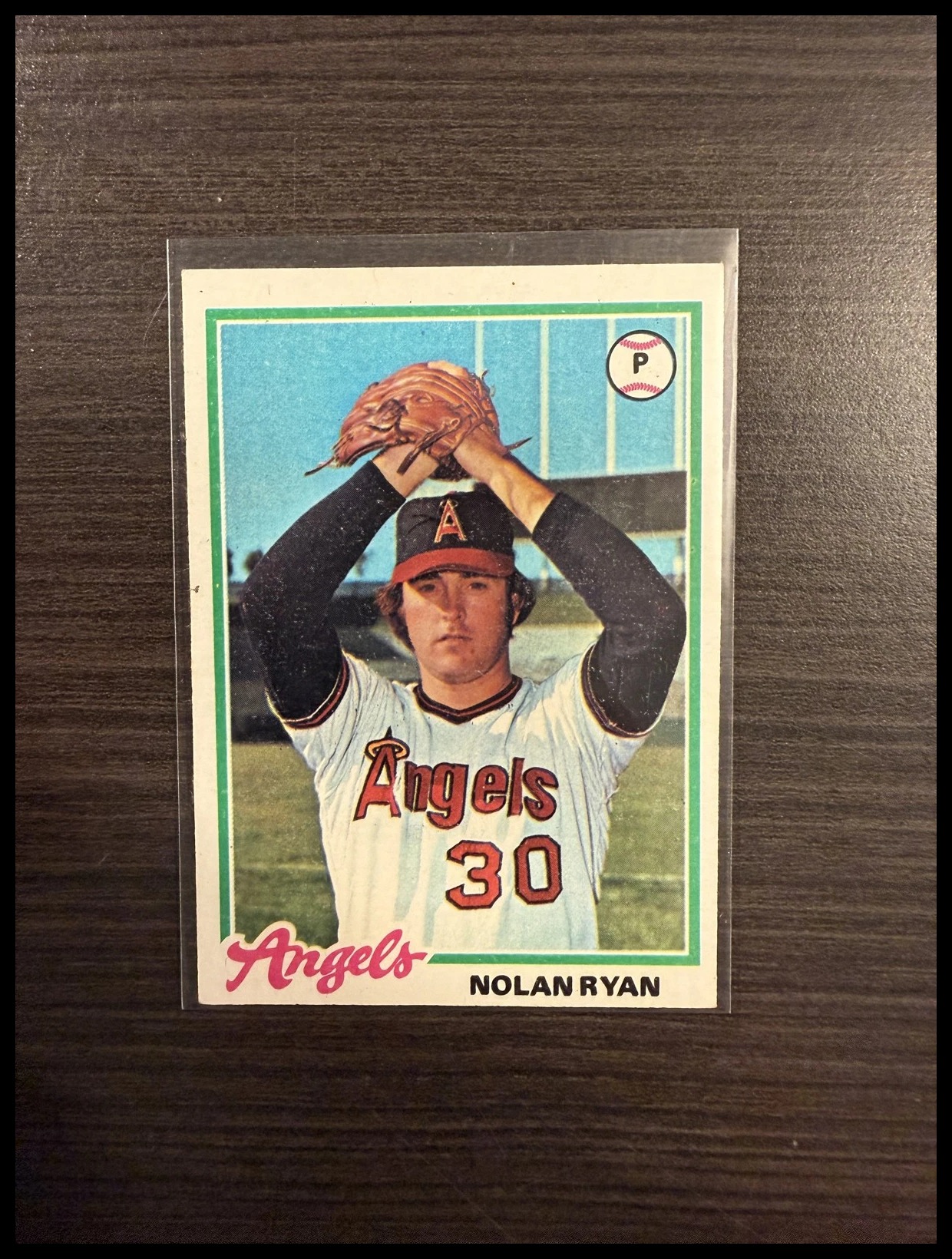
This card was first released in the 1978 Topps Baseball set, printed and distributed in the United States by Topps Company, Inc. in early 1978[1][2].
- It is one of Nolan Ryan's rarer cards from his career, commanding a premium in the market[5]
- The only known graded 10 grade of this card has been recorded, making it exceptionally rare at the highest level[5]
- The card features Ryan in his Houston Astros uniform during the 1978 season[1]
Rarity and print run
- Tier
- Rare
- Print run
- Very High
- First printed in
- 1978 Topps Baseball
- Demand
- High
- Supply
- Abundant
- Only one known graded 10 grade increases extreme scarcity at the top tier[5]
- High-grade copies (graded 9) are less common than lower grades, making them more valuable[1]
- The card is one of Nolan Ryan's rarer cards overall, contributing to its premium status[5]
Collector notes
Condition. Common flaws include off-center printing, corner wear, and edge dings. Check for centering ratios closely (ideal is 60/40 or better), and inspect corners for softening or chipping. graded grading is strict on surface quality and corner sharpness[1][3].
Storage. Store in a rigid, non-PVC plastic sleeve or holder, and keep in a climate-controlled environment away from humidity and direct sunlight. Use a top loader for ungraded copies and consider a magnetic one-touch case for graded cards[1].
Authenticity. Fakes are rare but reprints exist; authenticate by verifying the card's print texture, color saturation, and edge characteristics match original 1978 Topps cards. graded or graded certification is the best way to confirm authenticity[1][4].
Sources: sportscardinvestor.com, cardladder.com, sportscardspro.com, app.collectors.com, blog.unopenedpacks.com