Market outlook
Rising Outlook 8/10
The card benefits from Clemente’s iconic status, vintage Hall of Fame demand, and continued collector interest in cornerstone baseball issues. High-grade copies remain the main price driver, and even lower grades maintain respectable liquidity because of Clemente’s enduring popularity.
Next months. Expect steady to slightly higher pricing, with the strongest movement likely in graded 7-9 copies and well-centered, eye-appealing raw examples.
Long term. Over 1-3 years, the card should continue to appreciate gradually, especially in mid-to-high grades, as vintage Hall of Fame material remains a durable collecting category.
History
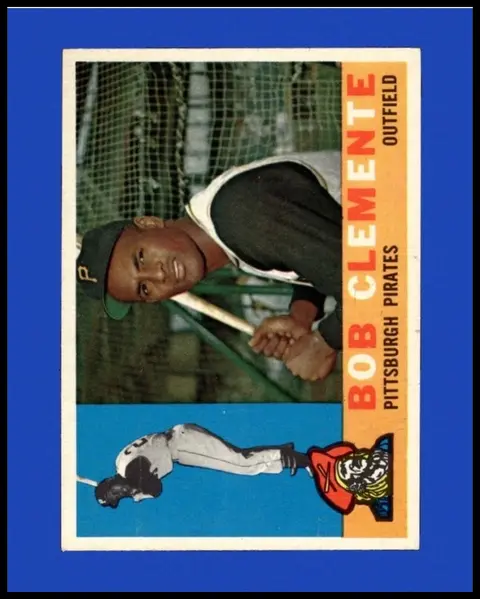
Roberto Clemente Walker was one of the greatest right fielders in baseball history and one of the most important Latin American players ever to appear on a Topps card. Born in Carolina, Puerto Rico, Clemente broke into the majors with the Pittsburgh Pirates in 1955 and became a Hall of Fame icon known for elite hitting, arm strength, defense, leadership, and humanitarian work. By the time this 1960 Topps card was issued, he was already an established star and one of the most collectible players of the era. His legacy extends far beyond statistics because of his status as a cultural trailblazer and his tragic death in a 1972 plane crash while on a humanitarian mission.
First released in the 1960 Topps Baseball set, printed and distributed in the United States in 1960 as part of Topps' annual flagship baseball card release. The card is number 326 and features Clemente as a Pittsburgh Pirates outfielder.
- 1960 Topps #326 is one of the key early mainstream cards of Clemente, issued well before his 1971 Topps card became his most famous vintage card.
- graded population data shows heavy submission volume with 8,132 total graded examples reported and no graded 10 recorded in the provided data, making high-end copies especially tough.
- Clemente’s 1960 Topps card remains a blue-chip vintage Hall of Famer card, with strong demand driven by his on-field greatness, global significance, and enduring collector appeal.
Collector notes
Condition. Centering is one of the biggest value drivers, followed by sharp corners, clean edges, good eye appeal, and strong surface gloss. Common flaws include off-centering, corner wear, print snow, wax staining, edge chipping, and surface scuffs. Because this is a 1960 Topps issue, tilt, registration, and overall print quality can vary noticeably.
Storage. Store in a penny sleeve and semi-rigid holder or top loader, then keep the card in a stable, dry environment away from light, heat, and humidity. For higher-grade copies, use archival-safe holders and avoid handling the surface directly. If graded, keep the slab protected from scratches and impact.
Authenticity. Watch for reprints and altered cards, especially if the paper stock appears too glossy, too bright, or inconsistent with 1960 Topps cardboard. Check for authentic aging, correct print texture, accurate fonts, and expected backs with proper Topps printing details. High-value copies should be authenticated and graded by graded, graded, or graded; trimming, color touch, and pressed cards are common concerns in vintage material. Compare the card stock and print quality to known authentic examples, and be cautious with unusually sharp-looking raw copies.