Market outlook
Stable Outlook 7/10
Recent tracked sales show strong but uneven pricing, with raw and graded values varying widely by grade and venue. Ohtani’s long-term popularity supports the card, but the absence of evidence for major population tightening suggests a stable-to-slightly-upward market rather than a sharp spike.[1][2][4]
Next months. Expect prices to remain volatile but generally firm, with graded 10 and equivalent gem-grade examples likely holding the strongest premiums.
Long term. Over 1-3 years, the card should remain a strong modern Ohtani chase, with the best upside in high grade examples if Ohtani continues elite performance and hobby demand stays strong.
History
Shohei Ohtani is a Japanese professional baseball player for the Los Angeles Dodgers and one of the most prominent two-way players in modern baseball history, known for elite performance as both a pitcher and hitter. His hobby significance is driven by his MVP-level career, global fanbase, and status as one of the most collectible active players in baseball cards.[1][2][6]
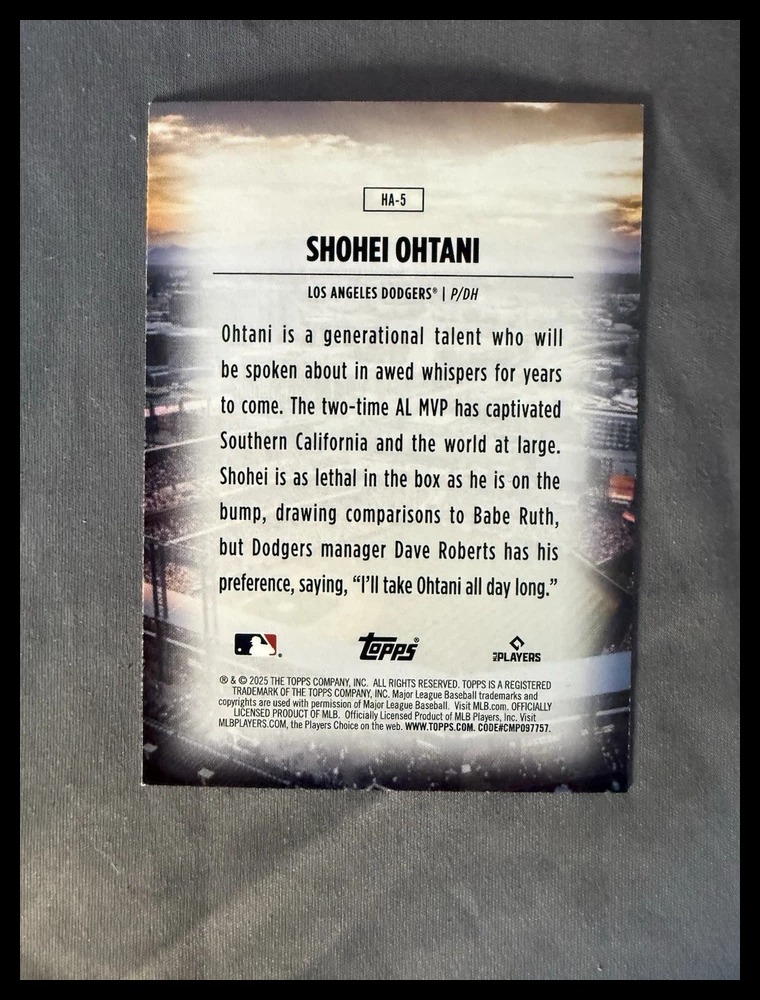
The card first appeared in 2025 Topps Series 1 as card #HA-5 in the Home Field Advantage insert set, released in 2025 by Topps.[1][2]
- #HA-5 is part of the Home Field Advantage insert line, which is treated as an SSP-style chase insert in hobby pricing data.[2]
- Market data shows the card has materially different values by grade, with graded 10 selling far above raw and mid-grade copies.[1][4]
- Collector coverage in 2025 highlighted Ohtani as one of the key chase subjects in Topps Series 1 due to his star power and the appeal of low-supply insert cards.[6]
Rarity and print run
- Tier
- Ultra Rare
- Print run
- Very High
- First printed in
- 2025 Topps Series 1 Home Field Advantage
- Demand
- Very High
- Supply
- Low
- Home Field Advantage inserts are treated as SSP-style chase cards in hobby market tracking.[2]
- High-grade copies command a steep premium, suggesting limited gem-mint supply relative to demand.[1][4]
- Shohei Ohtani is one of the most collected players in the hobby, intensifying competition for copies.[6]
Collector notes
Condition. Check for sharp corners, clean edges, centered borders, and surface issues such as print lines, dimples, scratches, or whitening. Insert cards like this commonly show edge wear from pack handling and case chipping on dark or glossy areas.[1][4]
Storage. Store in a penny sleeve and a rigid holder immediately after opening, and for higher-value copies use a semi-rigid or top loader with a clean sleeve. Keep away from heat, humidity, and friction that can create surface scratches or edge whitening.
Authenticity. Verify the exact card number #HA-5, Topps branding, and Home Field Advantage design. Counterfeits are less common for modern Topps inserts than vintage cards, but altered or re-slabbed copies can be an issue; compare print quality, font alignment, and holographic/finish consistency with known authentic examples.[1][4]
Sources: hobbyscan.com, sportscardinvestor.com, fanaticscollect.com, sportscardspro.com, youtube.com