Market outlook
Stable Outlook 6/10
Vintage 1st gen Pokémon cards have established collector bases with consistent demand. However, high supply of Jungle set cards limits dramatic appreciation. Market has matured past early speculation phases.
Next months. Expect stable pricing with minor fluctuations. High-grade graded 9+ copies may see modest appreciation. Lower grades remain stable collectibles without investment potential.
Long term. Long-term outlook depends on overall Pokemon TCG market health. Strong generational nostalgia supports stable prices, but abundant supply prevents significant appreciation. 1st Edition variants offer better long-term appreciation potential than Unlimited copies.
History
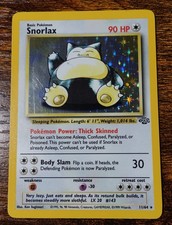
Snorlax is a Generation I Pokémon known for its massive size and love of sleeping. It represents the archetypal lazy giant creature and has been iconic since the original Red/Blue games released in 1996. The character embodies themes of rest and hibernation in the Pokémon universe.
June 16, 1999, as part of the Pokémon Jungle expansion set, the second main expansion of the Trading Card Game released after Base Set
- Snorlax #11 Jungle is among the most printed Pokémon cards from the Jungle set due to its popularity and common appearance in booster boxes
- The 1999 Jungle Set contained numerous printing errors and mistakes, including on the Snorlax card, making error variants notable to collectors
- Early printings of Jungle set cards are highly sought after, particularly 1st Edition versions with shadowless or early printing characteristics
Rarity and print run
- Tier
- Rare Holo
- Print run
- Very High
- First printed in
- Pokémon Jungle (1999)
- Demand
- High
- Supply
- Abundant
- High original print run makes most copies common in lower grades
- Vintage age (1999) provides scarcity in high grades due to condition loss over time
- 1st Edition versions are considerably scarcer than Unlimited printings
- Most copies were heavily played, making near-mint to mint grades extremely rare
Collector notes
Condition. Check for centering issues common in Jungle era cards; look for surface wear, edge whitening, and corner creases typical of heavily played vintage cards. The holographic pattern should be intact with no scratches. 1st Edition stamps can be difficult to read and verify on lower-grade copies. Be aware of common printing defects from the set itself.
Storage. Store in sleeve and top-loader away from direct sunlight and moisture. Maintain stable temperature and humidity. Avoid touching the card surface. Use archival-quality materials only. Store upright or flat in protective boxes, never in stacks with pressure applied.
Authenticity. Verify print quality and font consistency against known authentic samples. Check the card stock thickness and feel - counterfeit cards often use inferior cardboard. Examine the holofoil pattern under light - authentic Jungle holos have specific patterns. Compare the 1st Edition stamp shadow and placement. Cross-reference with graded and graded databases. Be cautious of too-perfect condition for age (over 25 years old).