Market outlook
Stable Outlook 7/10
Vintage holo demand remains steady, and Skyridge continues to attract set collectors. Pricing should remain resilient, but short-term moves are usually driven by grade availability and a few high-end sales.
Next months. Likely stable to mildly rising if strong graded sales continue and supply stays thin.
Long term. Likely gradual appreciation over 1-3 years, especially for graded 9 and graded 10 copies, while lower grades should move more slowly.
History
Houndoom is a Generation II Pokémon introduced in the Johto era, first appearing in the mainline Pokémon games as the evolved form of Houndour. In the TCG, Houndoom is valued as a Darkness-type Stage 1 Pokémon with a strong, villainous aesthetic that made it a recurring fan favorite in early-2000s sets, especially during the e-Card era.
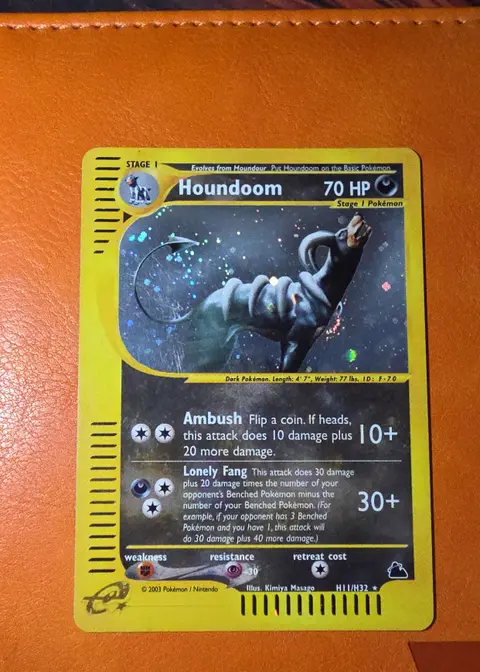
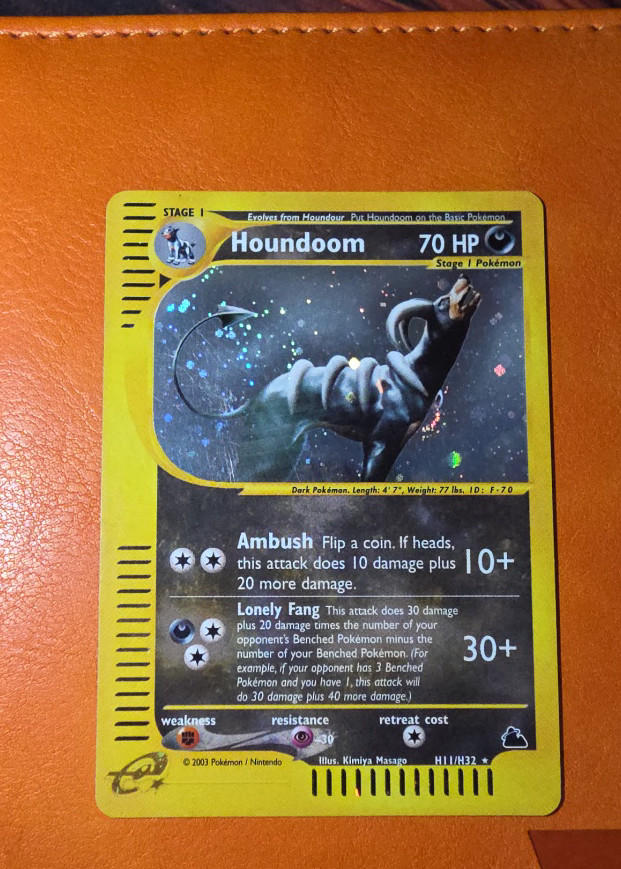
This English Skyridge Houndoom holo rare was first released in the Skyridge expansion on May 12, 2003.[1][7]
- Skyridge Houndoom exists in two separate print versions in the set: the non-holo Rare #12 and the Rare Holo #H11.[3][10]
- The card was illustrated by Kimiya Masago and is part of the final English e-Card era expansion, Skyridge.[3][7][8]
- Skyridge is a low-print, highly collected vintage set with 32 Rare Holo cards, and Houndoom #H11 is one of its chase holos.[10][14]
Collector notes
Condition. Check the holographic foil surface for scratching, print lines, edge wear, corner whitening, and centering. Skyridge holos often show surface scratching easily, and the card’s dark background makes whitening and print defects stand out.
Storage. Store in a penny sleeve and rigid top loader or semi-rigid holder, keep away from humidity and direct sunlight, and avoid repeated handling without gloves or clean hands. Use graded protection if the card is high grade or being preserved long term.
Authenticity. Verify correct set symbol, numbering as H11/H32, proper holofoil placement, font sharpness, and authentic Wizards-era stock/print texture. Counterfeits may show dull or overly glossy foil, incorrect text spacing, blurred energy symbols, or wrong card-back coloration.