Market outlook
Stable Outlook 5/10
The card has enduring vintage appeal, but it is not driven by major character hype or extreme scarcity. Prices tend to move with overall vintage Pokémon interest and grade premiums rather than sudden spikes.
Next months. Likely to remain stable with modest fluctuations based on condition, grading, and listing quality.
Long term. Likely gradual appreciation over 1-3 years, especially for high-grade copies, but not expected to outperform top-tier chase cards.
History
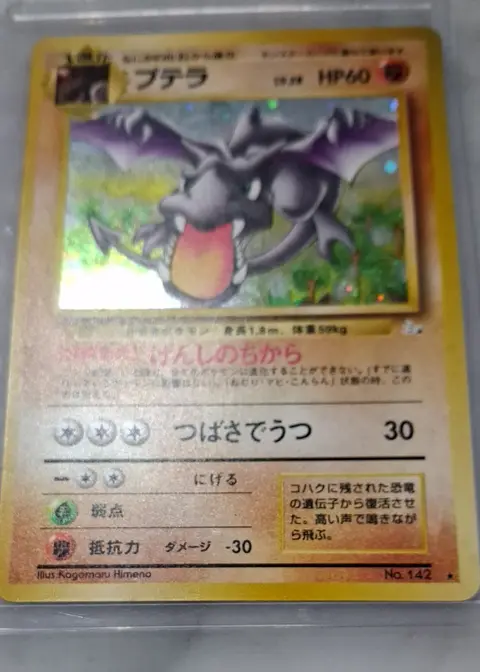
Aerodactyl is a Generation I Fossil Pokémon, known in Japanese as プテラ (Ptera). It is based on a pterosaur and is one of the franchise’s classic prehistoric creatures, introduced in the original Kanto Pokédex as National No. 142. In the games and cards, it is typically portrayed as a fierce, ancient, flying Rock-type Pokémon tied to fossil revival themes and early Pokémon worldbuilding.
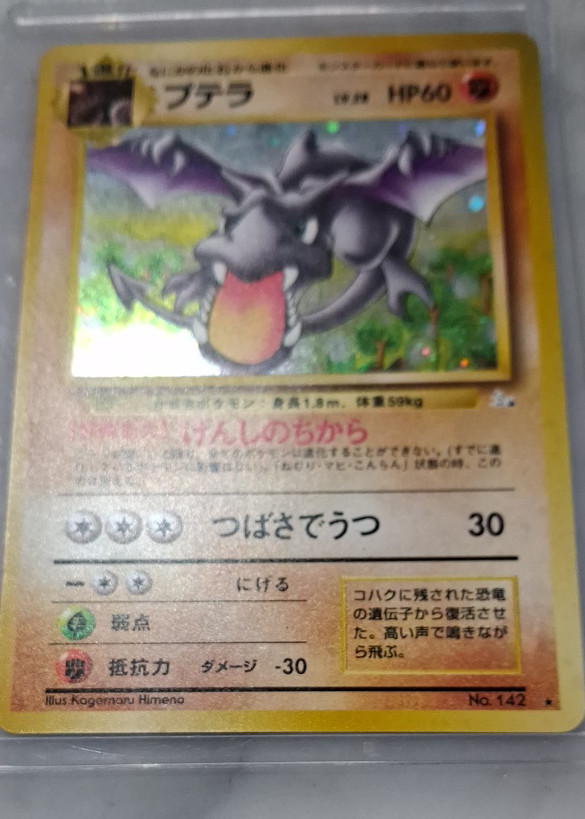
This Japanese Fossil Aerodactyl card was first released in Japan in the 1997 'Mystery of the Fossils' expansion, with a listed release date of June 21, 1997.
- Japanese name on the card is プテラ, which is the standard Japanese name for Aerodactyl.
- The card is No. 142, matching the Pokédex number for Aerodactyl.
- It is a Rare Holo card in the Japanese Fossil-era set and is one of the recognizable vintage fossil Pokémon cards.
Collector notes
Condition. Check the holofoil for scratching, edge wear, whitening, corner dings, and centering. Vintage Japanese holos often show surface scratching, print dots, and silvering/edge wear from handling. Strong examples should have clean holo, sharp corners, and minimal whitening.
Storage. Store in a penny sleeve inside a rigid top loader or graded-style semi-rigid holder, away from light, humidity, and heat. Use archival-safe sleeves and avoid friction with other cards to preserve the holo surface.
Authenticity. Authentic copies should have crisp Japanese printing, correct card number No. 142, and period-correct Fossil-era holo/stock characteristics. Fakes may show blurry text, incorrect holo pattern, overly glossy surfaces, poor color balance, or mismatched fonts and borders. Compare the card’s layout, set symbols, and Japanese text carefully against verified examples.