Market outlook
Rising Outlook 7/10
Long-term demand for iconic Mantle cards remains strong, and high-grade vintage examples continue to benefit from collector competition and limited supply. While the market can fluctuate with overall vintage sports card sentiment, Mantle’s flagship cards have historically held value well.
Next months. Likely stable to modestly higher pricing, especially for attractive mid- and high-grade graded copies.
Long term. Expected to remain a strong blue-chip vintage card with gradual appreciation over time, with the best-condition examples continuing to outperform.
History
Mickey Mantle (1931–1995) was one of baseball’s most iconic players, a New York Yankees switch-hitting center fielder whose combination of power, speed, and charisma made him a transcendent figure in American sports. A 20-time All-Star, 3-time AL MVP, and 7-time World Series champion, Mantle became one of the defining stars of the postwar baseball era. His cards remain among the most collected in the hobby because of his enduring popularity, Hall of Fame status, and the strong demand for high-grade vintage Yankees and Topps issues.
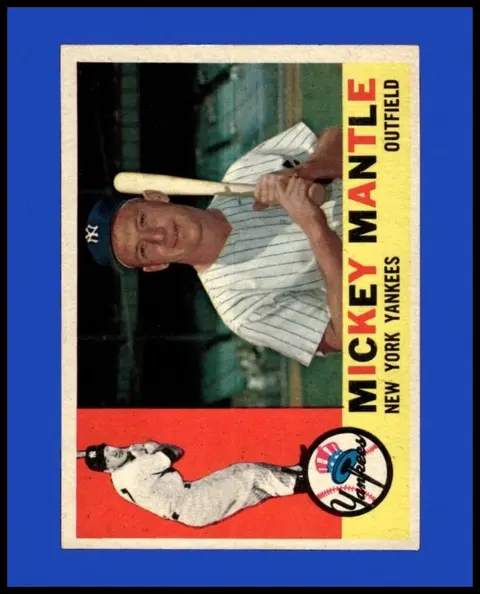
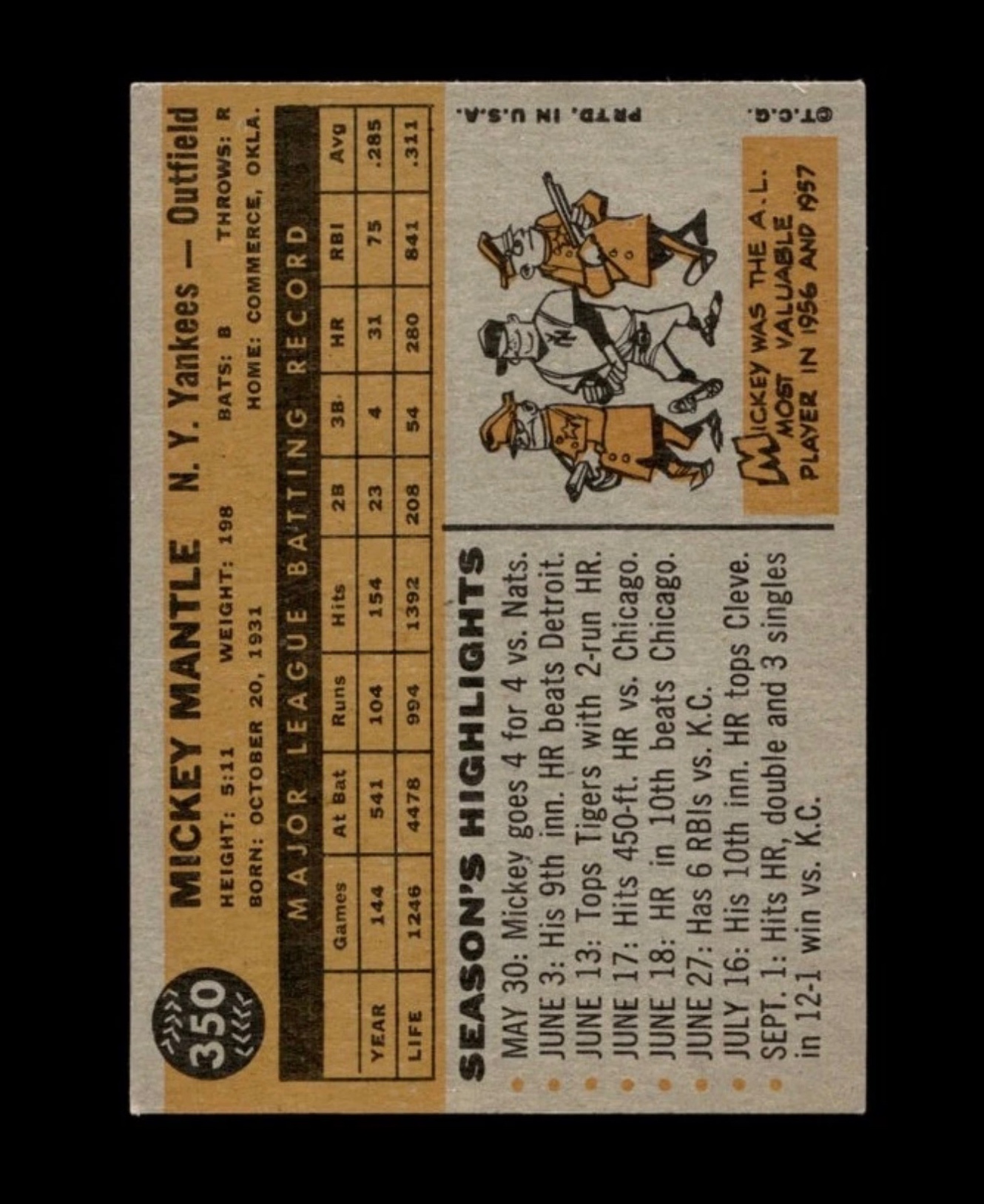
The 1960 Topps Mickey Mantle #350 was first released in 1960 as part of Topps’ 1960 Baseball set, distributed in wax packs and vending products through the U.S. card market. The card is from Topps’ full-color horizontal 1960 design and is one of the key star cards in the set.
- Card #350 is one of the major key cards in the 1960 Topps set and is highly sought after in all grades.
- The 1960 Topps issue is known for its bright horizontal design, which makes centering and edge wear especially important to collectors.
- Mantle cards from the 1950s and 1960s are among the most liquid vintage baseball cards in the hobby, with strong demand from both vintage specialists and general investors.
Collector notes
Condition. For this card, centering is a major value driver, along with sharp corners, clean edges, and strong color retention. Common flaws include off-centering, corner rounding, print spots, surface scratches, wax stains, and chipping along the black or colored borders. Because 1960 Topps cards often show wear quickly, even moderate condition examples can be highly desirable if the image and surfaces are clean.
Storage. Store in a penny sleeve and rigid top loader or semi-rigid holder for raw copies, or a graded/graded/graded holder for graded examples. Keep the card in a cool, dry environment away from light and humidity. For long-term protection, avoid repeated handling and consider a magnetic one-touch only if the card is properly sleeved first.
Authenticity. Authenticity concerns are important because Mantle cards are heavily counterfeited. Check print quality, paper stock, aging consistency, and edge wear that matches the card’s apparent condition. Reprints may have overly sharp image quality, incorrect color tone, glossy or unusual surfaces, or paper stock that feels modern. Compare the back typography, registration, and overall dimensions to known authentic examples, and when in doubt, use professional grading or authentication from graded, graded, or graded.