Market outlook
Declining Outlook 6/10
Recent price drops of -37.8% (7 days) and -2% (30 days) reflect post-hype correction in Sword & Shield sets amid newer expansions.
Next months. Continued soft prices or stabilization next 3-6 months unless reprints announced
Long term. Stable to slight decline in 1-3 years as nostalgia builds slowly but supply remains ample
History
Aerodactyl is a Rock/Flying-type Fossil Pokémon from the Pokémon franchise, first introduced in Generation I (Red/Blue, 1996). Revived from ancient DNA found in fossils like the Old Amber, it is depicted as a massive pterosaur-like creature symbolizing prehistoric power and speed, significant as one of the earliest revived Fossil Pokémon alongside Kabutops.
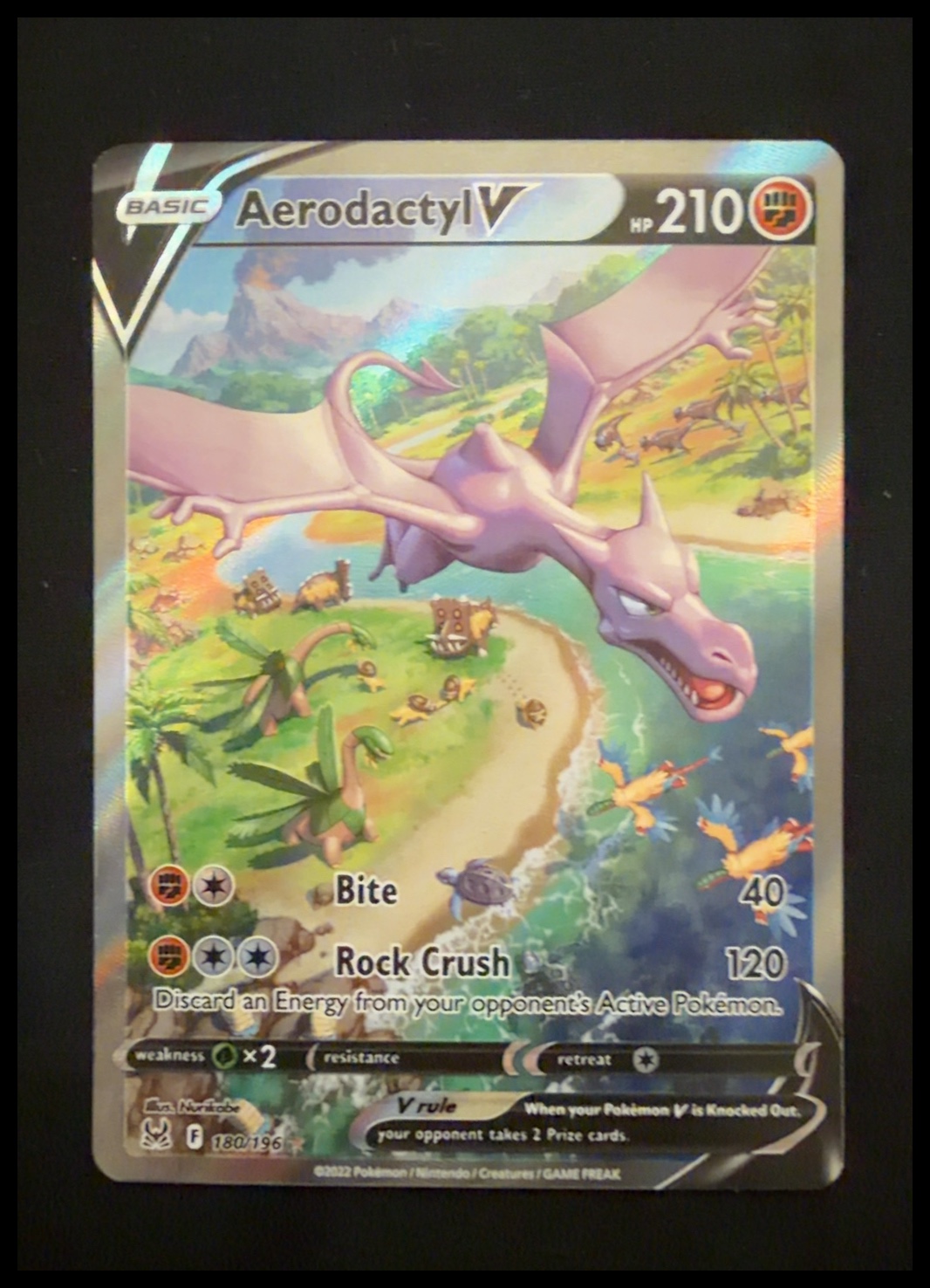
September 9, 2022, in the Sword & Shield: Lost Origin expansion set in English.
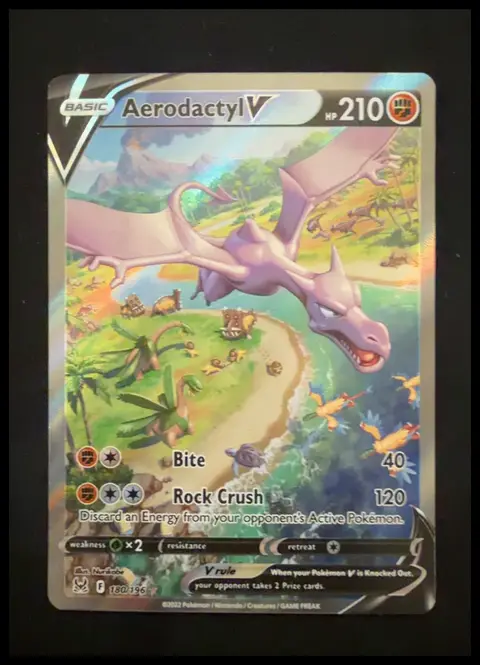
- Aerodactyl V #180/196 is the Alternate Full Art variant, prized for its stunning artwork depicting the Pokémon soaring dynamically.
- This card features Fighting-type attacks: Bite (40 damage for 1 Fighting Energy) and Rock Crush (120 damage for 2 Fighting Energy, discards a Stadium).
- Part of the Sword & Shield era's V series, emphasizing high-HP Basic Pokémon (210 HP here).
Rarity and print run
- Tier
- Ultra Rare
- Print run
- Medium
- First printed in
- Sword & Shield: Lost Origin
- Demand
- Medium
- Supply
- Medium
- Alternate Full Art variant pulls from Ultra Rare slot in Lost Origin ETB/master sets
- Chase card status boosts collector demand over standard #92/196
- No special stamps, but limited to 2022 print runs
Collector notes
Condition. Inspect centering on all edges (especially top due to holo pattern), check for print lines, surface scratches on the alt art foil, edge whitening, and corner wear; common flaws include roller marks and holo swirl imperfections.
Storage. Use semi-rigid or top-loader holders with sleeves, store in cool, dry places away from sunlight to prevent foil fading; avoid stacking without dividers.
Authenticity. Verify holo pattern consistency, font alignment, and card weight/thickness; check UV blacklight for genuine foil glow; cross-reference with official images and use graded/graded authentication for high-value copies; fakes often have blurry art or incorrect energy symbols.
Sources: sportscardinvestor.com, pricecharting.com, fancave.com, tcgplayer.com, pokedata.io