Market outlook
Stable Outlook 6/10
The card's market value remains steady due to sustained collector interest in early One Piece cards, but its Common status and high supply prevent significant price increases[1][2].
Next months. Price range will likely remain between 500–2,000 JPY for ungraded copies; graded copies may see slight increases if graded10 copies emerge[1][2].
Long term. 1–3 year outlook is stable with minimal growth; value may rise slightly if high-grade graded10 copies become scarce, but overall market remains limited by mass production[1][2].
History
Nami is the navigator of the Straw Hat Pirates in the manga and anime 'One Piece,' created by Eiichiro Oda. She is known for her intelligence, loyalty, and dream of mapping the world. Her backstory includes surviving the destruction of her home village by the pirate Arlong, which shaped her early motivation to steal treasure to buy freedom from Arlong. She later joins the Straw Hats after they free her village, and her character evolves into a beloved and essential member of the crew[1][2].
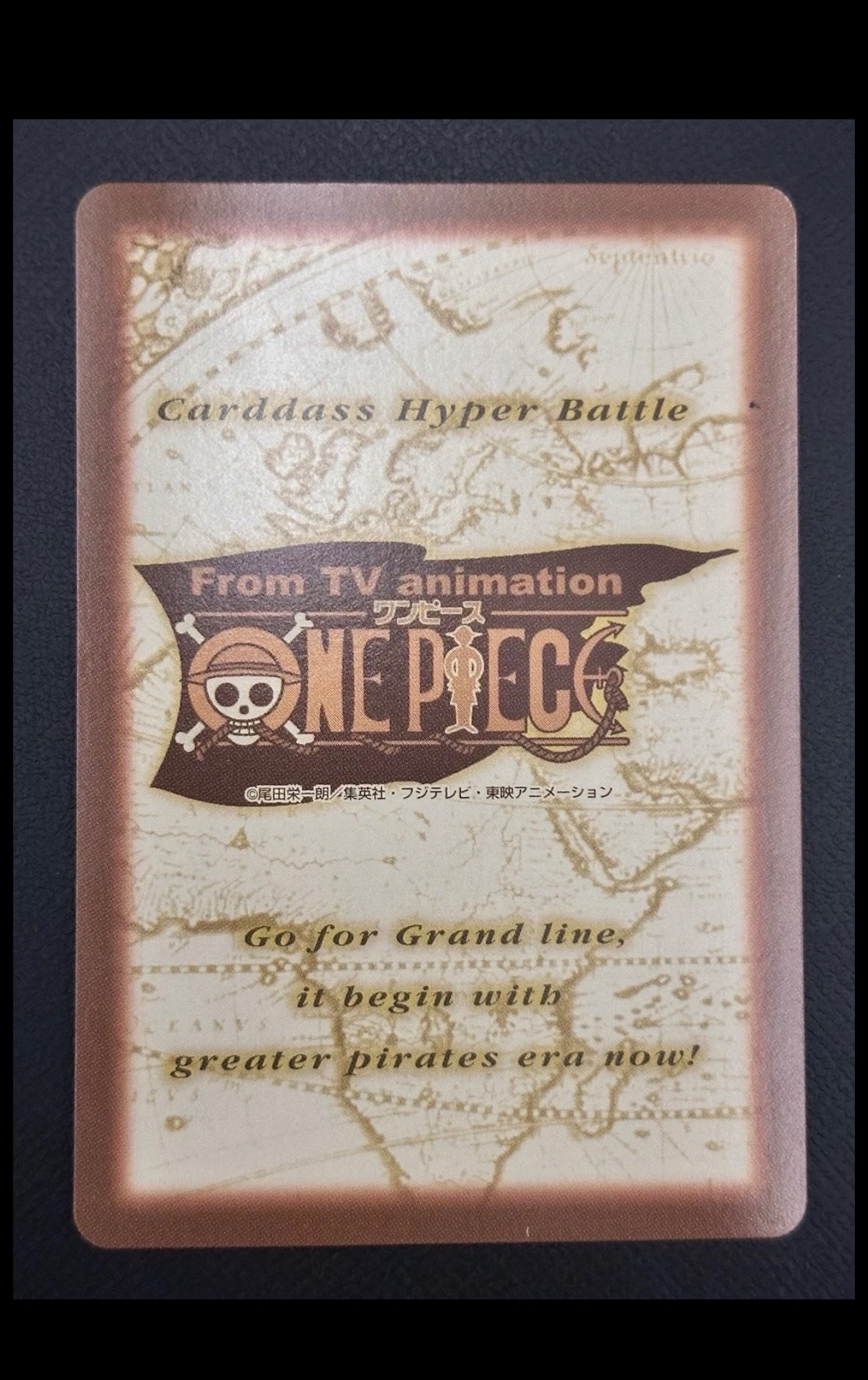
This Nami card was first released in Japan in 1999 as part of the 'One Piece Carddas Hyper Battle' set, specifically marked as S05. It is one of the earliest trading cards featuring Nami from the One Piece franchise[1][2][4].
- The card is from the 1999 'One Piece Carddas Hyper Battle' set, one of the earliest One Piece trading card releases[1][2].
- The card's text includes the phrase '海賊専門の泥棒' (Pirate-specialized thief), referencing Nami's early role[1][4].
- This is a Common rarity card, indicating it was widely produced and distributed in 1999[1][2].
Rarity and print run
- Tier
- Common
- Print run
- Very High
- First printed in
- One Piece Carddas Hyper Battle
- Demand
- Medium
- Supply
- Abundant
- Common rarity means it was widely produced in 1999
- High original print run from Carddas Hyper Battle set
- Age-related degradation reduces the number of high-quality copies
Collector notes
Condition. Key flaws include edge wear, corner creases, and surface scratches. Common issues for cards from 1999 are yellowing or fading due to age. Check for any text or image distortion, and ensure the card is not bent or dented[1][2][7].
Storage. Store the card in a rigid, non-acidic sleeve or case, preferably in a cool, dry environment away from direct sunlight. Avoid humidity and temperature fluctuations. Use a top loader or magnetic case for long-term protection[1][2].
Authenticity. Fakes may show inconsistent text, blurry images, or incorrect card stock. Reprints often have different color tones or lack the original 1999 printing marks. Authentication can be verified by comparing to known graded-certified copies or consulting official Carddas archives[1][2].
Sources: auctions.yahoo.co.jp, jp.mercari.com, cardrush-op.jp, paypayfleamarket.yahoo.co.jp, magi.camp