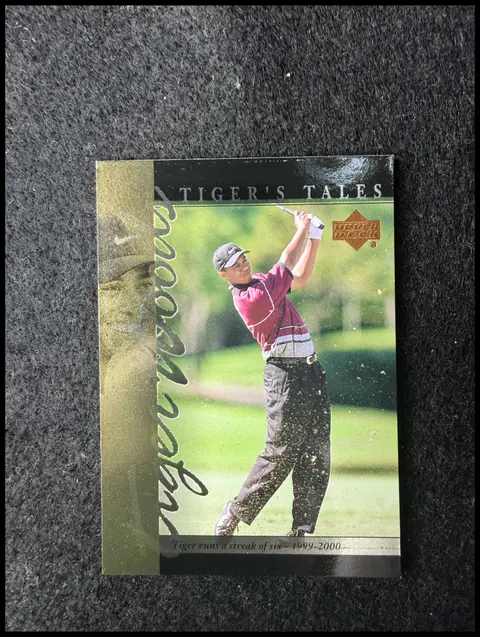
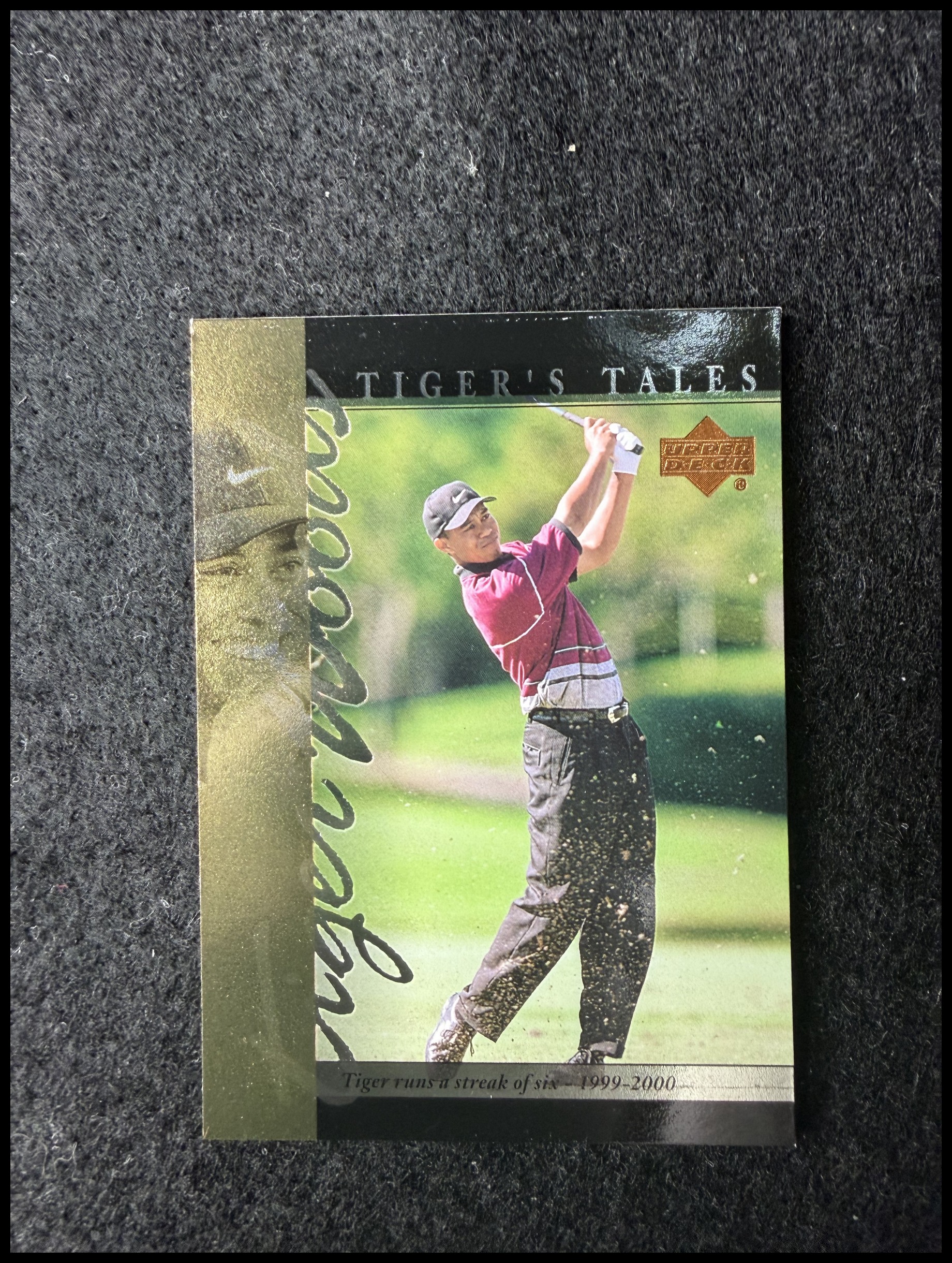
Market outlook
Stable Outlook 4/10
The card’s price profile is driven by Tiger Woods demand and grade sensitivity, but not by strong rarity pressure. That usually produces a stable market with gradual movement in top-grade examples rather than sharp appreciation for raw copies.[1][2]
Next months. Likely to remain stable, with small fluctuations tied to graded-pop reports and marketplace availability.
Long term. Top-graded examples may appreciate modestly over time, while raw copies are likely to remain low-cost and broadly available.
History
Tiger Woods is one of the most significant figures in golf history. Born Eldrick Tont Woods in 1975, he rose from a prodigy into a global sports icon, transforming golf’s popularity, media coverage, and commercial reach. By 2001, Woods was already a multiple major champion and one of the defining athletes of his era, which is why his trading cards from early-2000s golf sets remain widely collected.[1][2]
This card was first released in 2001 as card #TT20 in Upper Deck’s Tiger’s Tales golf insert set.[1][2]
- The card is cataloged as #TT20 in the 2001 Upper Deck Tiger’s Tales set.[1][2]
- SportsCardsPro lists it as not a rookie card and places it within the 2001 Upper Deck base/set family.[1]
- graded’s auction archive shows TT20 among the numbered Tiger’s Tales cards and confirms its set identity.[2]
Collector notes
Condition. Check centering, corner whitening, edge wear, surface scratches, and print defects. Insert-era golf cards from this period are often sensitive to minor corner chipping and back-surface scuffing, which can noticeably affect grade and value.[1]
Storage. Store in a penny sleeve and rigid top loader or graded slab, keep away from heat, humidity, and direct sunlight, and avoid frequent handling without clean hands or gloves. Because the card is relatively low-value raw but stronger in high grade, preserving corners and surface is especially important.[1]
Authenticity. Verify the exact back/front design, card number TT20, and 2001 Upper Deck Tiger’s Tales branding. Compare foil, print sharpness, and stock quality against known authentic examples; miscuts, blurry printing, or inconsistent card stock are warning signs. Because the card is common and inexpensive raw, altered or counterfeit examples are more likely to matter in higher-grade or slabbed copies.[1][2]