Market outlook
Stable Outlook 7/10
The card has steady Hall of Fame collector demand but very high supply, which keeps raw prices low and limits broad appreciation. High-grade graded 10 examples should remain the most liquid and retain the strongest premium.
Next months. Prices should remain relatively stable with minor fluctuations tied to grading market strength and Hall of Fame collector activity.
Long term. Likely gradual appreciation for top-graded copies, while raw and low-grade examples should remain inexpensive and highly available.
History
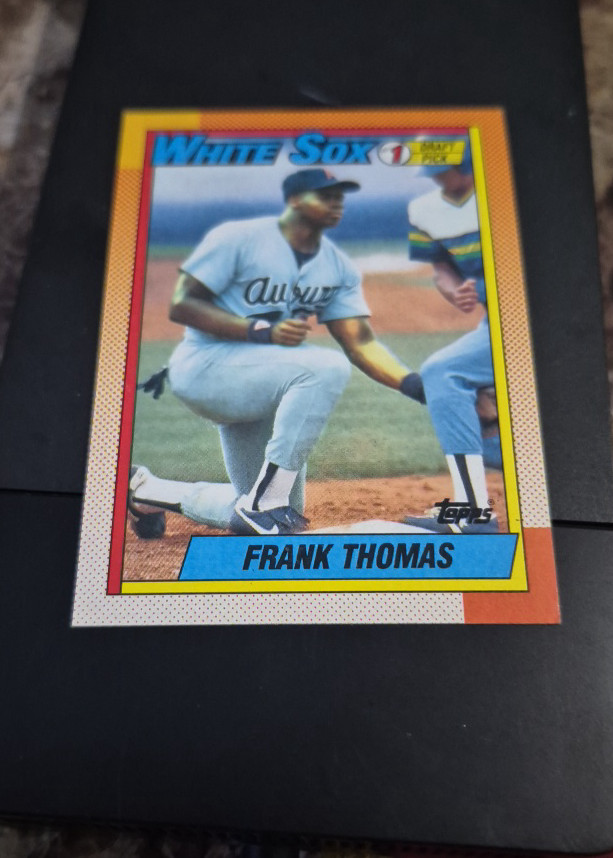
Frank Thomas, nicknamed "The Big Hurt," is one of the most accomplished right-handed power hitters in Major League Baseball history. Born in Columbus, Georgia, and raised in Georgia, Thomas became a star at Auburn University before debuting with the Chicago White Sox in 1990. He quickly established himself as an elite hitter, combining exceptional on-base ability, power, and plate discipline. He was a five-time All-Star, two-time AL MVP, and a Hall of Famer (inducted in 2014). His rookie-era cards are significant because they mark the beginning of one of the premier modern Hall of Fame runs of the 1990s.
First issued in 1990 as part of Topps Baseball Series 1, released in the United States during the 1990 baseball card production cycle and distributed through retail packs, wax packs, rack packs, and hobby cases. Card #414 is one of Frank Thomas's most recognized rookie cards from that year.
- This is Frank Thomas's flagship Topps rookie card and one of the key base rookies collectors chase from 1990.
- The card is widely available in raw form, but high-grade copies are much scarcer due to centering and condition issues common to early 1990s production.
- 1990 Topps is an extremely high-print modern-era set, so the card is generally considered a common base card rather than a scarce rookie, despite strong demand from Hall of Fame collectors.
Rarity and print run
- Tier
- Common
- Print run
- Very High
- First printed in
- 1990 Topps Baseball
- Demand
- High
- Supply
- High
- Massively printed mainstream base card
- Large surviving population in raw and lower-grade condition
- High-grade scarcity is driven more by condition sensitivity than true print scarcity
- Strong collector demand makes gem-mint copies feel scarcer than the card actually is
Collector notes
Condition. Check centering carefully on both front and back, as off-centering is one of the most common issues. Also inspect for soft corners, edge chipping, surface scratches, print dots, and wax/stain marks from pack storage. High-grade examples are especially sensitive to tilt, border wear, and color/focus quality.
Storage. Store in a penny sleeve and a rigid top loader, semi-rigid holder, or graded/graded-style slab for higher-value copies. Keep cards in a cool, dry, low-light environment away from moisture and heat. Use acid-free storage materials and avoid stacking loose cards, which can create edge and corner damage.
Authenticity. This card is widely reprinted in modern repacks and novelty products, so compare stock, gloss, borders, and print quality to known originals. Authentic 1990 Topps stock should show period-correct duller card stock, standard Topps printing, and consistent back text/layout. For higher-value graded or raw examples, compare the card number, font, copyright line, and photo resolution against verified scans. Third-party grading is recommended for valuable raw copies.