Market outlook
Stable Outlook 2/10
Available market indicators show a very low price, little recent sales activity, and plentiful retail inventory. There is no current evidence of a sustained collector premium or competitive demand spike.
Next months. Over the next 3–6 months, the card is likely to remain near bulk-Uncommon pricing, roughly ¥20–¥160 or around US$0.20–$1 depending on seller, condition, shipping, and availability. A meaningful increase would require tournament relevance, a popular Bronzong deck, or a sudden collector trend.
Long term. Over 1–3 years, the most likely outcome is stable nominal pricing with occasional minor increases as sealed product becomes less available. Significant appreciation is unlikely unless the card becomes competitively important, receives strong character-driven attention, or an unexpectedly short print supply is established.
History
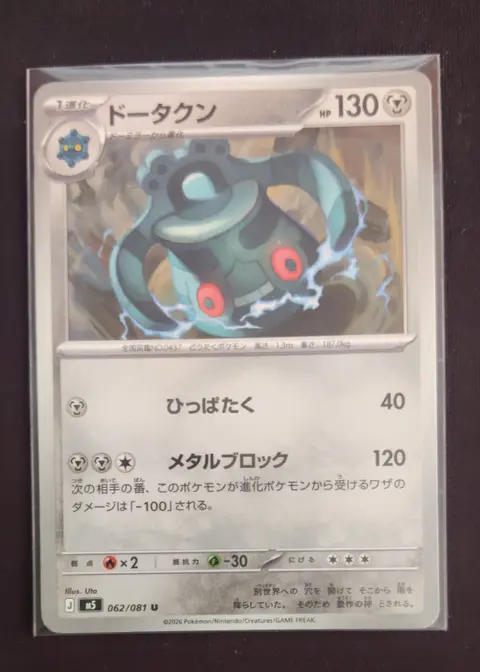
Bronzong (Japanese: ドータクン, Dohtakun) is a Steel-type Stage 1 Pokémon introduced in Generation IV. It evolves from Bronzor and is based on a bronze bell or ritual vessel; its Pokédex lore associates it with summoning rain and bringing plentiful harvests. This specific card depicts Bronzong as a Metal-type Pokémon.
This card was first released in Japan in the M5: Abyss Eye expansion, also known in some English-language references as part of the Pitch Black expansion, on May 22, 2026. It is card 062/081 and has a normal, non-holo Uncommon printing.
- The card is illustrated by Uta.
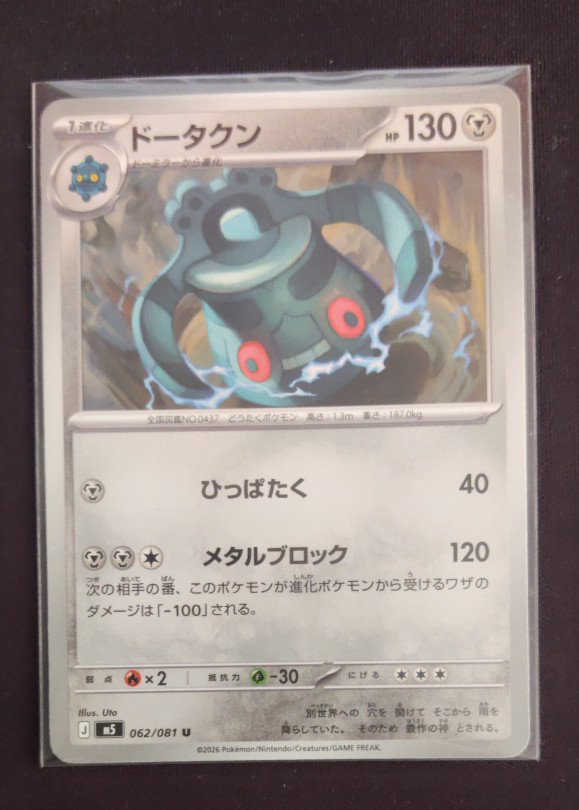
- It is a 130 HP Stage 1 Metal-type Pokémon with a Fire ×2 weakness, Grass -30 resistance, and a retreat cost of three Energy.
- Its attacks are Gentle Slap for 40 damage and Metal Block for 120 damage; Metal Block reduces damage from attacks by Evolution Pokémon during the opponent’s next turn.
- The card’s flavor text refers to Bronzong opening portals to another world and being revered as a bringer of plentiful harvests.
Collector notes
Condition. Check centering, whitening along the blue border, edge chipping, corner wear, surface scratches, dents, print lines, silvering, and factory roller marks. Japanese modern cards can also show minor factory centering and print-quality variation. Because this is an Uncommon normal printing, near-mint surface and edge quality matter more than scarcity.
Storage. Store in a soft inner sleeve followed by a rigid card saver or top loader, kept upright in a cool, dry, temperature-stable environment. Avoid direct sunlight, humidity, heat, PVC materials, tight binders, and repeated handling. For long-term storage, use archival sleeves and a sturdy storage box with minimal movement.
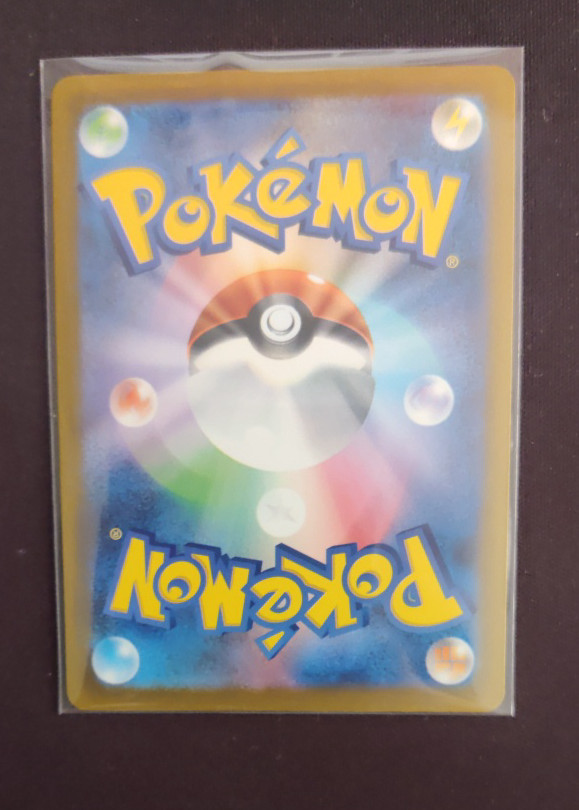
Authenticity. Verify the Japanese card layout, 062/081 collector number, M5 set identity, Uncommon rarity mark, Metal typing, artwork by Uta, and correct attacks and HP. Compare the font, energy symbols, border color, card dimensions, ink sharpness, rosette pattern, and reverse Poké Ball design with a known genuine Japanese Pokémon card. Be cautious of unusually glossy stock, incorrect text spacing, washed colors, fuzzy fine print, wrong card weight, or sellers offering large quantities at implausibly high prices.