Market outlook
Stable Outlook 7/10
Demand for early Pikachu cards remains strong, but the card is common enough that most copies do not experience dramatic appreciation. Price performance is driven mainly by grade, print variant, and condition scarcity.
Next months. Expect stable pricing for low- and mid-grade copies, with premium movement only in gem-mint or verified no-rarity examples.
Long term. Likely steady appreciation for high-grade first-print examples, while ordinary common copies should remain broadly stable with modest gains.
History
Pikachu is the franchise mascot of Pokémon, introduced in 1996 as the Electric-type Mouse Pokémon. It was created by Game Freak and is one of the most recognizable characters in global pop culture, representing the Pokémon brand across games, anime, merchandise, and trading cards.
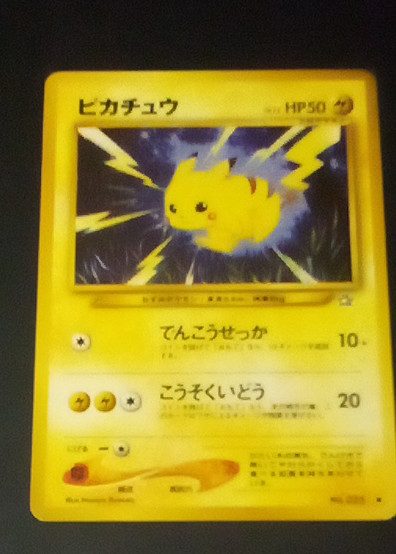
This Japanese Pikachu card first appeared in the 1996 Japanese Pokémon Base Set, officially called the Expansion Pack, released on October 20, 1996. A very early Japanese Pikachu also appeared as a CoroCoro magazine promo in October 1996, but the card described here aligns with the Base Set print.
- The 1996 Japanese Base Set Pikachu is commonly cataloged as card #25 and is a Common rarity card.
- Early Japanese print runs exist both with no rarity symbol and with a rarity symbol, with no-rarity copies considered the earliest main-set print run.
- Pikachu is one of the most collected Pokémon cards in the hobby, so even a common card has enduring demand, especially in high grade or first-print Japanese form.
Rarity and print run
- Tier
- Common
- Print run
- High
- First printed in
- Japanese Expansion Pack (Base Set)
- Demand
- Very High
- Supply
- High
- The underlying card is common, so raw copies are not scarce.
- Scarcity comes from first-print Japanese no-rarity examples and high-grade survivors.
- Population pressure is high because Pikachu is heavily collected across all eras.
Collector notes
Condition. Check for edge wear, corner whitening, surface scratching, centering, and print defects. Japanese vintage cards are often more consistent than English cards, but common flaws include silvering on edges, holo-style surface scuffs if applicable to the finish, and small back-surface scratches from handling.
Storage. Store in a penny sleeve and rigid top loader or graded slab, keep away from heat, humidity, and UV light, and avoid loose storage with other cards. For long-term preservation, use acid-free materials and stable room-temperature storage.
Authenticity. Authentic 1996 Japanese cards should have the correct vintage back, sharp print quality, and period-accurate card stock. Watch for washed-out colors, incorrect font spacing, poor cut quality, and suspiciously glossy modern reprints. Compare the copyright line, Japanese text layout, and card number formatting against known originals. For high-value copies, third-party grading is strongly advisable.
Sources: ebay.com, pricecharting.com, geek-verse-comics.com, elitefourum.com, banktcg.com