Market outlook
Rising Outlook 8/10
Clemente remains one of the most respected and collected vintage stars, and demand for premium Hall of Fame cards continues to support prices. Population scarcity in top grades, especially graded 8 and above, tends to drive long-term appreciation even when lower-grade material moves more slowly.
Next months. Prices should remain firm to slightly higher, with the best-conditioned examples continuing to attract aggressive bidding.
Long term. Over 1-3 years, the card is likely to appreciate gradually, especially in graded 8+ and eye-appealing copies, while lower grades should remain liquid and relatively stable.
History
Roberto Clemente (1934–1972) was a Hall of Fame right fielder for the Pittsburgh Pirates and one of the most celebrated players in baseball history. Born in Carolina, Puerto Rico, Clemente became an international icon for his elite all-around play, humanitarian work, and cultural significance as one of the first Latin American superstars in Major League Baseball. His legacy was cemented both by his on-field excellence and by his tragic death in a plane crash while delivering aid to earthquake victims in Nicaragua, which led to the Roberto Clemente Award and enduring collector demand for his cards.
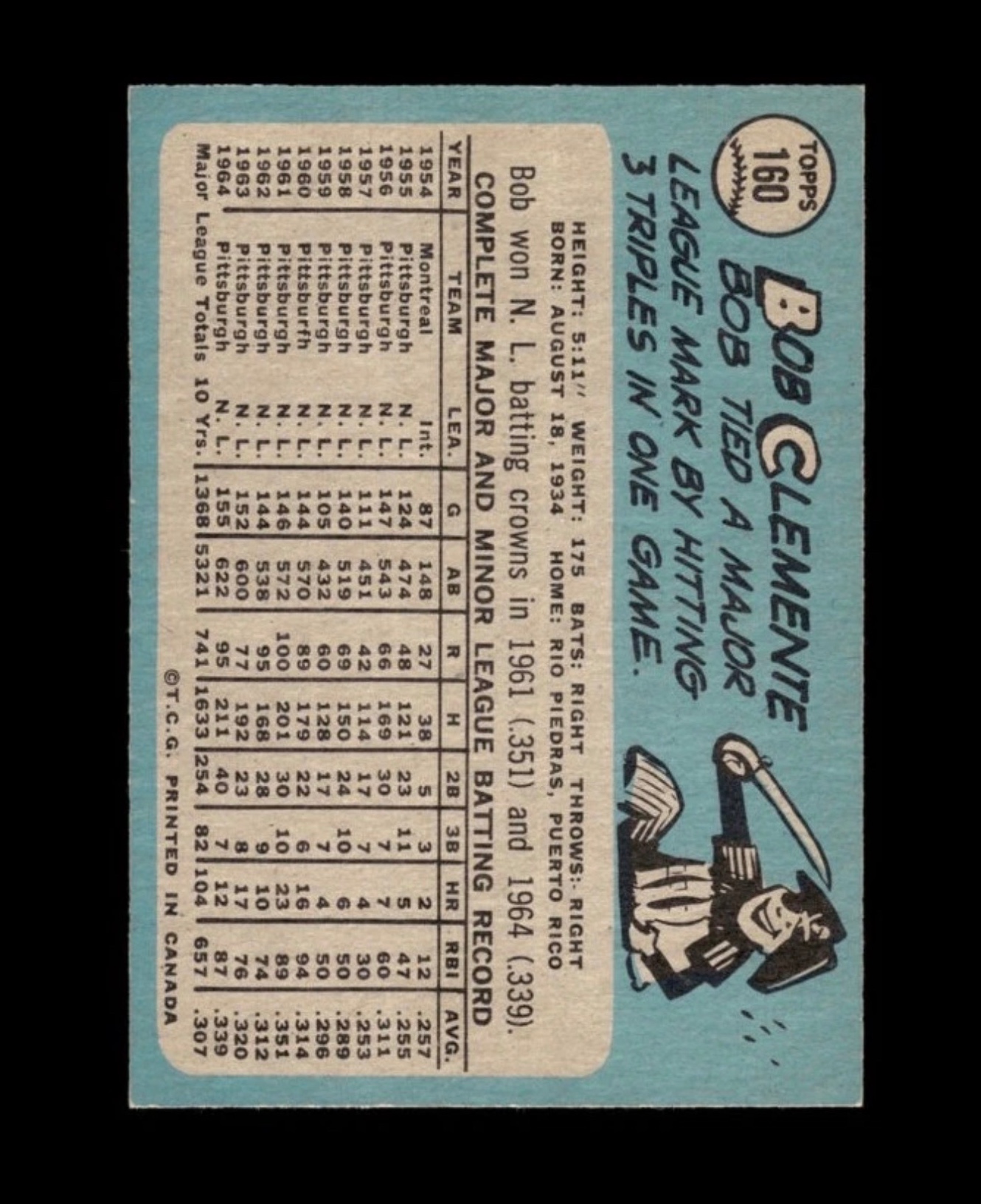
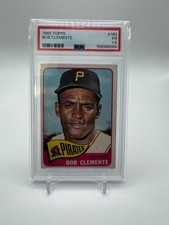
This card was first issued in the 1965 Topps Baseball set, released by Topps in 1965 in the United States as part of the standard Topps baseball card distribution that year.
- Card #160 is one of Clemente's key 1960s Topps issues and remains highly collectible across all grades.
- The 1965 Topps design is famous for its large color player portrait with a different colored background panel, and Clemente is among the set's iconic star cards.
- Clemente's cards command strong demand because he is considered one of baseball's all-time greats and his market spans both player collectors and vintage set builders.
Collector notes
Condition. Common issues on this issue include centering problems, corner wear, edge chipping, print snow, surface scratches, and poor registration. Because the card is black-bordered, even small edge wear and white chipping are very visible. Look closely for creases, paper loss, writing, wax staining, and color fading. High-grade copies are especially sensitive to centering and sharp corners.
Storage. Store in a penny sleeve and rigid top loader or archival semi-rigid holder, with the card kept in a cool, dry, low-light environment. Use acid-free materials and avoid PVC plastics. For higher-value copies, consider graded, graded, or graded grading for protection and market liquidity. Keep away from humidity, heat, and pressure that can worsen border wear or surface damage.
Authenticity. Authentic cards should show period-appropriate print texture, aging, and paper stock consistent with mid-1960s Topps production. Red flags include overly glossy surfaces, unnatural white core brightness, incorrect font or color reproduction, and suspiciously perfect edges on an otherwise ungraded vintage card. Because this is a popular high-value card, altered cards, recolored borders, trimmed copies, and reprints are common concerns. Professional grading is strongly recommended for valuable examples.